Introduction
Most websites that struggle to rank share one problem: they haven’t earned trust. Google’s Search Quality Rater Guidelines, all 170+ pages of them, return to the same four signals repeatedly: Experience, Expertise, Authority, and Trust. These are the foundations of E-E-A-T best practices, and they directly shape which pages rank and which get buried.
Technical SEO, fast load speeds, and backlinks all matter. But none of them compensate for content that feels thin, anonymous, or recycled. Search engines are getting better at detecting exactly that and rewarding pages that demonstrate real credibility instead. This guide breaks down what E-E-A-T means in practice, why it influences search rankings, and the specific steps you can take to improve E-E-A-T rankings, whether you run a blog, a business site, or a content-heavy platform.
What Is E-E-A-T?
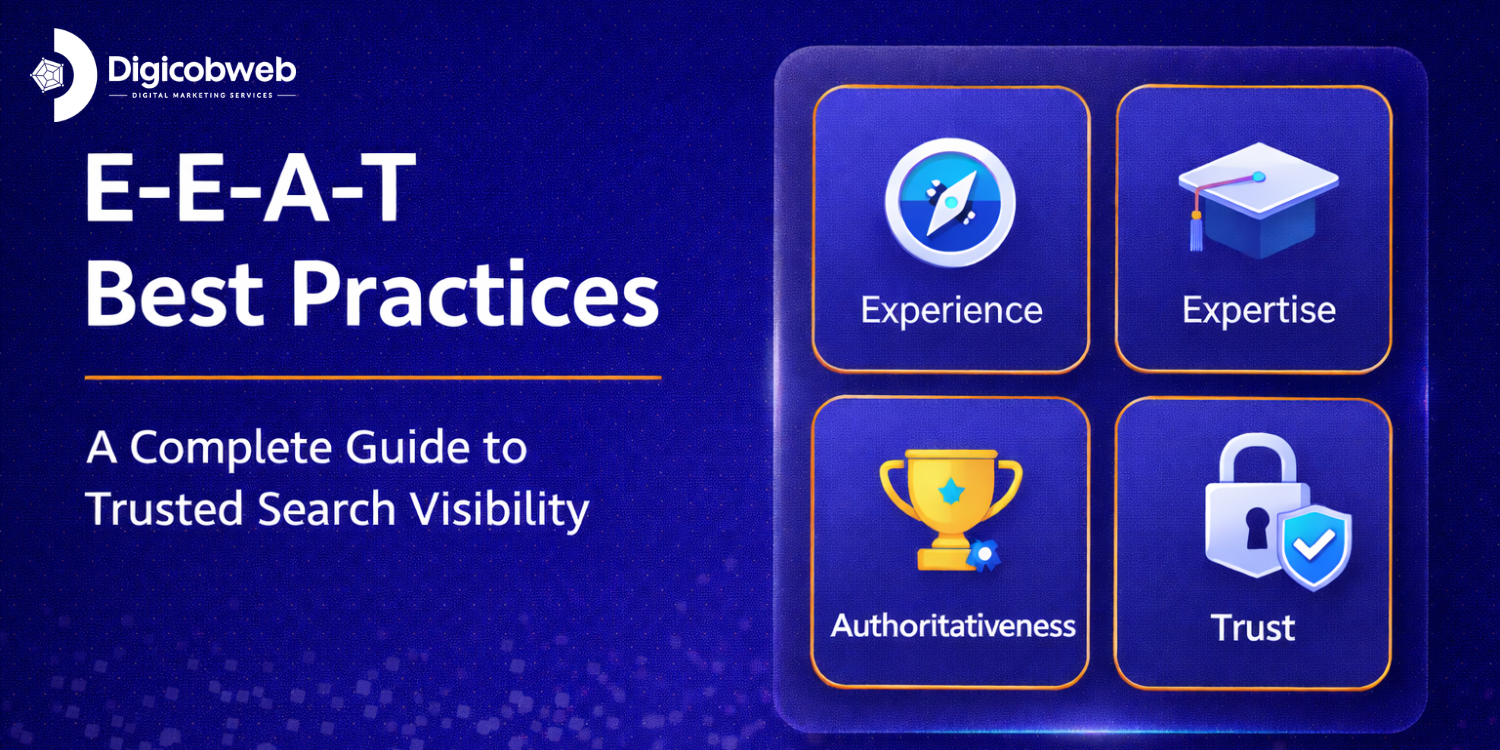
E-E-A-T stands for Experience, Expertise, Authoritativeness, and Trustworthiness. It is the framework Google uses through its Search Quality Rater Guidelines to evaluate whether a page deserves to rank. Understanding E-E-A-T best practices begins with understanding what each element actually means.
Experience
Experience is the first ‘E’ added by Google in December 2022. It refers to whether the content creator has genuine, firsthand involvement with the topic. A travel blogger who has visited the destination. A software developer who has built with the tool. A patient writing about a medical procedure they’ve gone through.
Experience is what separates insight from information. Anyone can summarize what other sources say. Only someone with real involvement can describe what it’s actually like: the nuances, the surprises, the things guides don’t tell you.
Expertise
Expertise is depth of knowledge. It shows up in how clearly a topic is explained, how accurately complex concepts are broken down, and whether the writer’s understanding goes beyond the surface. A certified financial planner writing about retirement brings a precision that a generalist cannot match.
Expertise doesn’t always require formal credentials. A mechanic with 20 years of hands-on experience is an expert in car repair. What matters is that the content reflects genuine, applied understanding, not just familiarity with the vocabulary.
Authoritativeness
Authority is the reputation of how your content is regarded by others in your field. It grows when credible sites link to your work, when journalists cite your data, and when your brand appears naturally in industry discussions. It cannot be manufactured quickly, but it can be built intentionally through consistent, high-quality output.
Trustworthiness
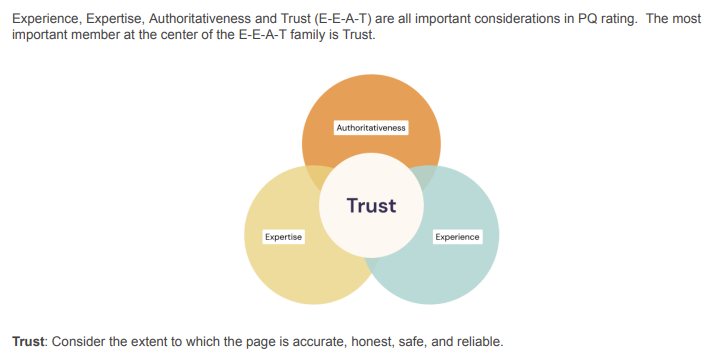
Trust is the central element of the E-E-A-T framework. Google treats it as the most important signal. Experience, Expertise, and Authority all feed into it. Content trust signals include transparent authorship, accurate and verifiable information, a secure and well-maintained site, and honest claims that don’t overstate or mislead.
KEY TAKEAWAY
Trust is not one element among four; it is the outcome that the other three build toward. A page with strong Experience, Expertise, and Authority will naturally produce high trust. A page missing any of the first three will struggle to earn it.
E-E-A-T vs. E-A-T: What Changed and Why It Matters
Google introduced E-A-T (Expertise, Authority, Trust) as part of its 2018 quality update. In December 2022, it added a second ‘E’ for Experience. This was not a minor revision; it reflected a fundamental shift in how Google defines content quality.
| Framework | Elements | What It Lacked | Practical Impact |
| E-A-T | Expertise, Authority, Trust | No firsthand experience required | Content could be technically accurate but lack real-world grounding or authentic perspective. |
| E-E-A-T | Experience + Expertise + Authority + Trust | Nothing more complete | Content must now reflect genuine involvement. Theoretical knowledge alone is no longer sufficient. |
The addition of experience matters most in areas where real involvement changes the quality of advice: product reviews, health information, travel, legal guidance, and financial planning. If you publish in any of these areas and your content doesn’t reflect firsthand experience, applying E-E-A-T best practices will require a fundamental shift in how you approach content creation.
How Google’s Quality Rater Use the E-E-A-T Framework
Google employs thousands of Search Quality Raters, real humans who evaluate pages using a detailed set of guidelines. These raters don’t control rankings directly, but their assessments help Google train and refine the algorithms that do.
When a rater evaluates a page, they ask questions like the following:
• Does the author have real experience with this topic?
• Is the content accurate and supported by credible, verifiable sources?
• Would a knowledgeable person consider this a reliable, trustworthy source?
• Is it clear who created the content and why they’re qualified to do so?
Understanding this process helps clarify what Google actually rewards. It isn’t word count, keyword density, or a particular formatting structure. It’s whether a real, knowledgeable person would look at your page and consider it trustworthy and genuinely useful.
⚡ PRO TIP
The Search Quality Rater Guidelines are publicly available. Reading even just the sections on E-E-A-T and YMYL is one of the highest-ROI activities for any content creator or SEO professional
E-E-A-T and YMYL: When the Stakes Are Higher
Not all content is evaluated against the same E-E-A-T standard. Google applies stricter scrutiny to ‘Your Money or Your Life’ (YMYL) content pages that could significantly affect a person’s health, financial stability, safety, or major life decisions.
YMYL content categories include:
• Medical information, symptoms, treatments, and medication guidance
• Financial advice, investment strategies, and tax information
• Legal topics, rights, and regulatory guidance
• Safety information and emergency procedures
• News and civic information that could influence real-world decisions
⚠ IMPORTANT
If your site covers YMYL topics and your content doesn’t meet high E-E-A-T standards, it will struggle to rank regardless of technical optimization. Generic blog posts cannot compete with licensed professionals or established institutions in these categories.
Even if your content isn’t strictly YMYL, applying the same rigorous E-E-A-T standards makes your site more competitive across every topic area. The framework rewards quality; universally higher-stakes topics just demand it more visibly.
Why E-E-A-T Influences Search Rankings
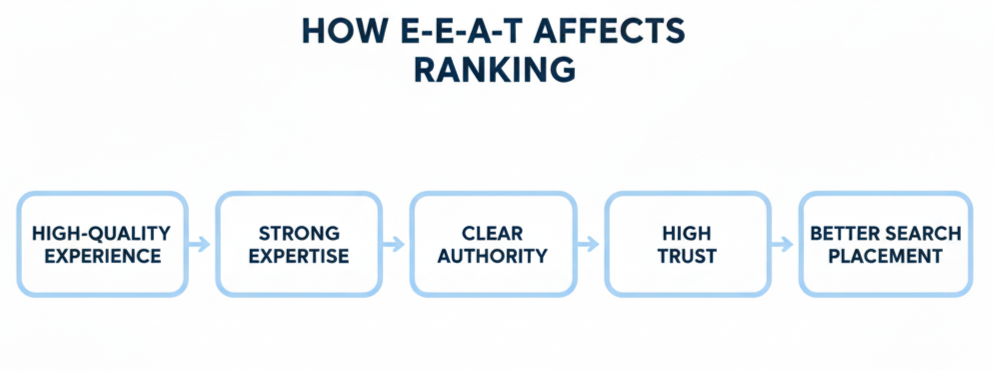
Search engines have one goal: connect users with results they can trust. The E-E-A-T framework is how Google evaluates whether that trust is warranted. Here’s what that means for rankings in practice.
It Signals Content Quality Beyond Keywords
Backlinks and keyword placement tell search engines what a page is about. E-E-A-T signals tell them whether it’s worth ranking. Clear, expert explanations. Accurate, grounded information. Real experience visible in the writing. These signals distinguish genuinely valuable pages from content that simply checks technical boxes.
1. It Reduces Bounce and Builds Engagement
When users land on a page that feels shallow or anonymous, they leave. High bounce rates, low dwell time, and no return visits all signal dissatisfaction. Pages that reflect real expertise and trustworthiness do the opposite; readers stay longer, explore more, and come back. Those behavioral signals directly support rankings.
2. It Protects Users From Harmful Information
In sensitive areas like health, finance, and legal guidance, bad information causes real harm. Strong content trust signals, verified claims, transparent sourcing, and clear authorship are how search engines identify pages that can be trusted to give advice that matters.
3. It Builds Compounding Domain Authority
A site that consistently publishes trustworthy, expert content earns recognition over time from users, from other sites linking to it, and from search engines. That accumulated authority makes every new piece of content easier to rank. Learning to improve website authority through E-E-A-T is one of the highest-leverage long-term SEO investments you can make.
E-E-A-T Best Practices: A Complete Breakdown
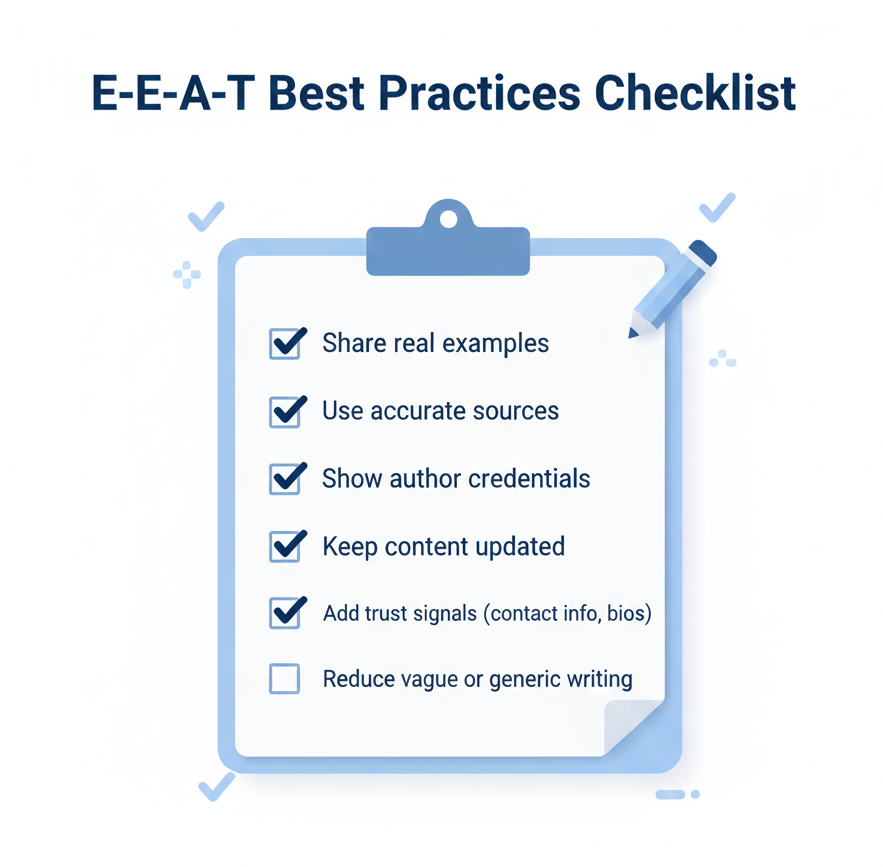
The following E-E-A-T best practices address each element of the framework directly. Applied consistently, they build the kind of content quality that search engines reward and users trust.
1. Demonstrate Real, Firsthand Experience
Generic content that summarizes what other sources say adds no value. Content that reflects genuine involvement, what you tested, what went wrong, what you actually learned gives readers something they cannot find elsewhere.
Practical ways to demonstrate experience:
• Include specific examples from your own work, testing, or research
• Share outcomes not just processes including failures and what they taught you
• Use screenshots, data, or results to make your claims concrete and verifiable
• Reference context describe the conditions under which something worked, and when it didn’t
2. Write With Genuine Expertise
Expertise shows up in clarity, not complexity. The best expert writing makes difficult topics easy to understand. It uses precise language, builds logical arguments, and avoids jargon used for appearance rather than precision. Focus on accuracy, clean structure, and explanations that leave readers more capable than they arrived
⚡ PRO TIP
If a reader needs to re-read a sentence more than once, the problem is usually the writing, not the reader. Expertise expressed clearly is more credible than expertise expressed impressively.
3. Build Authoritativeness Through Consistent, Referenced Output
Authority cannot be claimed it must be earned through external recognition. Build it by:
• Publishing consistently on a focused topic area rather than scattered subjects
• Creating content others reference original research, comprehensive guides, unique data
• Earning mentions from credible publications, podcasts, and industry sources
• Participating visibly in your niche panels, interviews, community discussions
4. Strengthen Content Trust Signals Across Your Entire Site
Content trust signals aren’t limited to individual pages they extend across your entire site. Search engines and users evaluate the full picture:
• Named authors with credentials, real photos, and visible bios
• Clear contact information and an accessible About page
• Transparent sourcing link to the studies, reports, and experts you reference
• Visible update dates on time-sensitive content
• SSL certificate, clean design, and accurate business details
5. Handle AI-Generated Content Responsibly
AI writing tools are widely used in content production. Google has stated clearly that AI-generated content is acceptable but only when it meets E-E-A-T standards. The core problem is that AI lacks firsthand experience and genuine expertise. It produces fluent, confident-sounding text that can be subtly or significantly wrong.
If AI is part of your workflow:
• Always have a subject-matter expert review and meaningfully revise the output
• Add firsthand perspective, original examples, and real-world detail that AI cannot produce
• Maintain transparent authorship never publish anonymously
• Treat AI as a drafting tool, not a finished content source
⚠ IMPORTANT
Publishing AI-generated content without expert review is one of the fastest ways to undermine E-E-A-T. Google’s systems are increasingly capable of identifying experience-free content regardless of how fluent it appears.
6. Keep Content Fresh, Accurate, and Updated
Outdated content erodes trust. A post referencing three-year-old statistics or recommending tools that no longer exist signals neglect to users and to search engines. Review high-value pages every three to six months. Update facts, replace outdated references, and mark revision dates visibly where accuracy matters.
7. Use Clear Structure and Plain, Readable Language
Readability is a trust signal. A page that’s dense, difficult to navigate, or cluttered with jargon pushes readers away. Use short paragraphs, descriptive subheadings, and language that respects the reader’s time. Make it easy to find exactly what they came for and easy to keep reading once they do.
How to Improve Website Authority
Website authority is earned, not optimized. It grows when your content proves genuinely useful, when credible sources recognize your work, and when your site consistently delivers on what it promises.
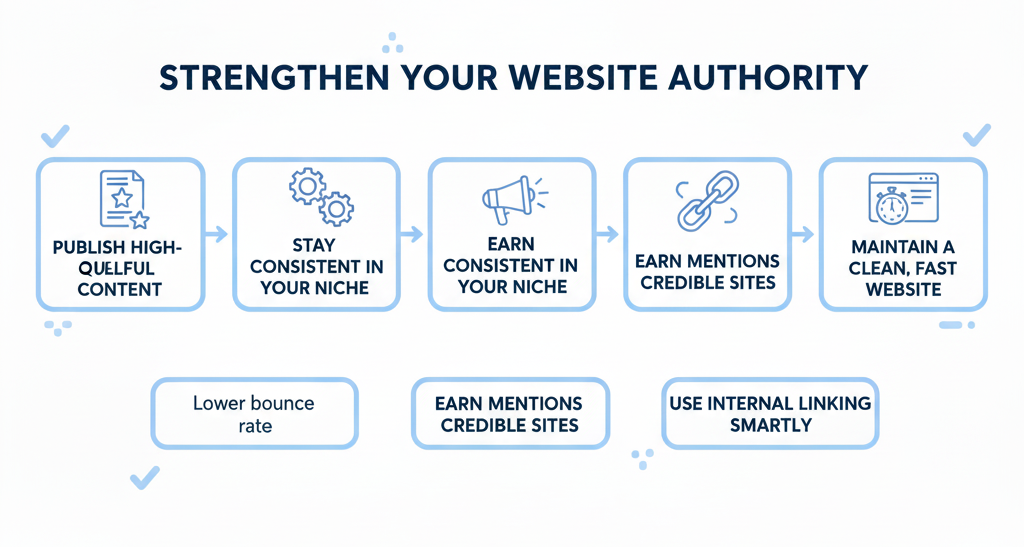
Here’s how to improve website authority through practical, repeatable steps.
1. Create Content That Solves Real Problems
Authority starts with usefulness. Pages that directly answer real questions, explain things clearly, and give readers something actionable build loyalty that compounds over time. Remove filler. Get to the answer. Solve the problem in front of the reader.
2. Build Topical Depth in a Focused Niche
A site that covers one topic area comprehensively builds topical authority, the recognition that it is a go-to resource within a specific domain. Covering 10 topics shallowly is less effective than covering one topic deeply. Build content clusters: a pillar page supported by multiple detailed, interlinked articles.
3. Earn Mentions and Links From Credible Sources
External recognition is the strongest authority signal. You don’t need hundreds of links a handful of high-quality mentions from credible industry sources outweigh dozens of low-quality ones. Earn them by:
• Publishing original research or data that others want to reference
• Contributing to industry publications and podcasts
• Building relationships with journalists and writers in your niche
• Monitoring unlinked brand mentions and requesting proper attribution where appropriate
4. Strengthen Internal Linking
A well-linked site helps search engines understand how your content relates and which pages carry the most weight. Connect supporting pages to pillar content. Use descriptive anchor text. Guide readers naturally through a logical content path that keeps them on your site.
Also Read: [ Link Building Strategies That Drive Rankings ]
5. Keep Your Site Clean, Fast, and Technically Sound
Technical quality reinforces content quality. A slow, cluttered, or hard-to-navigate site undermines even excellent writing. Fast load times, mobile responsiveness, clear navigation, and HTTPS security are the baseline for a site that users and search engines take seriously.
How to Improve E-E-A-T Rankings: A Step-by-Step Process
Improving E-E-A-T rankings is a sustained effort, not a one-time fix. These steps, applied consistently, move your site in the right direction and build the kind of quality that compounds over time.
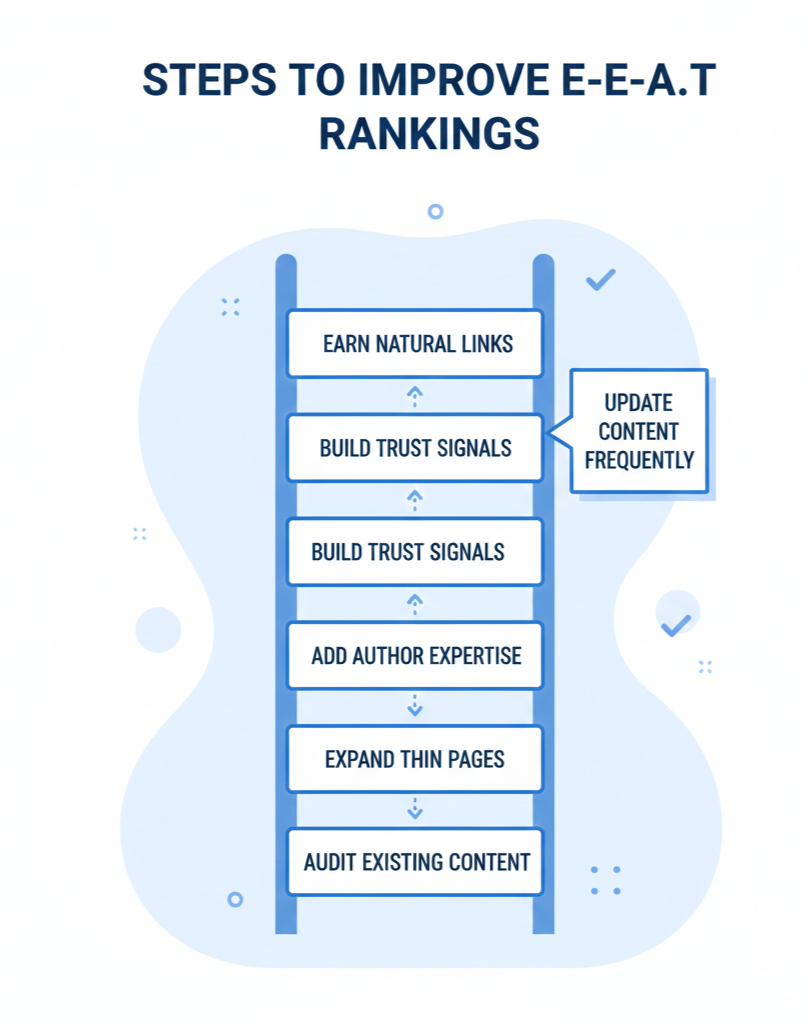
Step 1: Audit Existing Content Against E-E-A-T Standards
Before creating new content, review what you already have. For each high-traffic or high-priority page, ask:
• Does this content reflect real experience, or is it assembled from other sources?
• Is the information accurate and current?
• Is the author clearly identified with visible credentials?
• Are claims supported by credible references or evidence?
Pages that fail these checks pull your rankings down or miss opportunities to perform. Fixing existing content consistently produces faster results than publishing new pages.
Step 2: Establish and Strengthen Author Credibility
Every piece of content on your site should have a named author. Every author should have a bio that reflects actual qualifications and experience. This is non-negotiable for YMYL content but improves trust signals across every topic area.
• List relevant credentials and experience formal or practical
• Link to other published work by the same author
• Include a real photo wherever possible
• Update bios regularly as credentials and experience grow
Step 3: Expand Thin or Generic Content
Thin pages, those that cover a topic superficially without adding real value, drag down your overall domain quality in Google’s assessment. Identify them through Google Search Console (low impressions, poor click-through rates) and upgrade them:
• Add original examples and case studies from real experience
• Include credible external references and current data
• Make content actionable: tell readers exactly what to do, not just what exists
Step 4: Update and Maintain High-Value Pages
Freshness signals care and accuracy. For fast-moving topics, review every one to three months. For stable topics, every six months is sufficient. Always update the visible revision date when meaningful changes are made; this is a trust signal for both readers and crawlers.
Step 5: Build Quality Backlinks and Natural Brand Recognition
External recognition remains one of the strongest signals for E-E-A-T. Focus on quality over volume. Create content worth citing original research, comprehensive guides, and data-backed analysis and be consistent while recognition builds. Track unlinked brand mentions and convert them to links where possible.
Step 6: Improve User Experience to Reinforce E-E-A-T
E-E-A-T is partly measured through user behavior. Fast-loading pages, intuitive navigation, mobile-friendly design, and readable layouts all reduce friction and keep users engaged, which in turn sends positive ranking signals to search engines.
Common E-E-A-T Mistakes That Hurt Rankings
Many sites unknowingly undermine their own E-E-A-T. These are the most frequent and damaging mistakes:
| Mistake | Why It Hurts E-E-A-T | How to Fix It |
| Anonymous authorship | Removes the most visible trust signal a named, credible person behind the content | Add named authors with real bios and credentials to every page |
| Unreviewed AI content | AI lacks experience and genuine expertise produces fluent but potentially inaccurate content | Require expert review and firsthand additions before publishing AI-assisted content |
| Recycled information | Assembling facts from other sources adds no value and signals low expertise | Add original perspective, tested insight, or firsthand examples to every piece |
| Stale content | Outdated stats and broken references signal a neglected site | Schedule regular content reviews and mark update dates visibly |
| No About/Contact page | Reduces overall site trustworthiness. Users and search engines need to know who you are | Create clear, informative About and Contact pages with real business details |
| Keyword-stuffed writing | Unnatural phrasing that prioritizes keywords over clarity signals low quality | Write for the reader first. Use keywords naturally in logical positions |
| Surface-level coverage | Thin content that skips depth or nuance undermines credibility | Cover topics completely. If a page can’t go deep, expand it or consolidate it |
E-E-A-T Best Practices Checklist
Use this checklist to evaluate any page before publishing or during a content audit. It covers all four elements of the E-E-A-T framework and the core technical trust signals that support improved E-E-A-T rankings.
| E-E-A-T Area | Checklist Item | Done? |
| Experience | Content reflects firsthand involvement not just research from other sources | ☐ Yes / No / In Progress |
| Experience | Real examples, results, data, or screenshots are included to support claims | ☐ Yes / No / In Progress |
| Experience | Outcomes (including failures and lessons) are described, not just processes | ☐ Yes / No / In Progress |
| Expertise | All information is accurate, current, and verifiable | ☐ Yes / No / In Progress |
| Expertise | Complex topics are explained clearly without unnecessary jargon | ☐ Yes / No / In Progress |
| Expertise | Credible external sources are referenced and linked where appropriate | ☐ Yes / No / In Progress |
| Authority | The author is named on the page and credentials are clearly visible | ☐ Yes / No / In Progress |
| Authority | The author bio links to other published work and reflects real expertise | ☐ Yes / No / In Progress |
| Authority | At least one credible external site links to or mentions this content | ☐ Yes / No / In Progress |
| Trust | Contact information and About page are easy to find site-wide | ☐ Yes / No / In Progress |
| Trust | The site uses HTTPS and loads quickly on both desktop and mobile | ☐ Yes / No / In Progress |
| Trust | Content has been reviewed and updated within the last 6 months | ☐ Yes / No / In Progress |
| Trust | All factual claims are honest and supported by evidence | ☐ Yes / No / In Progress |
| Trust | The revision date is visible on time-sensitive pages | ☐ Yes / No / In Progress |
| AI Content | Any AI-assisted content has been reviewed and revised by a subject expert | ☐ Yes / No / In Progress |
| AI Content | Firsthand perspective and original examples have been added | ☐ Yes / No / In Progress |
| UX / Technical | The page is fully mobile-friendly | ☐ Yes / No / In Progress |
| UX / Technical | Navigation is clear and internal links guide readers logically | ☐ Yes / No / In Progress |
| UX / Technical | Bounce-driving issues (slow load, cluttered layout) have been addressed | ☐ Yes / No / In Progress |
Conclusion
Strong E-E-A-T best practices aren’t a campaign or a checklist you complete once. They’re the result of consistently doing the right things: publishing content that reflects genuine experience, content writing with real expertise, building authority through credible output, and maintaining a site that users and search engines trust.
Every site regardless of size, age, or budget can improve its E-E-A-T standing. Small, focused improvements compound. Fixing author transparency, updating stale content, expanding thin pages, and earning a handful of quality mentions all shift how search engines perceive your domain.
Start with what you already have. Audit your existing content against the checklist above. Fix the most critical gaps first, particularly authorship transparency and outdated information. Then build forward consistently, using the steps in this guide to steadily improve website authority and improve E-E-A-T rankings over time.
When you follow E-E-A-T principles with that mindset, reader trust is the goal, not ranking tricks; the rankings follow naturally. Because the content has genuinely earned them.
KEY TAKEAWAY
E-E-A-T is not a set of boxes to tick. It’s the standard Google uses to ask: ‘Would a real, knowledgeable person trust this page?’ When the answer is consistently yes across your content, your authors, your site structure, and your claims, your rankings reflect it.