As someone who works closely with small business owners and marketers navigating the ever-changing search landscape, I’ve seen firsthand how AI is shifting the game—especially with the recent launch of AI mode in India, which is revolutionizing local search experiences.
The shift is real — yes. But the fundamentals? They haven’t gone anywhere.
Recently, I shared a LinkedIn post about something many of us in SEO feel deeply: “Yes, AI is changing how people search, but amidst all the noise, some SEO foundations remain unchanged.”
And the response? Remarkable.
One marketer said: “ User Intent is becoming crucial” Another founder told me: “SEO basics still do the heavy lifting—clarity, value, and trust always matter.” These perspectives weren’t outliers—they reflect what many of us are observing daily.
So, in this blog, let me walk you through 12 SEO activities that still matter — even after search being more intelligent.
Why AI Is Dominating the Search Landscape
Organic search drives over 53% of website traffic across industries. And as AI has become an important part of how Google processes, ranks, and presents information:
- AI Overviews shortens answers from trusted sources in SERPs.
- SGE pulls info from structured data, FAQs, and topically relevant content chunks.
- Entity-based search understands context, not just keywords.
But here’s the catch: AI doesn’t replace SEO—it makes good SEO even more essential.
How SEO Is Evolving in 2025
SEO in 2025 is no longer just about optimizing for keywords—it’s about optimizing for understanding. With the rise of AI-powered search engines like Google’s SGE and tools like Perplexity, SEO has shifted toward contextual relevance, chunk-level content delivery, and real-time intent matching.
SEO now prioritizes:
- Answer-first content that directly addresses user queries
- Semantic-rich structure, using headings, schema, and internal links to guide AI comprehension
- E-EAT signals (Experience, Expertise, Authoritativeness, and Trust)
- User experience metrics, like scroll depth, engagement, and mobile responsiveness
In short, SEO has become more intent-driven, structured, and AI-aligned—but its core purpose remains: helping search engines discover, understand, and recommend the best content for users.
Still after all these transformations, SEO remains the same: it helps search engines understand, rank, and show the best content to the users.
And that’s where these next 12 activities come in…
Want help applying these evergreen activities?
SEO Activities That Still Drive Results

Even in the face of such AI disruption, some SEO strategies continue to drive rankings, clicks, and conversions because they align the way that AI is reading, summarizing, and ranking web content.
Let’s take a look at them.
1. FAQ Sections (AI Answer-Box Friendly)
A FAQ page is a structured page that answers frequent inquiries from clients regarding your product, service, or subject.
It improves the user experience and can be marked up using Schema.org structured data to support rich results.
Why is it Important:
FAQ content feeds directly into AI models and Google’s featured snippets.
These sections help break content into easy-to-digest answers, which AI search engines like Google SGE can extract for contextual responses. They also improve time on page and reduce bounce rate—factors AI models consider for helpfulness.
Use Case:
- Answering service-specific queries like “Is Local SEO worth it in 2025?”
- Enhancing your Google Business Profile page with Q&A
- Optimizing eCommerce product pages with buying-related questions
- Appearing in voice search queries (e.g., “Hey Google, does SEO still work?”)
- Supporting Google’s People Also Ask and AI snippets
Pro Tip:
Use schema markup (FAQ Page) to annotate these to AI and enhance featured snippet eligibility.

2. Meta Titles & Descriptions
Meta description and titles are HTML tags that control how your page is shown on SERPs. They aren’t a ranking factor in themselves, but still they do impact CTR and relevance signals that AI search models consider.

Why is it Important:
In spite of the invention of AI search, click behavior and semantic relevance are still applicable. Google constantly rewrites titles/descriptions, but well-written meta tags still affect the way the user sees your content.
It helps AI summarizers provide accurate previews in SERP overlays.
Use Case:
- Improving visibility for local landing pages (e.g., “SEO Company in Ahmedabad | DigiCobweb”)
- Targeting long-tail keywords in high-converting titles
- Reducing bounce by writing expectation-matching descriptions
- Increasing CTR in AI Overviews and Top Stories
- Supporting Open Graph previews for social sharing
3. Heading Structure (H1 to H3 for Chunking)
Why is it Important:
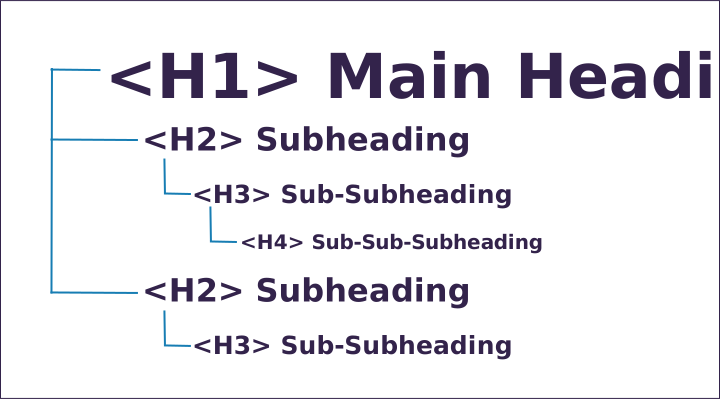
A clean heading structure makes your content more chunkable, digestible, and feature-snippet eligible. It’s essential for accessibility, too.
Use Case:
- Structuring local service pages with “H1: Local SEO Services,” “H2: Why Local SEO Works”
- Creating scannable blog formats optimized for AI overviews
- Enabling FAQ-style answers under H2s
- Improving accessibility and voice-reader compatibility
- Supporting TOC generation in AI-powered search previews
Tip: Instead of writing paragraphs under one heading, break down processes (like “How to Set Up GBP”) into H2 and H3 steps.
4. Semantic SEO (Synonyms & Related Terms)
Semantic SEO is the process of optimizing content by concentrating on primary keywords, employing synonyms and synonymous ideas, and matching the content with what individuals are actually looking for.
It emphasizes understanding and addressing the intent behind search queries to improve search engine rankings naturally.
Why is it Important:
AI search is keyword-non-dependent and is based on Natural Language Processing (NLP). Semantic SEO gives content semantic richness and aligns with the way AI processes queries. It makes content more visible in AI-created snippets and voice responses.
Use Case:
- Using terms like “AI-proof SEO” alongside “evergreen SEO tactics” in cluster content
- Covering related terms like “Google Maps Ranking” when discussing Local SEO
- Writing content with natural keyword variations for AI answer boxes
- Boosting E-E-A-T signals by covering topic comprehensiveness
Tools Tip: Tools like Clearscope or SurferSEO helps to discover semantically related keywords.
5. Topical Authority and Internal Linking
Topical authority is perceived expertise on a particular subject on your site gained by having thorough content that discusses all aspects of a topic. Internal linking ties related content items (such as blog posts, service pages, and resources) together through contextual anchor text, which allows users and search engines to see how they are related to each other.
Why is it Important:
Building on-topic authority with ‘content clusters’ whereby a lead pillar page points to several supporting cluster pages shows expertise and relevance. Internal links guide crawlers, distribute page authority, facilitate user navigation, and help AI models recover semantically related chunks of information more effectively.
When AI systems (like Google’s SGE or Perplexity) break down queries into sub-intents, they look for content that answers each dimension. Sites with strong topical clusters are more likely to have their content surfaced and synthesized into multi-source answers.

💬 Hiren Dave, added: “Focusing on topical depth and internal linking within a content cluster continues to pay off.”
And he’s absolutely right. Topic depth signals to search systems that you’re more than just another blog—you’re a knowledge source.
Use Cases:
- Link from pillar content on “Local SEO” to in-depth blog posts on Google Business Profile, NAP consistency, and citation building.
- Interlink all franchise SEO service pages with one another to establish semantic relevance.
- Use anchor text like “technical SEO audit checklist” to link to similar guides and make content more discoverable.
- Improve the site structure so that there is no single page that is isolated (i.e., has a minimum of one internal link).
- Strengthen contextual relations among AI-pertinent clusters, i.e., among schema markup blog posts and voice search blog posts and FAQs.
6. Content Clustering
Content clustering is an internal linking strategy where a central “pillar” page targets a broad topic and links to “cluster” pages covering subtopics. This builds topical authority and relevance.
Why is it Important:
In the AI era, topical depth matters more than keyword repetition. Clustering signals to Google and AI engines that your site comprehensively covers a subject. It also enhances navigation, internal linking, and time-on-site.
Use Case:
- Building a Local SEO pillar with cluster blogs like Google Business Profile Optimization, Citations Strategy, etc.
- Supporting multi-location businesses with city-wise subpages
- Creating AI-friendly content silos (e.g., SEO for Law Firms → Technical SEO, Content SEO, GBP SEO)
- Boosting link equity to key service pages
- Enhancing site architecture for crawlability and topic mapping
7. Clean URL Structure
Clean URL Structure is brief, to the point, and has appropriate keywords without any extra parameters, underscores, or dynamic IDs.
For example: www.digicobweb.com/local-seo-services than, www.digicobweb.com/page?id=123.

Why is it Important:
A Clean URL assists both search engines and visitors to easily comprehend the organization of your site quickly. It builds higher trust and CTR from organic and AI-driven results.
Use Case:
- Creating geo-specific pages like /services/local-seo-ahmedabad
- Improving click-through from Google’s AI Overviews or search features
- Enhancing keyword relevance of landing pages and clusters
- Supporting better internal linking for topic clusters
- Making URLs easier to share and remember across devices
8. Schema Markup /Structured Data
Schema markup is embedded information you place on your site code that tells search engines what your content is. It enhances your listings with rich results like FAQs, star rating, local business information, etc.
Why is it Important:
In the AI search era, schema helps machines not just crawl but also “comprehend” your content. Structured data increases your chances of being featured in AI-generated abstracts, voice search, and rich SERP features. It’s the foundation of Entity SEO and feeds Google’s AI understanding of your brand and services. Leads from SEO close at 14.6% compared to just 1.7% for outbound leads.
Use Case:
- Adding LocalBusiness schema to support Google Business Profile relevance
- Marking FAQs, reviews, and products for enhanced AI and rich result visibility
- Using BreadcrumbList to improve content hierarchy recognition
- Supporting event schema to appear in local event results
- Integrating HowTo schema for tutorials and guides
Tools Tip: Try Google’s Markup Helper or RankMath plugin.
9. Robots.txt & Sitemap.xml
Robot.txt: Robots.txt may be a content record that tells look motor creepy crawlies which pages or segments of your site to crawl or not to crawl.
Sitemap.xml: Sitemap.xml could be a well-structured list of pages on your location that makes a difference when motors find and record your substance in a compelling way.

Why are they Important:
AI search models are highly reliant on indexed, crawlable, and contextually mapped content. If main pages are not crawling nor indexed in your sitemap, they would not appear in standard or AI search results. These files form the foundation of how bots understand your site.
Use Case:
- Blocking crawl of admin pages, duplicate URLs, or staging sites
- Ensuring newly launched location pages are quickly indexed
- Improving crawl budget for large multi-location websites
- Helping AI engines discover structured and siloed content
- Preventing outdated or thin content from being surfaced in AI previews
10. Page Speed Optimization (Core Web Vitals)
Page Speed Optimization is the act of improving the rate at which your pages load—especially on mobile—by improving metrics like Largest Contentful Paint (LCP), First Input Delay (FID), and Cumulative Layout Shift (CLS) based on Google’s Core Web Vitals.
Why is it Important:
Page speed directly impacts user experience, conversion, and AI performance metrics. AI algorithms maximize for quickly loading, mobile-friendly content to deliver better results. A slow site can reduce your visibility in both traditional rankings and AI summaries.

Use Case:
- Compressing images for GBP-optimized service pages
- Deferring non-critical JavaScript and using lazy-loading
- Fixing CLS issues on mobile for improved readability
- Boosting speed on multi-location landing pages to increase engagement
Tools Tip:
Use PageSpeed Insights or GTmetrix to inspect.
11. Writing Answers, Not Just Keywords
Writing Answers refers to optimizing your content by addressing actual user questions instead of stuffing exact-match keywords. It’s about conversational, helpful, and answer-first writing.
Why is it Important?
AI search tools such as SGE and ChatGPT reward useful answers.. Content that answers the user’s question directly — particularly in natural language — will be more likely to be cited or summarized. It also helps boost your chances of being featured in “People Also Ask” and voice search.

💬 Vishvam Mangroliya, commented: Structure, clarity, and context have become the real ranking signals. We’re shifting from keyword targeting to query satisfaction. AI models don’t care if your content is answering the purpose of the search.
His insight perfectly captures the shift—your SEO should focus on solutions, not just syntax.
Use Cases:
- Use the format of H2s as questions users ask on Google or Quora
- Write in a natural voice that reflects conversation
- Answer concisely at the beginning of each section, then elaborate
- Monitor search intent via tools like AlsoAsked, AnswerThePublic
- Update existing blog intros with direct question-based framing
12. Mobile App Optimization (Responsive Design)
Mobile optimization helps your site to operate and display properly across various screen sizes and devices.
Why is it Important:
AI engines are biased towards mobile-first content. If your website is not mobile-friendly, it will never be suggested by Google’s AI-based features, nor will it be displayed prominently in local search.
Use Case:
- Creating fully responsive layouts for local service pages
- Making tap-to-call and click-for-directions buttons functional on GBP
- Optimizing CTAs and content blocks for mobile scroll behavior
- Using mobile-friendly fonts and touch zones for better UX
- Running mobile usability tests via Google Search Console
Conclusion: AI Is Evolving, But SEO Rules Are Also the Same
Let me leave you with this: SEO is not a tech to-do list—it’s a long-term process of earning trust. And even in the age of AI, it’s most important how useful, well-structured, and relevant your content is.
These 12 activities we just explored… They’re not tricks—they’re principles. They ensure your business shows up when and where it matters, whether it’s a traditional search result or an AI-generated overview.So no, SEO isn’t going anywhere. It’s simply becoming smarter—and so should we.