Introduction
Google AI Overviews are changing how search results work, not just how they look. Instead of showing a list of links and letting users decide, Google now answers many queries directly with an AI-generated summary pulled from multiple sources.
For SEO professionals and content creators, this represents a structural shift. Rankings remain important, they no longer guarantee clicks. A page can appear in search results without holding an organic ranking position, and a top-ranked page may lose prominence if it does not clearly contribute to the AI summary. If you are new to how search optimization works, our SEO guide for beginners covers the foundational concepts you will need before diving into AI overview strategy.
This affects how traffic is earned, how authority is built, and how content should be written going forward. Google AI Overviews reward clarity, accuracy, and intent alignment over traditional optimization tactics. Understanding this shift is essential for anyone working with AI Overviews for SEO, because the rules for visibility are no longer limited to classic SERP positions.
Key Takeaways
• Google AI Overviews synthesize content from multiple sources and appear above organic results for many informational queries.
• Rankings still matter but no longer guarantee clicks. Visibility in AI overviews is now a separate goal.
• AIO coverage varies significantly by industry and query type (as of 2025 data — details below).
• No special opt-in is required; existing E-E-A-T and helpful content best practices are what Google recommends.
• You can partially control your content’s inclusion using noindex, nosnippet, and data-nosnippet tags.
• Key content gaps to address are understanding AI mode, setting up tracking, and building topical authority.
What Are AI Overviews?
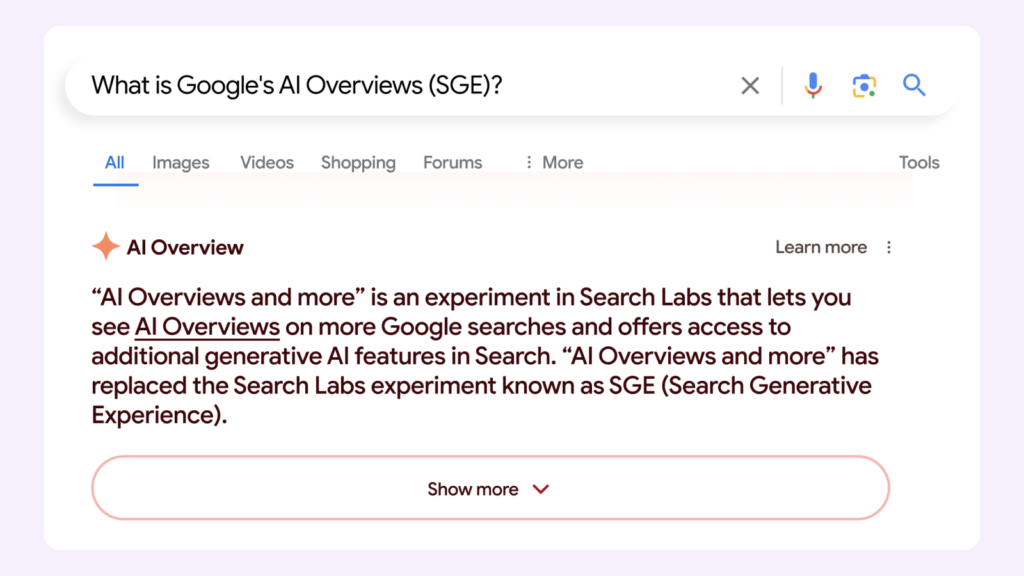
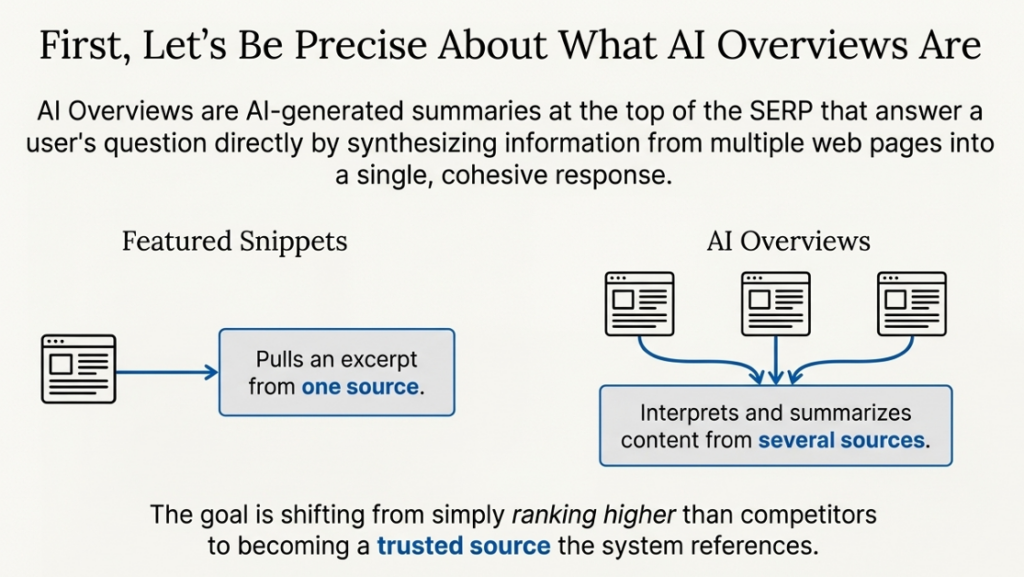
Google AI Overviews are AI-generated summaries that appear at the top of certain search results. Their purpose is to answer a user’s question directly by combining information from multiple web pages into a single response.
Unlike featured snippets, which pull a short excerpt from one source, Google AI Overviews synthesize content across several sources. They do not quote a page word for word.
This is where AI Overviews SEO becomes fundamentally different from traditional optimization. In classic SERPs, the goal was to rank higher than competitors. With AI Overviews for SEO, the goal is to become a reliable source that the system trusts enough to reference. This connects closely to the broader shift from SEO to AEO (Answer Engine Optimization), a transition that AI Overviews are actively accelerating.
Another key difference is intent coverage. Featured snippets usually answer a very specific question. AI Overviews often handle broader or multi-step queries, such as explanations, comparisons, or “how it works” searches. That broader scope changes how content needs to be written and structured.
What Is Google AI Mode? (And How Is It Different?)
2026 Update- New Feature:
Google launched AI Mode in 2025 as a dedicated AI-powered search interface, a separate tab within Google Search where users receive a fully conversational, AI-generated response instead of a traditional SERP. Unlike AI Overviews, which appear as a snippet above organic results, AI Mode replaces the search results page entirely for users who opt into it.
- AI Overviews: a summarised answer block sitting above organic results on the standard SERP
- AI Mode: a full conversational search experience where AI generates the entire response
Both features draw from web sources, and both reward the same content qualities: clarity, accuracy, and topical authority. For SEO professionals, optimizing for both means optimizing for the same foundational principles, which we cover throughout this guide.
How AI Overviews Work
Google AI Overviews operate by examining the purpose of a query and then producing a summary that combines information from various reliable sources. The system does not seek the well-written page. Instead, it focuses on the most straightforward explanations that closely match the user’s intent.
The process begins with intent matching. Google assesses if a query would gain from a summarized response. Such searches are typically informational, exploratory, or involve comparisons. Once this criterion is fulfilled, the system seeks out content that describes the subject clearly and reliably throughout the web.
AI Overviews do not depend on one ranking factor. They evaluate relevance, subject matter expertise, factual correctness, and the extent to which a page contributes to the explanation. Pages that address a portion of the question effectively may be included even if they do not address the subject.
This evaluation framework sits within Google’s broader algorithmic logic, which has changed significantly over recent years. Our guide to Google algorithm updates traces how Google’s content quality criteria have evolved, providing useful context for why AI Overviews reward certain content structures over others.
Google has provided instructions regarding this procedure detailing how sources are chosen and condensed. Their materials explaining how Google generates AI Overviews offer an understanding of the system’s focus and what it excludes.
For AI Overviews for SEO, the practical takeaway is straightforward. Content that explains things cleanly, stays focused on intent, and avoids unnecessary padding is far more likely to be used. Optimization here is less about ranking mechanics and more about contribution quality.
Why Are Google’s AI-Powered Overviews Important?
Google AI Overviews are not just another SERP feature. They change how value is distributed across search results. Here’s why they matter, broken down clearly.
1. Visibility Moves Above Rankings
- AI Overviews often sit above organic results, capturing attention before users scroll.
- A page can influence the search result without ranking first.
- Traditional position-based visibility is no longer the only way to be seen.
2. Click Behavior Is Changing
- Informational queries are increasingly answered directly in the overview.
- This can reduce click-through rates, even for high-ranking pages.
- At the same time, repeated exposure inside AI Overviews builds brand familiarity.
3. Authority Is Being Reinforced, Not Reset
- Google tends to reference sources that show consistent accuracy and topic depth.
- Once a site becomes a trusted contributor, it is more likely to appear again.
- AI Overviews for SEO reward long-term credibility over short-term tactics.
4. The SEO Competition Has Expanded
- You are no longer competing only against other pages.
- You are competing to shape how Google explains a topic.
- AI Overviews SEO prioritizes contribution quality, not just ranking signals.
5. This Shift Is Already Happening
- AI Overviews are rolling out across more query types and industries.
- Waiting to adapt means reacting after visibility has already declined.
- Understanding AI Overviews optimization now helps protect future search presence.
5 Surprising Truths About Google’s AI Overviews
When Google AI Overviews first rolled out, the reaction was loud and anxious. Many SEOs expected a sharp drop in organic traffic and a future dominated by zero-click searches. That fear was understandable, but early data paints a calmer picture.
Once you step away from speculation and look at Google’s own guidance and real-world studies, a more practical reality emerges. AI Overviews are not rewriting SEO from scratch. They are reinforcing patterns that were already in motion. Here are five truths that matter if you work with search at a strategic level.
1. The Official Advice: Do Nothing New (and Everything You Were Already Doing)
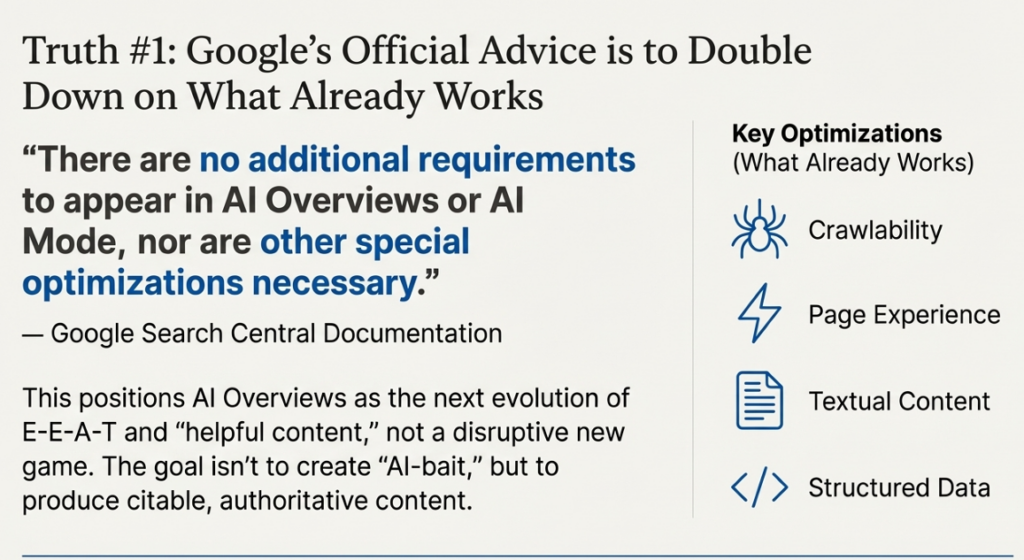
This might be the most reassuring news for content creators. Instead of introducing a complex new set of rules, Google emphasizes that the existing foundations of good SEO are what matter.
As stated in the Google Search Central documentation:
“There are no additional requirements to appear in AI Overviews or AI Mode, nor are other special optimizations necessary.”
This guidance positions AI Overviews not as a disruptive new game but as the next evolution of Google’s long-standing push for E-E-A-T and “helpful content.” It confirms that the strategic goal isn’t to create new “AI-bait” but to double down on creating the kind of citable, authoritative content that has always been the endgame of sophisticated SEO. Google reinforces that all the existing fundamentals continue to be worthwhile.
Key best practices include:
- Ensuring crawling is allowed (robots.txt).
- Making content findable through internal links.
- Providing a great page experience.
- Making important content available in textual form.
- Supporting text with high-quality images and videos.
- Ensuring structured data matches visible text.
- Keeping Merchant Center and Business Profile information up-to-date.
| 📖 Related Reading: [BestAI SEO Tools for Real-World Optimisation] |
2. The Takeover Isn’t Total: AI Overviews Are Surprisingly Selective
The rollout has been far from universal. An analysis by SEOClarity found AI Overviews appear for just 9.78% of queries, while a similar study by Semrush found a prevalence of 6.71%. This selectivity becomes even more pronounced when broken down by industry, search intent, and query type.
Data Note:
The statistics below are drawn from 2024–2025 industry studies by seoClarity and Semrush. AIO coverage has been expanding, and these figures should be treated as directional benchmarks. Always verify current coverage for your specific industry before making strategic decisions.
Data from Semrush reveals a dramatic variance across different sectors:
| Industry | AI Overview Occurrence |
| Health | 23.02% |
| Science | 20.13% |
| Real Estate | 0.41% |
| Food & Drink | 1.27% |
Furthermore, a critical finding from Botify’s analysis shows that AIOs appear for 59% of searches with informational intent but only 19% of those with commercial intent. Adding another layer of complexity, seoClarity noted the surprising and controversial appearance of AIOs for sensitive “Your Money Your Life” (YMYL) topics. This has led to public concern over the risks of AI-generated advice for critical financial and health queries.
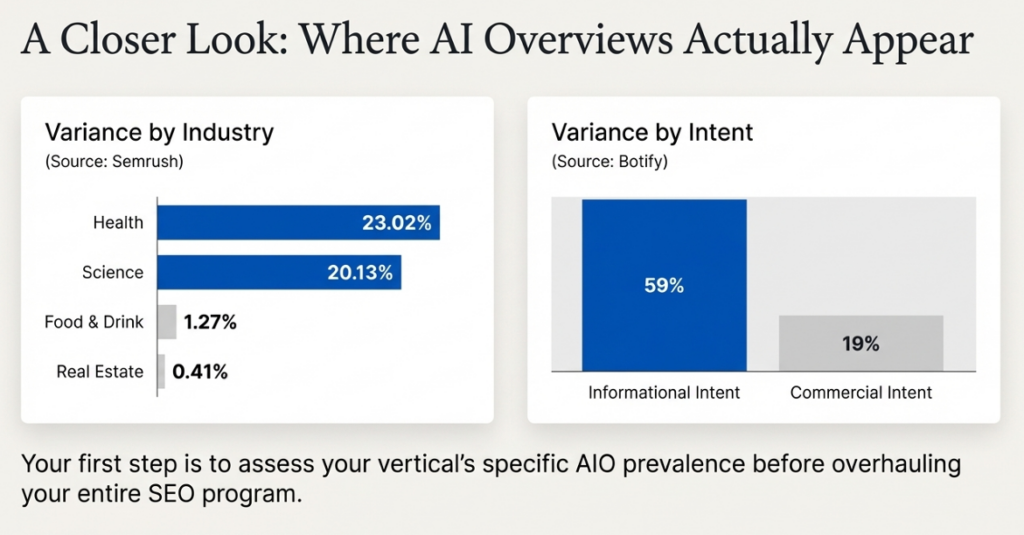
This data gives strategists a clear directive: assess your vertical’s specific AIO prevalence before overhauling your entire SEO program.
3. The “Zero-Click” Narrative Has a Twist: Clicks from AIOs May Be Higher Quality
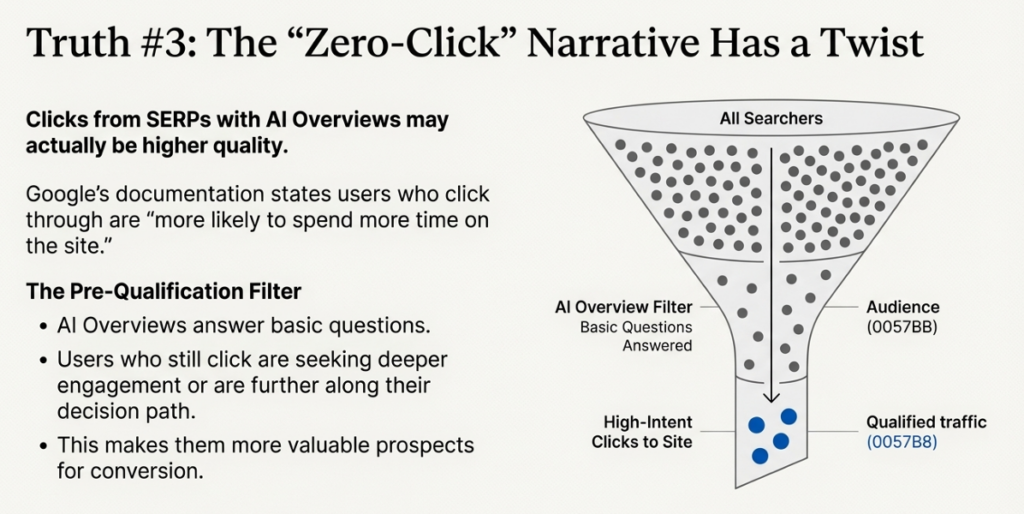
Google’s own documentation introduces a benefit, stating that clicks from search result pages featuring AI Overviews are considered “higher quality,” meaning users who click through are more likely to spend more time on the site.
Important Caveat:
This claim originates from Google’s own documentation and has not been independently verified at scale by third-party research as of 2026. Treat it as a working hypothesis. Your own Google Search Console data comparing CTR and engagement metrics on pages cited in AIOs versus those that are not is the most reliable source of truth.
Industry logic supports this claim. Sources like Adsmurai theorize that AIOs act as a pre-qualification filter. Users have their basic questions answered by the summary, so those who click through are not just browsing; they are seeking deeper engagement, specific details, or are further along in their decision-making processes. This makes them more valuable prospects for conversion.
4. Local Search Is Largely Unaffected, For Now
In a notable change from the earlier Search Generative Experience (SGE) beta, an analysis from seoClarity confirmed that AI Overviews are currently not being shown for local search queries that trigger map results and the “three-pack.”
For agencies and businesses focused on local SEO, this temporary exclusion of AIOs means that optimizing for the “map pack” and traditional local SERP features remains the highest-impact strategy for the foreseeable future. Although this might change, at present the existing local search environment provides a zone of consistency.
2026 Caveat:
Google has been testing AI-generated responses for location-adjacent queries in select markets. Verify current local AIO status for your specific query categories, as the picture may have changed since this was written.
5. You Cannot “Opt-Out,” But You Still Have Control Over Your Content
Although there isn’t an “opt-out” option for AI Overviews, site owners do have some control. You can apply SEO strategies to restrict how Google handles your content, thereby influencing whether it appears in an AIO.
Understanding the trade-offs is key:
- noindex tags:
This is the “nuclear option.” It removes a page from Google’s index entirely, preventing it from appearing in any search results, including AIOs.
- nosnippet tags:
This is a more targeted tool. It prevents Google from showing a text snippet for your page, which should also prevent the content from being used in an AI overview while allowing the page to remain visible in search results.
- data-nosnippet and max-snippet:
These offer more granular control, allowing you to specify which parts of a page can be used for snippets or to limit the length of a snippet, respectively.
Impact on SEO: Challenges & Opportunities
Google AI Overviews are reshaping how SEO performance should be evaluated. The impact is not purely negative or positive. It depends on how content aligns with the way these summaries are generated and displayed.
1. Reduced Clicks on Informational Queries
One of the most immediate effects is a decline in clicks for straightforward informational searches. When AI Overviews provide a complete explanation at the top of the page, users often do not need to visit multiple websites. This is especially common for definition-based, introductory, and how-it-works queries. Rankings still matter, but they no longer guarantee traffic in the same way they once did.
2. Brand Visibility Without Direct Traffic
Even when users do not click, being cited in an AI Overview has value. The brand name, domain, or page reference is visible at the moment the user is forming an understanding of the topic. Over time, repeated exposure within AI Overviews for SEO can increase brand recall and trust, which may lead to future branded searches or deeper engagement.
3. Authority Concentration Across Topics
AI Overviews tend to favor sources that demonstrate consistent accuracy and subject-matter depth. As a result, authority is becoming more concentrated around a smaller set of trusted sites within each topic area. This makes topical consistency more important than occasional high-performing pages. For AI Overviews SEO, long-term credibility now compounds faster than before.
4. Higher Expectations for Accuracy and Clarity
Because AI overviews synthesize information, weak or misleading content carries more risk. Inaccuracies can be amplified, which is why Google appears to prioritize sources with clear language, precise claims, and up-to-date information. Content that lacks clarity or relies on vague generalizations is less likely to be included in AI-driven summaries.
5. New Opportunities for Influence
Despite the challenges, AI overviews create an opportunity to influence how a topic is explained at scale. Pages do not need to rank first; they need to explain one aspect of a topic better than most alternatives. Our guide to SEO activities that still matter in the AI search era identifies which tactics have the highest return when optimizing for AI-driven search environments.
| Need help optimizing your content for Google AI Overviews and to ensure your pages are structured, authoritative, and AI-ready for maximum visibility? |
SEO Strategies for AI Overviews
Optimizing for Google AI Overviews requires a shift in how content is planned and evaluated. The focus moves away from ranking tricks and toward explanation quality, structure, and intent alignment.
1. Structure Content for Direct Answers
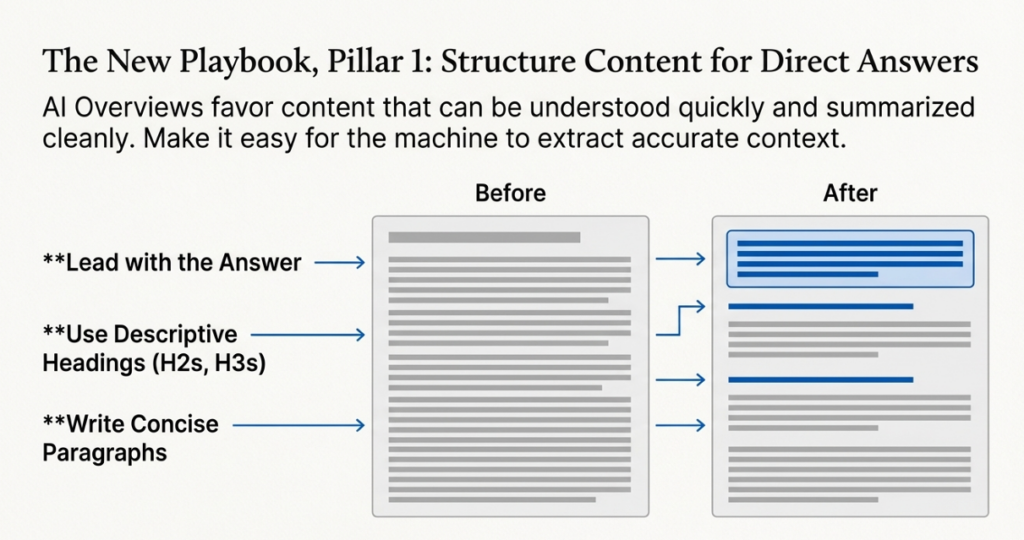
AI overviews favor content that can be understood quickly and summarized cleanly. Pages should lead with clear answers before expanding into supporting details. Use descriptive headings, concise paragraphs, and logical flow so each section stands on its own. This makes it easier for Google to extract accurate context when generating AI Overviews.
2. Build Topical Authority, Not Isolated Pages
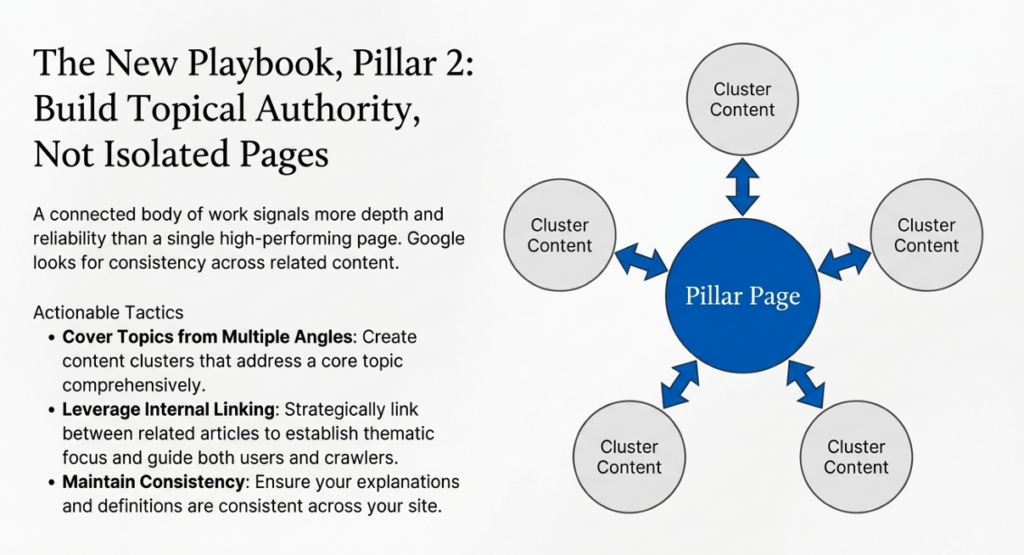
Single high-performing pages are less effective than a connected body of work. Covering a topic from multiple angles signals depth and reliability. When Google evaluates sources for AI Overviews for SEO, it looks for consistency across related content, not one-off explanations. Internal linking and thematic focus help reinforce this authority.
3. Match Search Intent Precisely
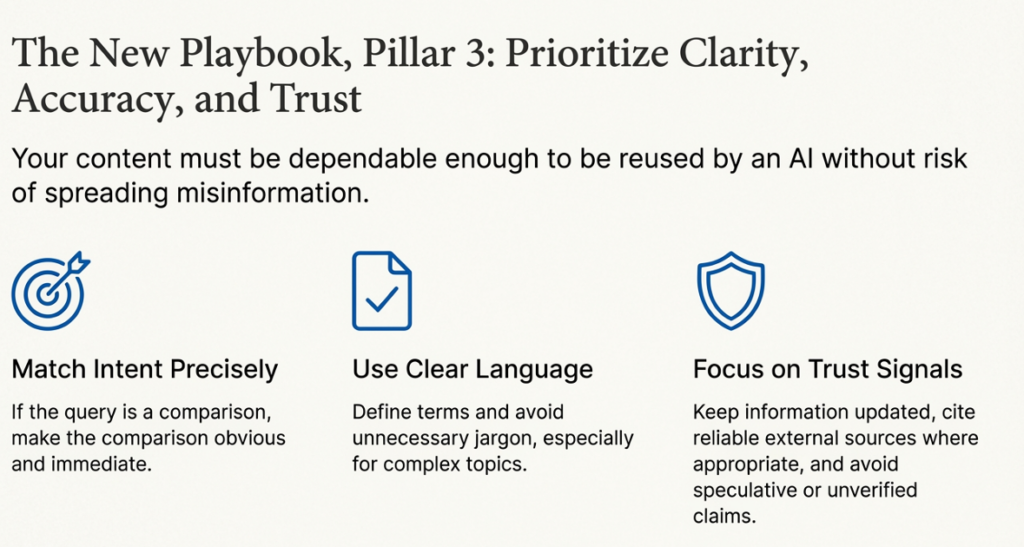
Intent alignment is critical for AI Overviews SEO. If the query is explanatory, the page should explain. If it is comparative, the differences should be obvious early. Content that drifts away from the core intent or delays the answer is less useful for AI-generated summaries.
4. Prioritize Clarity and Context
Clear language outperforms clever phrasing. Define terms, avoid unnecessary jargon, and provide context where confusion is likely. AI Overviews optimization rewards content that removes ambiguity and supports accurate summarization, especially for complex or technical topics.
5. Focus on Trust Signals That Matter
Accuracy, freshness, and source credibility all influence whether content is used in AI overviews. Keep information updated, cite reliable references where appropriate, and avoid speculative claims. If you are thinking about how to optimize content for AI overviews, start by making your explanations dependable enough to be reused without risk.
The Future of SEO
AI Overviews are not replacing SEO. They are changing what good SEO looks like in practice. The direction is clear, even if the rollout is uneven.
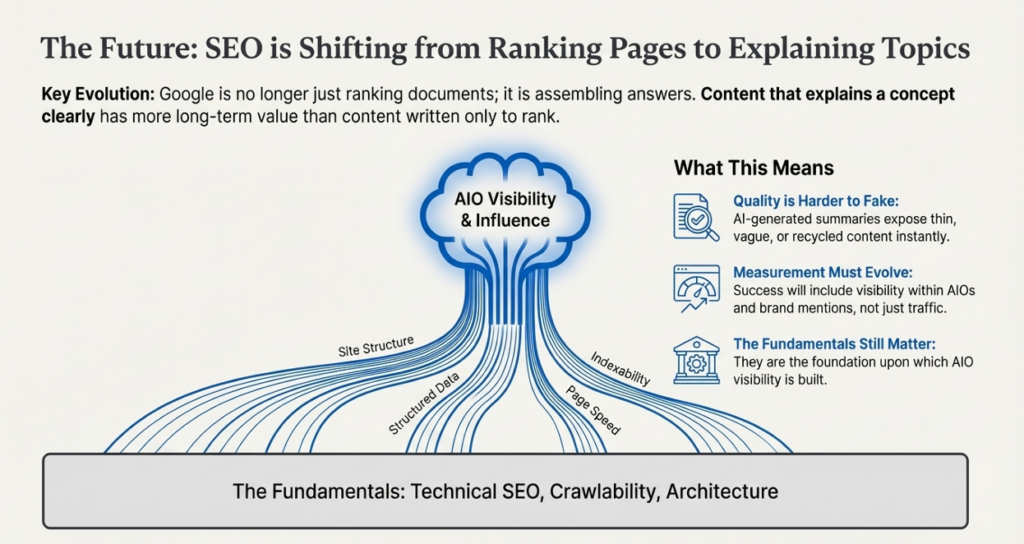
1. SEO Is Shifting From Ranking Pages to Explaining Topics
For years, SEO focused on winning positions. AI Overviews shift the focus toward owning explanations. Google is no longer just ranking documents. It is assembling answers. Content that explains a concept clearly and accurately has more long-term value than content written only to rank for a keyword.
This does not make rankings irrelevant. It changes their role. Rankings help Google discover and trust content, while AI overviews decide how that content is reused.
2. Content Quality Becomes Harder to Fake
AI-generated summaries expose weak content faster. Thin pages, vague advice, and recycled opinions have little value when Google can compare sources instantly. What survives is content with real subject understanding, clear structure, and factual grounding.
For AI Overviews for SEO, this raises the bar. Surface-level optimization will not hold up. Pages need to be good enough to be reused without context or clarification.
3. Topical Authority Will Matter More Than Ever
The future favors sites that cover topics deeply and consistently. One strong article is no longer enough. Google looks for patterns across a site that show expertise over time.
This is where AI Overviews SEO aligns closely with long-term strategy. Building clusters of related content, maintaining accuracy, and updating key pages will matter more than chasing new keywords.
4. Measurement Will Need to Evolve
Traffic alone will not tell the full story anymore. Visibility inside AI Overviews, brand mentions, and repeat exposure across related queries will become part of how success is evaluated.
SEO teams will need to connect search performance with brand demand, engagement quality, and downstream conversions. The value of being cited may not always show up in analytics immediately, but it compounds.
5. What Still Works, And Will Continue To Work
Technical SEO, crawlability, internal linking, and clear site architecture are not going away. Neither is intent-driven content. AI Overviews do not replace these fundamentals. They rely on them.
The future of SEO is not about fighting AI. It is about making your content useful enough to be trusted by it. Those who focus on clarity, accuracy, and depth will not lose relevance. They will shape how their topics are understood.
Conclusion: What This All Really Means for SEO
The fundamentals still apply, but the margin for shallow content is shrinking fast. Rankings alone are no longer the finish line. Influence is. Pages that explain topics clearly, accurately, and consistently are shaping how search results are summarized, even when users never click.
The biggest mistake right now is treating AI overviews as a separate optimization problem. They are not. They are a stress test for content quality, intent alignment, and topical authority. If your content helps Google understand a topic better, it has value. If it exists only to rank, it is replaceable.
The path forward is not about chasing visibility inside AI overviews. It is about becoming the source Google trusts enough to cite. That requires better explanations, tighter focus, and fewer shortcuts.
The path forward is not about chasing visibility inside AI overviews. It is about becoming the source Google trusts enough to cite. Explore our full range of SEO services to see how we help businesses stay visible as search continues to evolve.