Introduction
Look, social media isn’t just about posts or filters. It’s where people talk, argue, and buy. Miss that, and you’re invisible. Simple as that.
From what I’ve seen, brands that just sell don’t last. The ones that listen and sound real do. Sound familiar?
Here’s the thing: people don’t want ads. They want connection. Want to know why? Because trust drives clicks.
In this guide, you’ll learn how to shape a social media marketing strategy that actually works. Not random tips, but a full approach to connect, convert, and grow.
What is Social Media Marketing?
Social media marketing is the procedure of crafting content for social media platforms to market your products and services, create a community comprising your audiences, and steer traffic to your company. With innovative features and new platforms coming up each day, social media marketing is continuously advancing.
Social media marketing is all about assembling with your prospects and clients where they are and as they socially engage with each other and your business brand.
While social media marketing as a whole is extremely valued and advantageous to your business growth, your strategy and tactics will diverge based on which social networks your audience spends most of their time on.
A Brief History of Social Media Marketing
Let’s rewind for a second. Back in 1997, Andrew Weinreich launched Six Degrees. It let people create profiles and connect with others. Crazy idea, right? But it changed how we communicate online. No exceptions.
Then came Facebook in 2004, born inside Harvard dorms. It didn’t take long before it dropped the “The” and took over the world. By 2006, Facebook was open to everyone. Ads followed soon after. That’s when social media turned into a playground for marketers. Real talk: it changed the rules forever.
A year earlier, some ex-PayPal folks rolled out YouTube. Google bought it in 2006, and suddenly video marketing blew up. Did you see that coming?
Then came Twitter. 140 characters to speak your mind. Instagram arrived in 2010, where visuals said everything. Marketers? They didn’t wait. Can you blame them?
LinkedIn was already paving its own lane. Launched in 2002, it wasn’t about selfies or status updates. It was about business. Pure networking, real opportunities. From what I’ve seen, LinkedIn’s still the go-to space for B2B growth, and it’s showing no signs of slowing down.
The story of social media marketing is basically a timeline of bold ideas meeting global audiences.
Why Social Media Marketing Matters for Businesses
Social media isn’t optional anymore. It’s where audiences expect you to show up, share value, and sound human. Want to know why? People don’t buy from brands they don’t trust. Simple.
1. Create Brand Awareness
Across diverse social platforms, organizations can tell their story, explain why they offer the services they currently deliver, and present audiences with the latest trends and client and employee stories.
If B2B leaders can use the voice of their stakeholders and employees, they can outspread their brand reach even more. Each employee has an individual network, and every network has possibly thousands of contacts. Also, each of those contacts is linked to thousands of other people.
2. Generate Leads
You can create expressive conversations within your target industries by promoting videos, news, insights, and thought-provoking trends on social media sites. Not only do you build integrity with your clients, but these social media tactics can result in gaining leads.
3. Nurture Leads
Social selling empowers sales staff to build and shape relationships with leads. By using thought leadership content, social proofing, and other conversant content, they can assist potential clients in resolving challenges. In turn, this enables your sales team to create confidence and authority.
4. Enable Social Listening
Listen to clients and what people are saying about your organization. This gives you an opportunity to get open feedback about how others view your business and brand. It opens a window into refining the weaker parts of your business while strengthening facets that already exist with people.
5. Link Social Posts to Business Openings
With the precise enterprise solution, social media marketing leaders can steer social posts to the CRM to comprehend clients better.
6. Measure Efforts.
Social media tools track KPIs. Know what works. Adjust fast. You can even allocate a fiscal value to organic social media interactions. Earned media value (EMV) provides details of your organic social engagement and reach that would have cost if you had used ads.
7. Steer Thought Leadership
Being on social media platforms offers business brands a chance to steer thought leadership by resolving issues and challenges. Craft how-to guides, webinars, and other useful content to assist people, and, in reply, people could better trust your brand for business guidance.
8. Build and Shape a Community
With proper planning, you can create an active community around your business on social media. You can use employees and clients alike to produce instant Likes and Shares for your promoted content so that it reaches fresh audiences.
9. Build User-generated Content
User-generated content (UGC) can speak to brands in more dependable approaches, and it keeps your content publishing channels full of fresh content.
10. Connect with Key People
Distributing thought leadership posts through social media is a preferred methodology for meriting the consideration of topmost stakeholders. Use webinars, eBooks, videos, podcasts, and other content to resolve the challenges of people in your social networks.
11. Use AI Insights Smartly
Using AI-driven insights in social media helps spot what your audience responds to most. Tools like predictive analytics or sentiment tracking highlight which formats and topics perform best. From what I’ve seen, pairing these insights with real human judgment creates stronger campaigns that actually convert.
What are the Categories of Social Media Marketing?
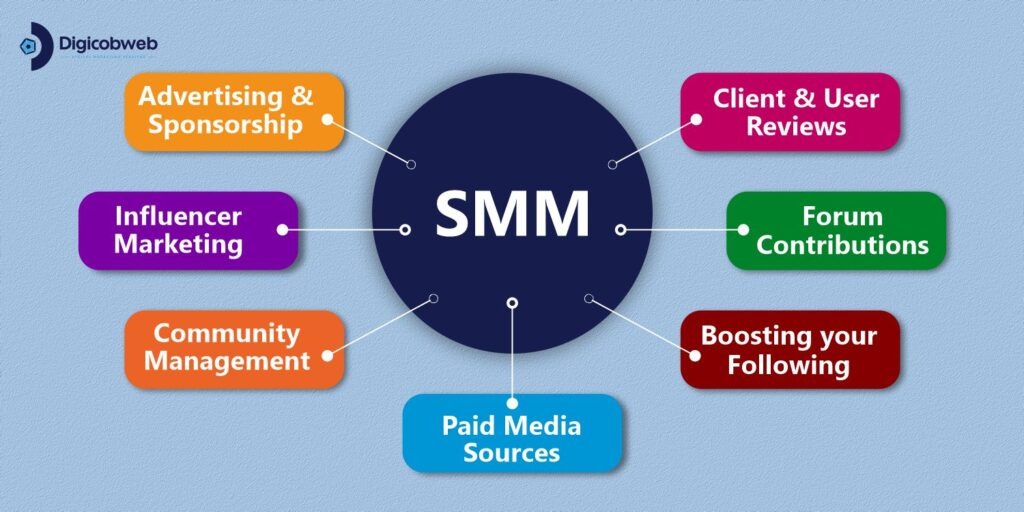
Sideways from the likes of Facebook, LinkedIn, Twitter, and Instagram promotions, social media marketing takes many diverse categories and approaches, such as
- Advertising and sponsorship
- Community Management
- Paid Media Sources
- Boosting your Following
- Forum Contributions
- Client and User Reviews
Social Media Strategy Framework (Step-by-Step)
Look, every solid social plan starts with knowing your audience and goals. From what I’ve seen, the best brands keep it simple. Track results. Adjust fast.
Step 1: Research your target audiences.
You can’t make content that clicks unless you know their habits. Sounds basic? It’s not.
Think: who are they, and what do they care about?
For example, millennials who love stylish headphones. Now you know what content grabs attention.
Step 2: Decide on which precise platforms you will market on
No point shouting into the void. Instagram for lifestyle millennials. LinkedIn for professionals. Clear?
Say you’re targeting lifestyle-loving millennials, then Instagram’s your playground. They dominate that space, so meet them where they scroll.
Step 3: Determine substantial metrics and KPIs
No matter what business you’re in, your strategy has to be driven by data. No exceptions.
The important social media metrics include
- Reachability analytics of your feeds
- Clicks on content or account
- Analysis of impressions and interactions
- Breakdown of hashtag performance
- Comparison of organic and paid likes
- Sentiment Analysis of the brand
Step 4: Explore your competition.
Explore competitors. Quick scan. See what works and where they fail. Copy smartly. From what I’ve seen, this simple step often shapes better goals than guessing ever could.
For instance, if your competitor is leading on Facebook but has placed lesser efforts into Twitter or LinkedIn. You might want to concentrate on the networks where your audience is less catered to rather than attempting to win fans away from a leading player.
Step 5: Create unique and pleasing content.
Let’s be honest, your audience has already seen your competitors’ posts. So give them something different. Something real.
That’s why your content must stand out. Simple moves build connection fast. Go live for a product drop or Q&A. Ask customers to share experiences with your brand hashtag. Works every time.
Ask your customers or partners to share their experiences using your brand hashtag. Repost them. It’s effortless social proof.
Step 6: Set a schedule for your posts.
Keep it consistent. Schedule posts ahead with tools that handle images and captions. Life’s easier. Trust me.
How Marketing Strategy Varies Across Platforms (and What Stays the Same)
Each platform runs on its own rhythm. Facebook rewards engagement. Instagram loves visuals. LinkedIn wants lessons, not jokes.
Core idea stays: build trust, share value, and talk to people.
a. Facebook
Look, Facebook is huge. Perfect for B2C brands. Ads, groups, organic posts—mix them right. Since launch, it’s grown into a tool that mixes ads, groups, and organic posts perfectly.
From what I’ve seen, a good Facebook strategy combines paid campaigns with strong community interaction. Do this right, and you gain loyalty, not just traffic.
b. Instagram
Visuals rule here. Stories feel real. People shop and explore in-app. Every post can drive sales. Blend posts, reels, and influencer content.
People can now discover, explore, and shop without leaving the app. That means every post can drive discovery or conversion. A strong Instagram plan blends organic posts, shoppable tags, reels, and influencer tie-ins.
c. Twitter (X)
Twitter’s the heartbeat of quick conversations. It’s where news breaks, thoughts spread, and brands show personality.
Real talk: tweet’s impact depends on clarity and timing. The platform’s tools, like Spaces, Communities, and Moments, help brands to connect, not just post.
d. YouTube
YouTube ranks second globally in traffic. It’s where people go to learn, binge, and belong.
From my experience, long-form educational videos perform best. Tutorials, product walk-throughs, and behind-the-scenes insight. That’s what keeps audiences hooked. It’s not about going viral; it’s about staying useful.
d. LinkedIn
Not just resumes anymore. Real conversations happen here. Share lessons, insights, stories. From my experience, it’s the top place for thought leadership.
Posts that share genuine insights, stories, or lessons perform far better than cold promotions. From what I’ve seen, it’s the go-to place for thought leadership. Want to reach decision-makers? Post content that helps them think differently, not just buy faster.
d. Threads
Threads is Meta’s latest push toward short, open conversations think Twitter, but with a friendlier vibe. It’s built around community, not chaos.
In my experience, brands using Threads well don’t overthink it. They share quick thoughts, tips, and real-time updates that show the human side of their brand. That’s what engagement really means.
Don’t copy-paste tweets here. Instead, talk like you would to your peers. Ask questions. Start conversations. That’s how visibility grows naturally.
Concluding:
Each platform has its role: storytelling on Instagram, conversation on Threads, credibility on LinkedIn, community on Facebook or YouTube. Post smarter, not everywhere. Real results follow.
Real-Life Case Studies of Social Media Campaigns
Here are some social media campaigns that nailed creativity and impact. See what happens when brands actually listen instead of just talking. Real results follow.
1) Starbucks India – “From Chaiwala to Cappuccino”
Starbucks India’s 2025 campaign celebrated small local business owners who transitioned into baristas and entrepreneurs. Real stories, raw visuals, heartfelt captions. Big impact online.
75 million organic views. 250k shares. Starbucks India grew Instagram following 33% in two months. Impressive, right? Simple moves, big wins.
2) Spotify Wrapped
Spotify’s annual “Wrapped” campaign isn’t just fun; it’s built for share-power. In 2022, the campaign engaged 156 million users, and in its first 3 days that year, it generated 425 million social mentions.
From what I’ve observed, it works because you become the promotion when you share your stats, your friends see you, you see them, and the brand fades into the background.
3) Nike’s AI-Powered Personalisation Push
Used AI to deliver personalized ads: workout plans, sneaker drops, and recovery tips. Engagement tripled. Conversions are up 27%. Proof that creativity and automation can work together.
How to shape a social strategy
It’s all about clarity, consistency, and tracking results. Nike’s 2025 campaign used AI to deliver personalized ads—workout plans, sneaker drops, recovery tips. Want proof?
3x higher engagement rate than traditional social ads and boosted conversions by 27% across its fitness ecosystem. Automation and creativity can coexist.
How to Create and Shape a Social Media Marketing Strategy
Initiating on the ground floor and building up, here is our outline of how to produce a social media marketing plan from scratch.
Step 1: Select your social networks
Choosing social networks depends on the targeted audience, time, and accessible resources.
- Audience: Where do your probable clients hang out? Which network has the right demographics?
- Time: How much time can you dedicate?
- Resources: What skill sets and professionals do you have to work with? Facebook stresses higher quality content. Pinterest and Instagram need images and videos. Do you have the resources to craft what’s required?
Step 2: Fill out your profiles entirely
Profiles will need two integral parts
1. Visuals
For text, your main area to adapt is the bio and info section. A professional social media bio must be informational and friendly.
2. Text
For visuals, you must aim for constancy and acquaintance with the visuals on social media. Your profile photo should match on Instagram and Facebook. Your cover picture on Twitter must be similar to that on LinkedIn.
Step 3: Identify your voice and tone
Work on questions like these:
- If your brand were an individual, what personality would it have?
- How would it connect with your audience?
- Are there any organizations that have a similar personality to your brand?
- How do you want your clients to think about your organization?
Step 4: Pick your posting strategy
Find responses to what the precise number of posts per day is. How frequently should you post? At what time should you post? What content should you post?
Step 5: Analyze and test
Analyze and test. The more you post, the more you’ll learn which content, timing, and frequency work.
Step 6: Automate and engage
Automate and engage. Set a system to stay on top of updates and interact with your community. Real talk: start automating posts.
Social Media Marketing Tips
Here are some ways to up your game and market your brand effectively.
1. Craft a Strategy
Every platform requires its strategy. Each platform is diverse in some approach, and it is vital to comprehend what works best to generate targeted content and engagements.
Some questions to anticipate are
- Why am I using this social media platform?
- Who are my targeted prospects or customers?
- What business message am I trying to communicate?
- What content fits best on this particular platform?
- How can I make my content exceptional and helpful?
2. Be Steady
Irrespective of your business size and what platform you are using, be mindful of keeping these facets steady and consistent:
- Brand Image
- Business Message
- Posting Regularity
- Use of Hashtags
3. Create and Shape Engagements
Engaging with your followers is significant in building a community and feeling more friendly. Conducts to do this comprise:
- Liking and responding to user comments
- Enable live streaming
- Crafting polls and quizzes
- Post content that attracts
- Monitor and analyze key metrics
Best Social Media Marketing Tools
1. Buffer
Buffer’s still a favorite. It’s simple, reliable, and perfect for scheduling and analyzing posts across Instagram, LinkedIn, and Facebook. Makes life easier. From what I’ve seen, small brands love its clean layout and affordable pricing.
2. Hootsuite
If you manage multiple accounts, Hootsuite saves your sanity. It pulls every message, post, and comment into one dashboard. You won’t need ten tabs open ever again.
3. Sprout Social
This one’s built for pros.Deep analytics, collaboration tools, CRM integration.
Real talk: not cheap, but worth it if you’re serious about strategy.
4. Canva
Visual content drives attention, right? Canva helps you design fast, without needing a designer. Want a tip? Use its “Brand Kit” feature to keep your color palette and fonts consistent.
5. Notion
Social teams now plan entire campaigns inside Notion. From calendars to approval workflows, it keeps everything visible, editable, and connected. Sound familiar? That’s because chaos kills consistency.
6. Later
Later isn’t just a scheduler anymore. It’s got TikTok analytics (where active) and smart link features that help turn posts into conversions. In my experience, eCommerce brands swear by it.
7. Brandwatch
Want to know what people really think of your brand? Brandwatch tracks mentions, emotions, and viral trends in real time. Insight at scale.
8. Bitly
This one’s gaining traction fast. It combines scheduling, analytics, and ad tracking across all networks. If you’ve ever felt your reporting’s scattered, Metricool fixes that.
10. ChatGPT for Social Copy & Insights
Look, AI’s here to stay, and used right, it saves hours. Many marketers use ChatGPT for hooks, captions, or competitor research. But remember: it assists, doesn’t replace human creativity.
Best Social Media Resources
Learning never stops in marketing. From what I’ve seen, the people who stay ahead keep upskilling. Managing pages or building strategies? A good course sharpens instincts fast.
Not every course is worth your time. But these? They’ve earned trust across the industry.
HubSpot’s free course covers everything from social strategy to ROI tracking. It’s updated often, making it a solid pick if you want practical, actionable training.
1. HubSpot Social Media Certification
HubSpot’s free course covers everything from social strategy to ROI tracking. It’s updated often, making it a solid pick if you want practical, actionable training.
2. Google Digital Garage – Fundamentals of Digital Marketing
Beginner-friendly, but not basic. Real value,You’ll learn search, content, and social, all tied to analytics. Real talk: every marketer should take this at least once.
3. Meta Blueprint
If you’re serious about Facebook or Instagram ads, this one’s gold. Covers campaign setup, audience insights, and budgets.
4. Coursera – Social Media Marketing Specialization (Northwestern University)
Focuses on brand storytelling and analytics. From my experience, excellent for deeper skills. Want to understand how campaigns scale? This course breaks that down clearly.
5. LinkedIn Learning – Social Media Marketing Foundations (by Brian Honigman)
Still one of the best for grasping platform-specific strategies. From what I’ve seen, it’s perfect for professionals who prefer self-paced learning.
6. Skillshare – Advanced Social Media Strategy by Cat Coquillette
Still one of the best for grasping platform-specific strategies. From what I’ve seen, it’s perfect for professionals who prefer self-paced learning.
7. The Wharton School – Digital Marketing, Social Media, and E-Commerce
Wharton’s program digs into case studies from real brands. If you’re building an executive-level portfolio, this one’s a no-brainer.
8. Neil Patel’s YouTube Channel
Not a course, but an absolute must-watch. His breakdowns on trends, algorithms, and growth tactics are short, sharp, and based on data.
9. Later’s Social Media Strategy Hub
Later has evolved into a go-to resource library: templates, guides, and trend reports all in one place. Want to stay relevant? Bookmark it.
Look, the goal isn’t to collect certificates. It’s to learn, test, and adapt what works for you. No exceptions.
Moving forward: build a social media presence that lasts.
Look, social media isn’t just trends anymore; it’s where real business happens. From what I’ve seen, the brands that win aren’t posting the most—they’re posting with purpose.
There are billions of active users scrolling right now. That’s billions of chances to connect, inspire, and convert. Sound overwhelming? It doesn’t have to be. Start small. Stay consistent.
Keep content aligned with what your audience cares about. Strategy beats speed. Track, adapt, and use insights smartly.
Real talk: don’t chase every trend. Stay authentic. Ready to turn your pages into growth engines?
Don’t wait. Our team at Digicobweb can help you create a social media strategy that actually delivers, from community building to conversions. Let’s make your brand stand out where it matters most.