
Introduction
Sites that want search engines to understand their pages need to use data. This is not something they can ignore anymore. Search engines are changing how they show results. They do not just show links anymore. Search engines need to know what a page is about and what it is talking about. Structured data helps with this. It gives search engines the information they need in a way that they can understand. Structured data is like a guide that explains what everything means.
The real problem that structured data solves is ambiguity.
Structured data helps to avoid confusion.
Without data, search engines have to figure out what things mean from the HTML and the way things are laid out on the page and from the text patterns. This method works.
This guide is actually doing things. You will not find explanations or big promises that do not mean much. It shows you how structured data is used, how schema markup for search engine optimization really works when people use it, and how to use schema markup for search engine optimization in a way that follows the rules of search engines, like how schema markup for search engine optimization should be used.
What Is Structured Data?
Structured data is a standard format for telling the search engines what your page content means. It’s a way to describe the content of your page to a search engine in such a way that a software program (spider or crawler) can understand it without necessarily interpreting it.
Instead of forcing crawlers to guess which HTML elements and text patterns represent important data, structured data markup specifies what each piece of content represents.
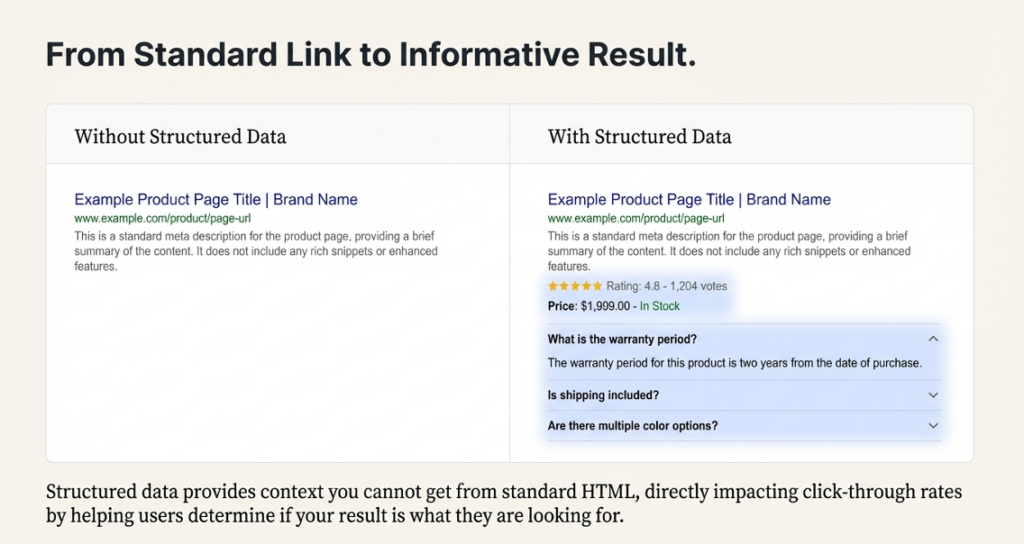
Structured data defines entities that exist, such as articles, products, organizations, reviews, or their attributes. Having this information helps feed rich results, knowledge graphs, and other enhanced search features. It’s more important because it helps the search engine understand the page context with less ambiguity.
Structured data in SEO is fundamentally a form of communication. You are communicating to the search engines precisely what the page contains and how it should be categorized. When carried out correctly, this very data presents the right indexing together with consistent interpretation across search systems.
Structured Data vs Schema Markup
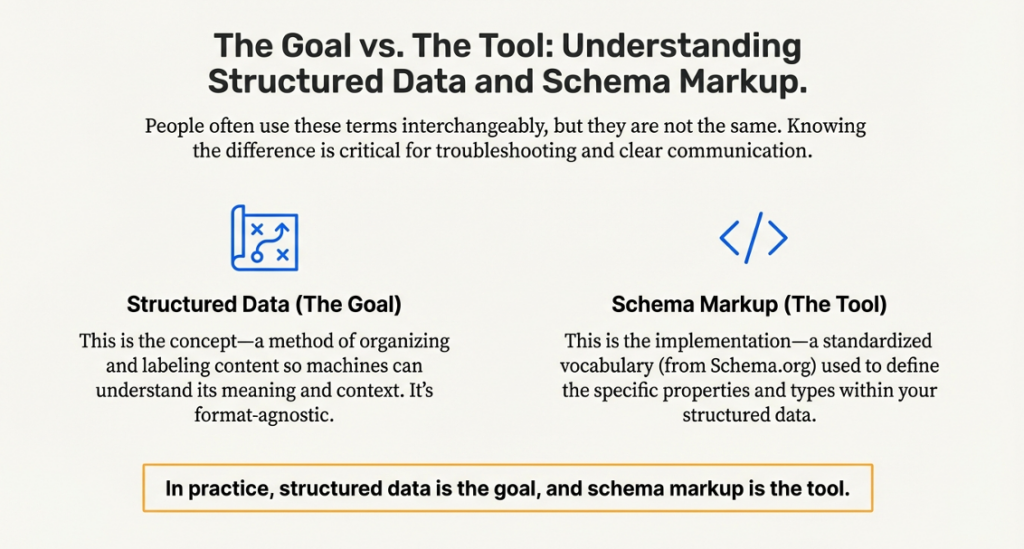
When we talk about data and schema markup, people usually think they are the same thing. They are not. Data and schema markup do different things to help with search engine optimization. It is really important to know the difference between data and schema markup. This helps us avoid mistakes when something goes wrong with the markup or when we need to explain things to the people in charge.
The table below shows how structured data and schema markup are different and how they work together in life.
| Aspect | Structured Data | Schema Markup |
| Definition | A method of organizing and labeling content so machines can understand its meaning | A standardized vocabulary used to describe structured data |
| Purpose | Provides context and meaning to page content | Defines the specific properties and types used in that context |
| Scope | Conceptual and format-agnostic | Tied to Schema.org definitions |
| Used by | Search engines, AI systems, data parsers | Implemented by developers and SEOs |
| Dependency | Can exist in multiple formats | Most commonly used to implement structured data |
| SEO Role | Helps search engines classify and interpret content | Enables structured data to be understood consistently |
| Common Misunderstanding | Assumed to be “code” or a ranking factor | Assumed to work automatically without proper content matching |
| Real-World Example | Describing a page as a product with price and availability | Using Product, offer, and availability properties from Schema.org |
In practice, structured data is the goal, and schema markup is the tool. When people refer to structured data markup, they usually mean Schema.org definitions applied using formats like JSON-LD. What matters most is not the wording, but whether the markup truthfully represents what users can see on the page.
Why Structured Data Matters for SEO
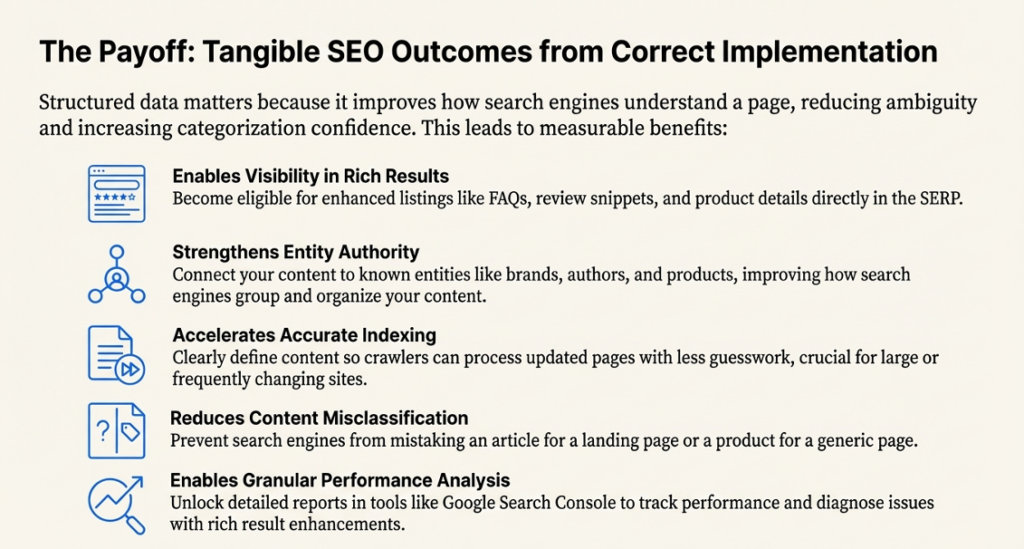
Structured data matters, not because it promises rankings, but because it improves the way in which search engines understand a page. When markup is correctly implemented, it reduces ambiguity and helps search engines categorize content with greater confidence.
1. Visibility in Rich Results
Using data makes your website eligible for rich results like FAQs, review snippets, and product details. This is really useful because it makes your search listings more informative. It adds context that you cannot get from standard HTML. Structured data is what makes this possible. It is a good thing to have. Structured data helps people find the information they need when they search for something. It can include things like FAQs, review snippets, and product details.
2. Clear Understanding of Page Context
When you do not have structured data, search engines have to make guesses about what a page is about. Structured data markup helps a lot by saying what things are on a page, how they are related, and what they are supposed to do. This is really important for pages that do lots of things or have a lot of information. Structured data is very useful for these kinds of pages because structured data helps search engines understand what the page is about.
3. Impact on Click-Through Rate
When you have structured data, it does not mean you will get rankings. It usually makes your listings look better in search results.
The title of your listing, the ratings people give you, and the details you provide all help people figure out if your result is what they are looking for. This can affect how likely people are to click on your result.
It does not take the place of the basic rules of search engine optimization.
4. Faster and More Accurate Indexing
Structured data is really helpful for search engines. They can look at updated pages and understand what is going on without having to guess as much.
When you clearly say what something is and what it is about, the crawlers that search engines use do not have to work hard to figure out what you mean.
This means that search engines can keep track of things easily, which is especially important for big websites or websites that change a lot.
Structured data makes it easier for search engines to keep everything straight and up-to-date.
5. Stronger Entity Associations
Search engines really need to know about the relationships between things. When you use data markup, it helps your content connect to things that are already known, like brands, authors, products, and organizations.
This makes it easier for search engines to group your content in a way that makes sense.
It reduces the problem of having lots of pieces of information that are not connected, and it improves how search engines organize content.
6. Consistency Across Search Surfaces
Search engines really need to know about the relationships between things. When you use data markup, it helps your content connect to things that are already known, like brands, authors, products, and organizations.
7. Reduced Risk of Misclassification
Pages without data can get mixed up, especially when the layout is really complicated or there are lots of different types of content.
Having a clear schema markup for search engine optimization is a help because it stops articles from being thought of as landing pages.
This is important for search engine optimization, so it is good to have schema markup for search engine optimization to avoid these problems with pages and products and articles.
8. Better Data for Performance Analysis
Structured data helps us get a view of things in tools like Search Console.
When we use result enhancements with markup, we can figure out what is going on with structured data when we see drops or improvements or problems with structured data that make some pages not work right.
Types of Structured Data Used in SEO
Not all structured data types are useful for every website. The goal is to use a schema that’s a good match for what the page is about and what users actually see on the page
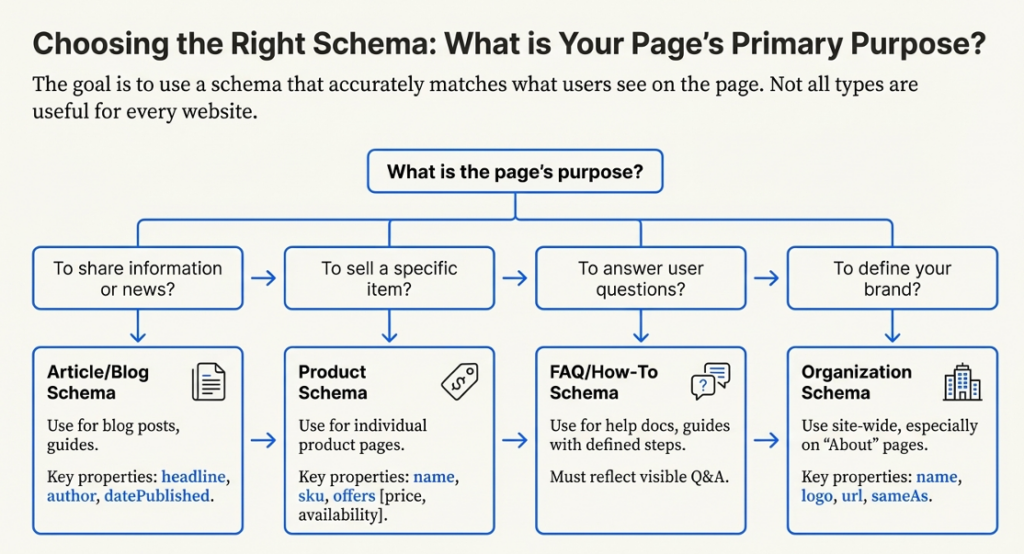
Here are the commonly used structured data types for search engine optimization and when and how to use them.
Organization
When we talk about an organization schema, we are basically talking about the identity of a business or a brand.
This helps search engines figure out that a particular website is connected to a business or brand, the organization schema.
Some things that are the same with these things include:
- name
- logo
- url
- sameAs (social profiles)
This markup helps people know our brand and makes it look the same on search systems. It is good for brand recognition. It helps to keep things consistent across all the search systems that we use.
Article/Blog
The article schema is used for things like blog posts, news articles, and guides. This helps the search engines figure out who wrote something and when it was published.
The article schema also tells the search engines what type of content it is, like a blog post or a news article.
Some important things about this are
- headline
- author
- datePublished
- dateModified
- mainEntityOfPage
This is really important for websites that are all about the content. For these sites it is crucial that people know who wrote the stuff and that the information is up-to-date.
The thing is, authorship and freshness of the content really matter for content-driven sites.
Product
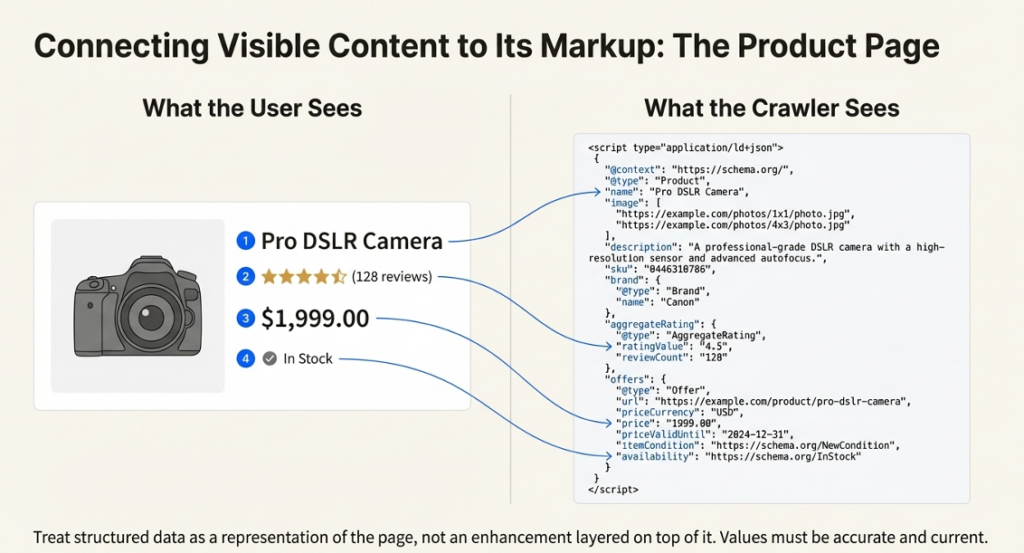
The product schema is used on the pages for each product. This is where you can see the price of the product if the product is available and the details of the product.
The product schema is really helpful because it shows users the pricing, availability, and product details.
Some things that are usually part of something are:
- name
- description
- sku
- offers (price, availability)
When you are looking at a page that’s clearly about something you can buy, that is when you should use product markup.
Do not use it on pages that list lots of things, like category pages.
Product markup is for pages that are really about a specific product that people can purchase.
Review/Rating
The review and rating schema provides context around user feedback. It must be tied to a specific product, service, or content piece.
Important rules:
- Reviews must be visible on the page
- R/Ratings reflect real user input
- Self-serving reviews should be avoided
Misuse here is one of the fastest ways to lose rich result eligibility.
FAQ / How To
FAQs are really useful when you want to make sure the answers are easy to find and clearly presented on the page.
You use the Asked Questions and How-To schemas for content that is meant to teach someone something or answer their questions in a straightforward way.
Things you can use it for include:
- Help documentation
- Product setup guides
- Educational articles with defined steps
Do not use this schema for marketing claims or hidden content
How to Implement Structured Data Markup
When you are working with data, the implementation is really important.
The way you set up the data is crucial. You have to think about the format you use, where you put the data, and how well it matches the information that people can see.
The implementation of data is key.
JSON-LD vs Microdata vs RDFa
Three supported formats for structured data markup:
- JSON-LD
- Microdata
- RDFa
JSON-LD is the preferred format for structured data for SEO. It keeps markup separate from HTML, which makes it easier to manage, debug, and update. Search engines also process it more reliably because it does not depend on DOM structure.
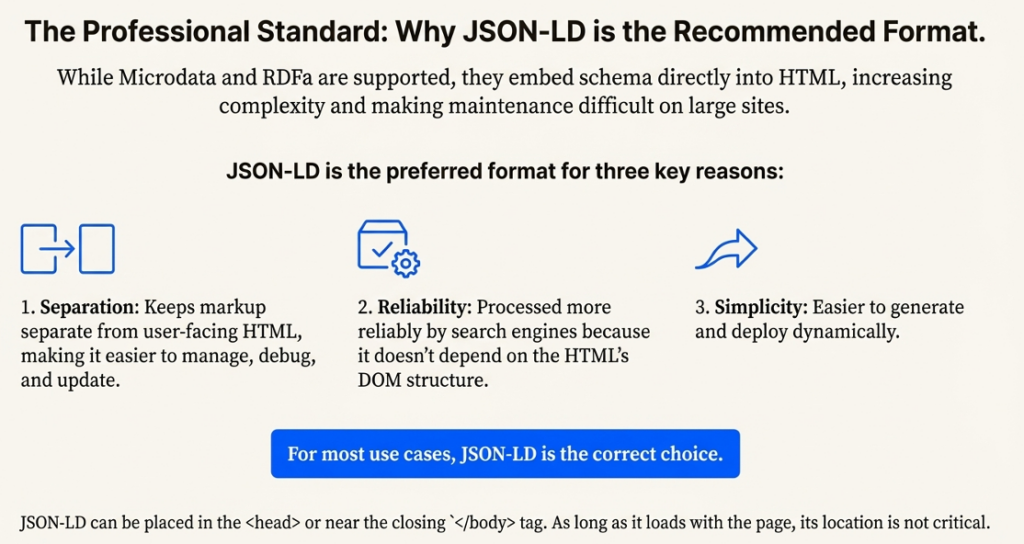
Microdata and RDFa embed schema directly into HTML elements. While still supported, they increase implementation complexity and are harder to maintain on large sites.
For most use cases, JSON-LD is the correct choice.
Where to Place Structured Data
You can put JSON-LD markup in the head of the page or near the end of the body. Where you put it does not matter.
The important thing is that the JSON-LD markup loads when you load the page. This means you can place JSON-LD markup in the head or near the closing body tag, and it will still work fine.
What matters is alignment:
- Markup must reflect visible content
- Properties must match page intent
- Values must be accurate and current
Treat structured data as a representation of the page, not an enhancement layered on top of it.
| Have questions about implementing structured data markup on your site? |
| Contact us for guidance |
Structured Data Implementation Examples
When you use data, it works really well if you do it based on what the page is about, not just what is easy to do with a template.
Here are some examples of how people use schema markup for search engine optimization on their web pages.
Blog Article Page
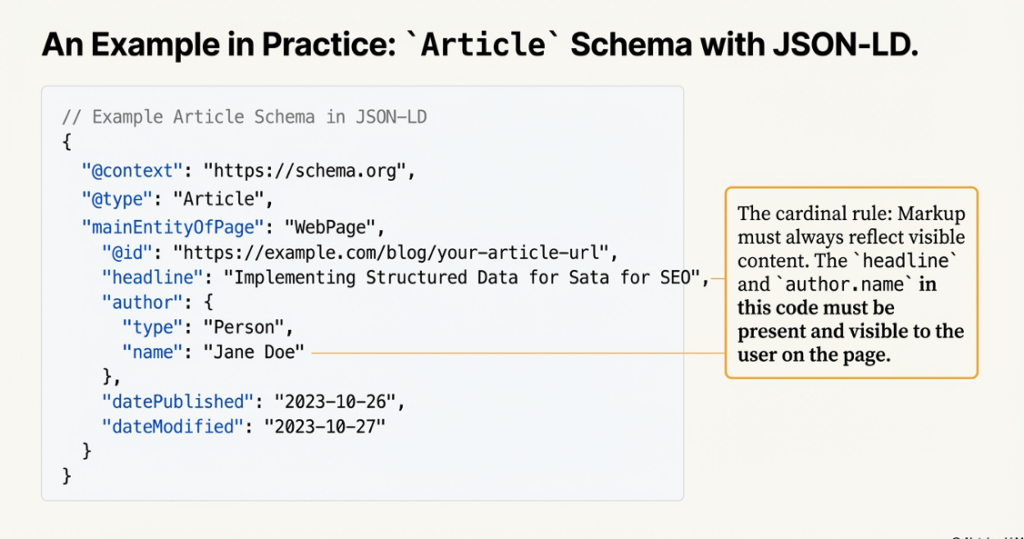
When you write a blog article, you should use the article or blog posting schema. This schema is really important because it helps search engines figure out who wrote the blog article, when it was published, and what the blog article is about.
The article or blog posting schema is very useful for defining the kind of content you have in your blog article.
Typical use case:
- Educational or informational content
- Clear author attribution
- Defined publish and update dates
When we are implementing something, we should make sure it is accurate. The title that we see at the top of the page should be the same as the title in the markup.
Product Detail Page
Product schema is appropriate only for individual product pages where pricing and availability are visible. It should never be used on category or comparison pages.
Typical use case:
- Single product for sale
- Price, currency, and availability displayed
- Optional user reviews
Product structured data markup helps search engines associate commercial attributes with the correct entity, reducing the risk of misclassification.
FAQ Content Page
When you have a page that is set up with questions and answers that users can see, you should use the FAQ schema.
This is because the FAQ schema is really good for pages that have questions and answers that are all visible to users. The page is structured around these questions and answers, so it makes sense to use the FAQ schema in this case.
Typical use case:
- Help center articles
- Setup or troubleshooting pages
- Educational content with clear Q&A formatting
We think expandable sections are okay. We do not like it when content is hidden or added in a sneaky way. If users of the website cannot get to the answer, then the answer should not be marked up. We want to make sure that users can see the information they need, so we do not want any hidden content, especially when it comes to sections and marked-up answers.
Organization Information Page
An organization schema is often implemented site-wide but is especially important on About or Contact pages.
Typical use case:
- Brand identification
- Official website representation
- Social profile confirmation
This markup supports entity consistency across search results and knowledge systems.
Validating Structured Data
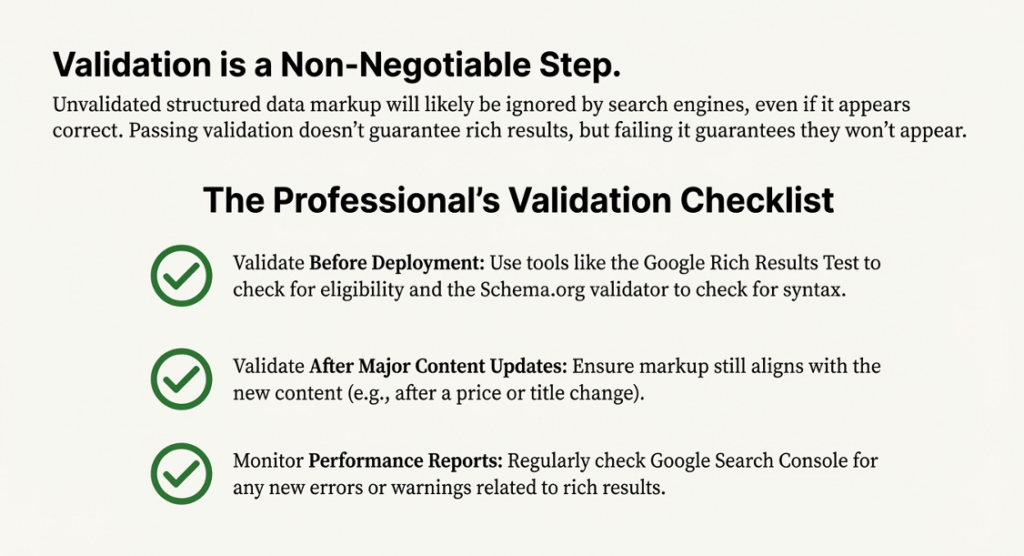
Validation is something you have to do. It is not something you check after you have already launched something.
If you put codes on your website like structured data markup and you do not validate it, then it will probably be ignored. This is true even if the codes look fine when you first look at them.
You really need to make sure your structured data markup is validated so it works properly.
Using a Schema Markup Checker
The Google Rich Results Test will tell you if your web page is eligible for search features. The Schema.org validators will check if the syntax is correct and if the properties are accurate.
You need to use these tools to make sure your schema markup is working properly on your web page.
Always test your web page with the Google Rich Results Test and the Schema.org validators to see if your schema markup is correct.
We need to do the validation. The validation is a step. We are talking about the validation, so the validation is key.
Validation should be done:
- Before deployment
- After major content updates
- When rich results disappear from Search Console
Passing validation does not guarantee rich results, but failing it guarantees they won’t appear.
Common Validation Errors
Most errors fall into a few predictable categories:
- Missing required properties
- Invalid data types or formats
- Markup applied to the wrong page type
- Inconsistent values between markup and visible content
Warnings are often overlooked, but they usually signal reduced eligibility or partial interpretation.
How to Fix Validation Issues
Fix issues at the source rather than suppressing errors. Update the markup to reflect the actual page content or adjust the page to support the required properties.
When a page cannot meet schema requirements, remove the markup entirely. Incorrectly structured data is worse than no structured data.
Common Structured Data Mistakes to Avoid
Most structured data issues come from overuse or misalignment with content. Search engines are strict about accuracy, and repeated mistakes can lead to markup being ignored entirely.
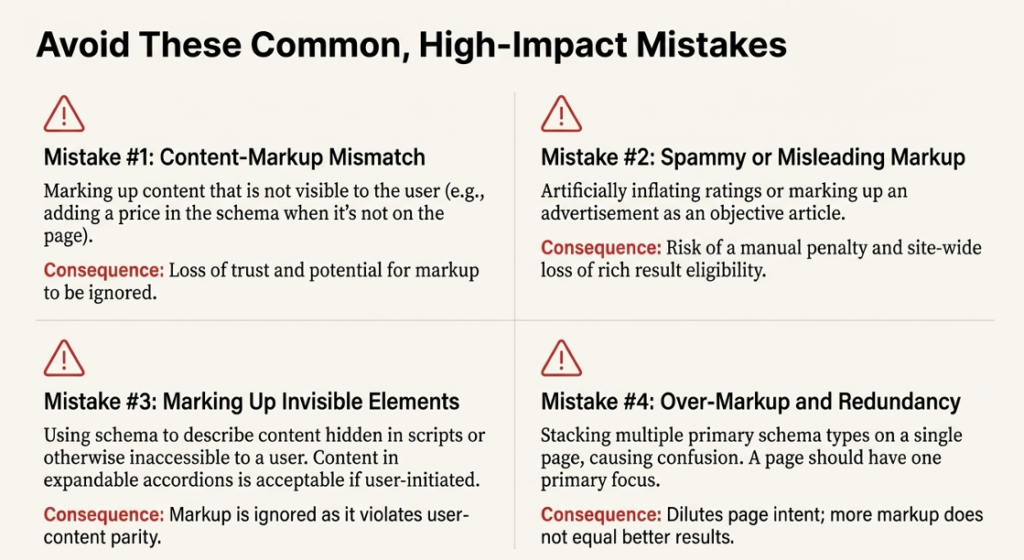
1. Mismatched Content and Markup
People often make a mistake when they add information that’s not even on the page.
The product price and review score and author name should only be in the data markup if they are visible to users.
Search engines look at the markup. The content that people actually see. If the information in the markup and the content do not match, then people do not trust search engines much.
Search engines need to be able to trust the information they find, so when the markup and the content do not match, search engines have a problem with trust.
2. Spammy or Misleading Markup
You should not use data to make things seem better than they are. For example, do not add reviews or make your ratings look higher than they really are.
When people misuse this thing, it usually means they will not be able to get results on their whole website, not just the page that has the problem.
This type of misuse can cause a lot of trouble. It affects the entire site. The rich results will be.
This is a big deal for the website. This type of misuse is something that people should try to avoid because it can hurt their website.
3. Marking Up Invisible or Injected Elements
You should not use codes to hide things from people who are looking at your website. Do not add scripts or extra content that only computers can see.
It is okay to have content that can be expanded, like when you click on something. It shows you more as long as people can get to it too.
If people cannot easily get to the content, then the content should not be included in the schema markup for search engine optimization. The schema markup for search engine optimization is only helpful if people can actually see the content. So if the content is not accessible to people,
It does not make sense to include it in the schema markup for search engine optimization.
4. Over-Markup and Redundancy
When you put a lot of different schema types on one page, it gets confusing. A page should really have one main thing it is about.
You can add things to the page, but only if they help make the main thing clearer.
The main thing on the page is what is important, so do not add things unless they have a good reason to be there.
Using a lot of markup does not mean you will get results. More markup is not always the answer to getting what you want.
The amount of markup you use does not determine how good your results will be. Markup is a tool, and using more of it will not make your results better.
Structured Data and AI-Driven Search
Computer search systems that use intelligence need signals that are organized in a certain way to understand what things mean.
This helps the computer figure out what is what and how things are connected without getting confused. Artificial intelligence search systems, like these, rely on signals to understand content.
When you look at a website, structured data markup is like a label that tells computer programs what the page is actually about, not just what words are on it.
This is really useful for things like companies, products, or people who write things because it helps computer programs understand what they are looking at. Computer programs can then take this information.
Match it up with other information from other places more correctly. This is very important when you want to get a version of something, compare things, or get answers that make sense in a certain situation because structured data markup helps computer programs like AI systems understand the context of the information, and this is especially important for structured data markup and AI systems.
For AI-generated search features, structured data for SEO is really important. It helps with things like names, dates, and relationships. The search results are more accurate. This means there is a chance of getting things wrong.
Structured data for SEO does not tell the AI what to do. It makes the information the AI uses better. This is good because it helps the AI give results.
Structured data for SEO is like a foundation that supports the AI-generated search features.
Best Practices for Long-Term SEO
You should always keep an eye on your data. It is not something you do once. Then forget about it. Search engines are always changing what they want from you. The content on your website is also changing all the time. If your structured data gets out of date, it can cause problems.
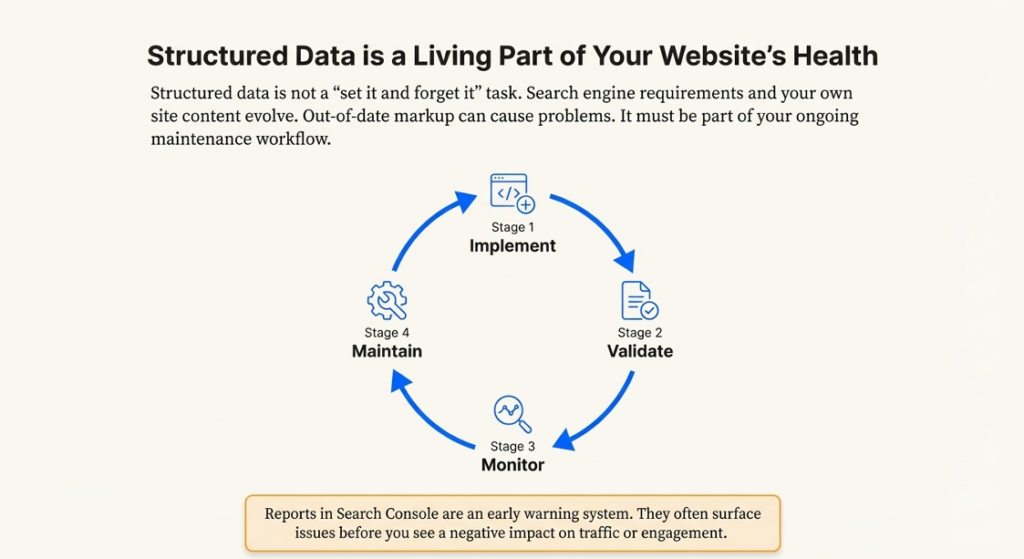
Structured data needs to be part of the work you do to keep your website running smoothly.
Ongoing Maintenance
When the page content gets updated, the structured data markup needs to be looked at. If something, like the title or the price or who wrote it, changes, the structured data markup has to change too. This is so that the structured data markup and the page content do not have information. The structured data markup should always match the page content.
Templates are like the backbone of sites; they drive both the content and the schema, so it is crucial to get them right.
Staying Aligned With Schema Updates
Schema.org is always making changes. Adding new things to its properties. You do not need to check every update that Schema.org makes.
To get the results from search engines, it is a good idea to follow the instructions in the search engine documentation. This helps make sure that your schema markup for search engine optimization is okay and can still show up as results. You should always check the search engine documentation to keep your schema markup for search engine optimization working properly and showing results.
Monitoring Performance
You should use Google Search Console to keep an eye on the data reports and the rich result enhancements. If you see a drop in the Search Console, it usually means there is a problem with the validation: the content does not match, or the policy has changed. You need to check the Search Console to see how the structured data is doing and if the rich results are working correctly.
I think of these reports as a way to check if everything is okay. They usually show us problems before we notice anything is wrong with the traffic or how people are interacting with the site.
Conclusion
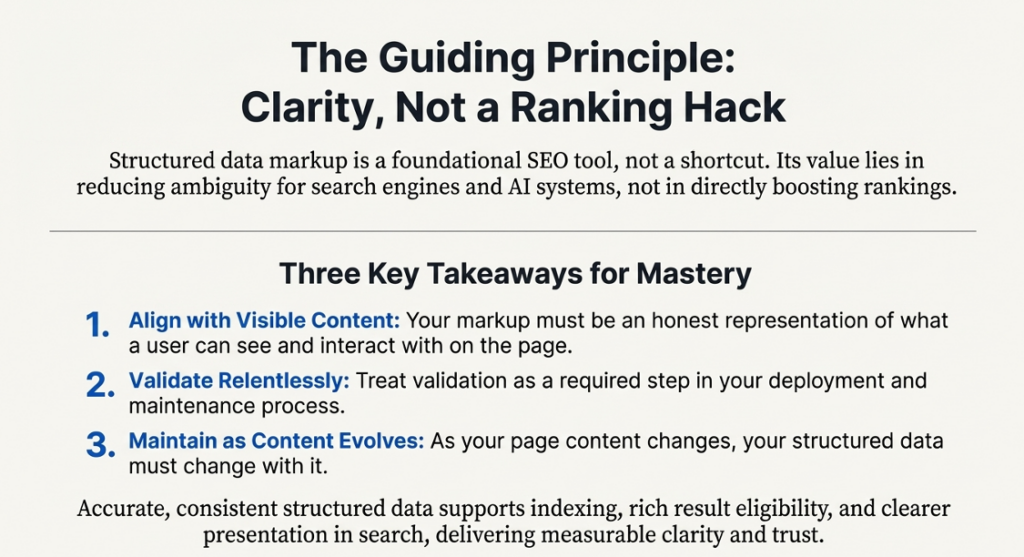
Structured data markup is a foundational SEO tool, not a shortcut or ranking hack. When implemented correctly, it clarifies page intent, ensures accurate entity recognition, and improves eligibility for rich results. Its value lies in reducing ambiguity for search engines and AI systems, not in directly boosting rankings.
The practical takeaway is simple: align your schema markup with visible content, validate it regularly, and maintain it over time. Accurate, consistent structured data supports indexing, rich result eligibility, and clearer presentation in search results. Treat it as a supporting layer of SEO that reinforces your content and technical structure, and it will consistently deliver measurable clarity and trust.