Introduction
✦ Quick Answer: Service area business SEO is the process of optimizing your online presence to rank in local search results without a physical storefront. It covers your Google Business Profile service area settings, location-specific landing pages, NAP consistency, local citations, schema markup, and content signals, all designed to prove to Google you are the most relevant, trusted choice in the cities and neighborhoods you serve.
A service area business (SAB) is any business that travels to customers rather than receiving them at a fixed location. Plumbers, electricians, HVAC technicians, landscapers, mobile pet groomers, cleaning companies, and home repair contractors all fall into this category.
Unlike traditional local SEO tactics that attempt to get foot traffic, service area optimization is merely about showing Google and your customers that you’re applicable to the cities and neighborhoods you serve, despite the fact that you don’t have a physical location of business.
This guide covers the specific challenges SABs face, how to properly set up and optimize your Google Business Profile, how to build location relevance through landing pages and content, why schema markup is now non-negotiable, and how to track performance across multiple service areas. By the end, you’ll have a complete plan to make your service area business visible in local search and competitive with every business that has a physical address.
1. Unique Challenges for Service Area Businesses
What makes SEO tricky for service-only businesses?
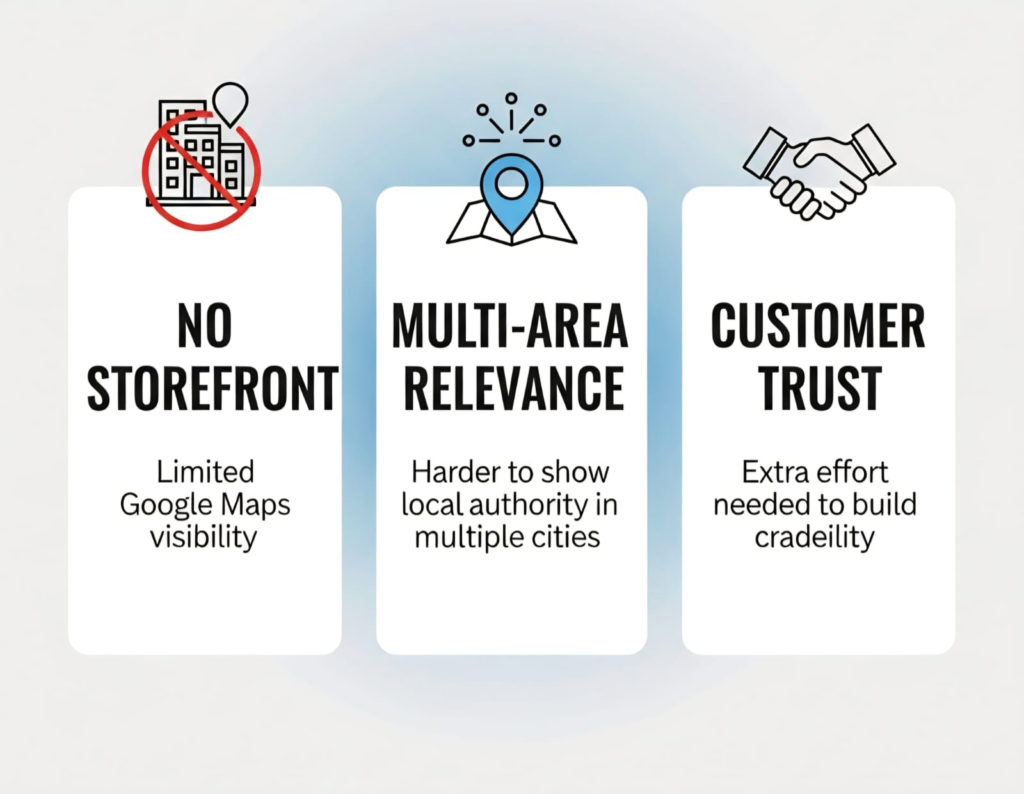
Unlike a restaurant, store, or clinic, service contractors don’t have a fixed location where customers visit. This creates three main challenges:
- No storefront for Google Maps visibility: Without a location, it’s harder to appear in the Local Pack, where map listings are front and center.
- Showing relevance in multiple areas: If you operate in five cities, you need to show Google that you’re trustworthy in all of them, not just the location of your business.
- Managing customer trust: Many customers still expect to “see” a business on the map. Service-only businesses need extra effort to build credibility with reviews, service area signals, and local content.
The Good News: Google doesn’t penalize service area businesses. But the path to visibility is different. Rather than pinning your hopes on passersby or walk-ins, you must:
- Establish defined service area limits within Google Business Profile
- Create content that reflects your local expertise
- Earn trust through reviews and authority-building in each market
Key Insight: The 2025–2026 local search environment has made structured signals more important than ever. Service area businesses that invest in schema markup, consistent NAP data, and location-specific pages now compete directly with and often outrank brick-and-mortar competitors in their service zones.
That’s why the rest of this blog focuses on how to overcome these hurdles with service area business SEO strategies customized for mobile service providers, contractors, and home service companies.
2. Google Business Profile for Service-Only Businesses
Your Google Business Profile is the foundation for ranking service area businesses. Even without physically being there, you can use GBP to indicate your service areas, establish credibility, and show up in local search.
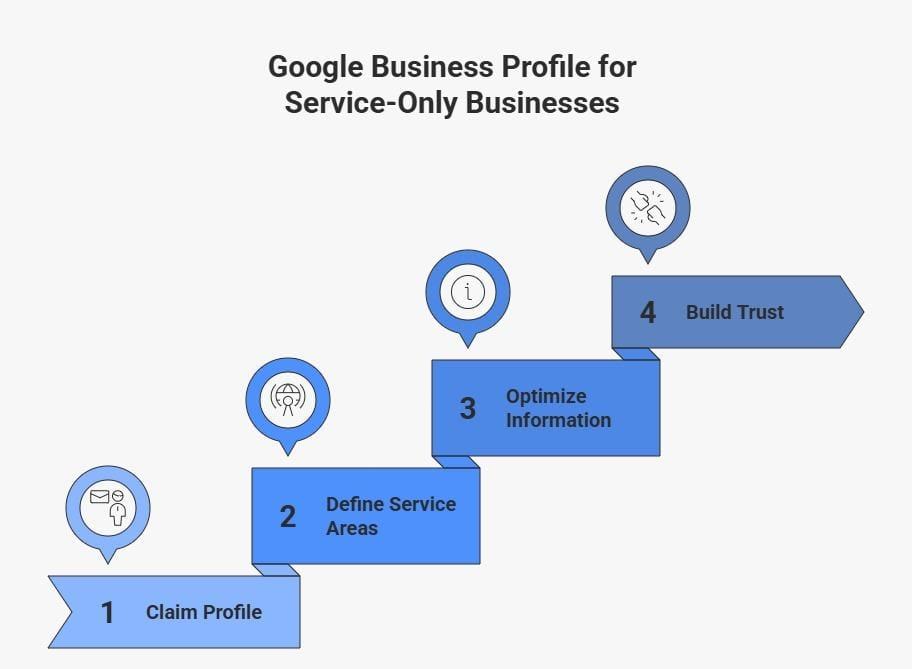
Step 1: Claim and Authenticate Your Profile
Begin with Google Business Profile verification. The ways to verify are mail, phone, or email. For service businesses alone, you must mask your home address so that you can have a private personal life but are still allowed to set service areas.
Step 2: Decide on Your Areas of Service
You can post the cities, regions, or ZIP codes that you serve in GBP. This informs Google precisely where your business is involved, which is important for showing up in local search results for each community.
Step 3: Optimizing Business Information
- Use an accurate business name and category
- Add complete business hours and services
- Include a concise, keyword-rich description (incorporate service area business SEO).
Step 4: Build Trust via Media and Reviews
Post images of your crew members, equipment, and previous projects to build credibility. Encourage customers to leave reviews, which help your local search visibility directly.
Pro Tip: In 2026, review velocity matters more than review volume. A steady flow of 5–10 genuine reviews per month signals active business management to Google. A burst of 50 reviews at once triggers spam filters.
3. Service Area Settings Optimization
If you have an online business without a physical store, your Google Business Profile service area settings are what make or break your visibility. This is where you tell Google exactly which cities, ZIP codes, or regions you service.
Best Practices for Service Area Optimization
- Be Specific but Realistic: List cities or ZIP codes where you actually serve customers.
- Avoid Overextending: Don’t add every city in your state. Stick to your true service areas.
- Match On-Site Content: Make sure your website mentions these areas, ideally with location-specific landing pages.
- Update When Expanding: If you start covering new regions, update your GBP right away.
This step is about showing Google you’re not “everywhere,” but you are the best choice in the areas you actually serve.
| Setting | Recommended Approach |
| Service area input | List specific cities and ZIP codes, not radius |
| Number of areas | Up to 20, prioritize your highest-volume markets |
| Area size | City or neighborhood level, not county or state |
| On-site match | Every GBP area should have a corresponding landing page |
| Update frequency | Immediately when coverage changes |
4. Creating Location Relevance Without a Storefront
One of the hardest aspects of operating a service area business is proving to Google (and shoppers) that you’re local in the absence of a physical shop or office. As you can’t depend on walk-in traffic or a physical storefront, you must establish relevance otherwise.
Why NAP Inconsistency Hurts Service Area Businesses
Real Impact: If your company name is ‘Dallas Fast Plumbing’ on your website but ‘Dallas Fast Plumbing LLC’ on Yelp and ‘DFW Plumbing’ on your Facebook page, Google sees three potentially different businesses. That confusion directly reduces your local map pack rankings.
NAP Best Practices for SABs
- Location-Specific Landing Pages
Create dedicated pages for your top service areas. Each should feature unique content, customer testimonials from that area, and service details tailored to local needs.
- Local Content Marketing
Local content marketing is all about publishing blogs about community events, seasonal service tips, or regional challenges. For example, a plumbing business might write about “Winterizing Pipes in Chicago” to show real geographic expertise.
- Citations and Directories
Make sure your business is listed (with accurate NAP information) on good local directories and service sites. Since you don’t have a store, these citations assist in validating your presence.
- Local Reviews
Encourage happy customers to mention their city or neighborhood in reviews. This helps tie your business to the service location in Google’s eyes.
- Backlinks From Local Sources
It’s best to partner with associations, charities, or blogs in your city and get inbound links to your city-specific pages.
Example Scenario
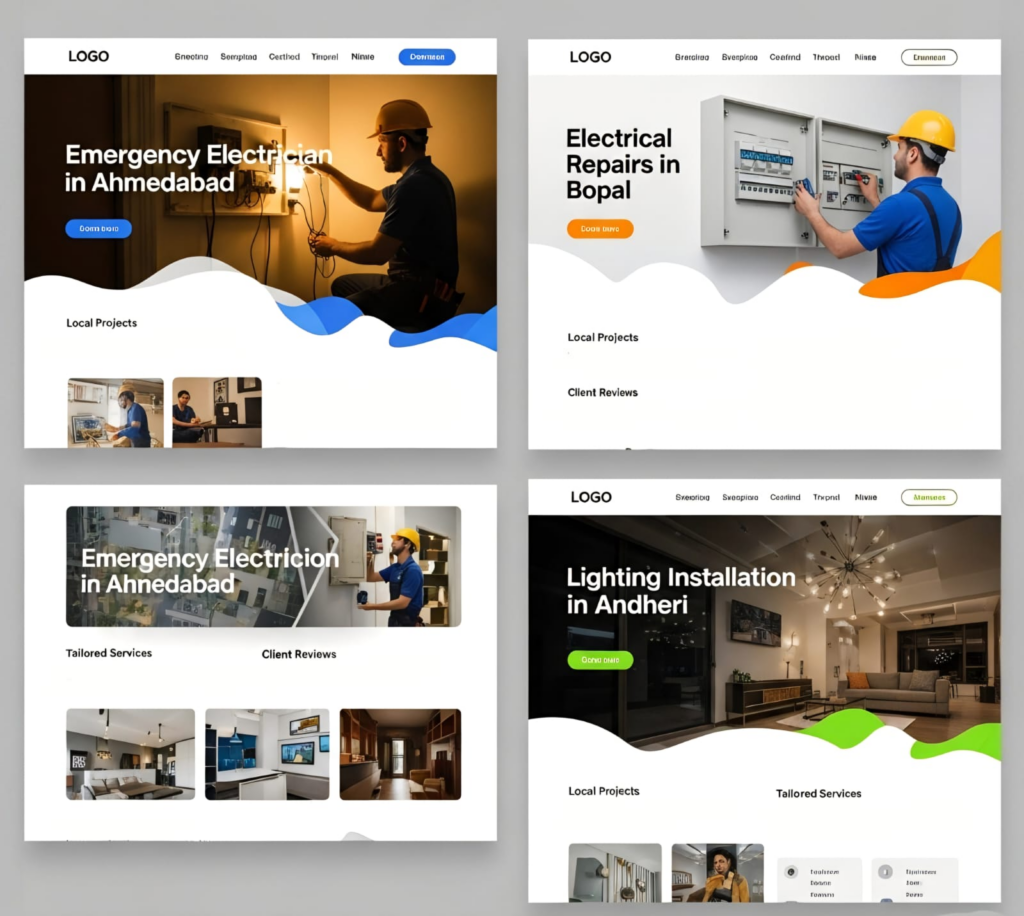
Imagine a mobile electrician covering three towns. Instead of one generic “Services” page, they publish:
- “Emergency Electrician in Ahmedabad”
- “Electrical Repairs in Bopal”
- “Lighting Installation in Andheri”
Each page highlights projects done locally, reviews from nearby clients, and clear service area coverage. This approach tells Google, “I’m relevant in each of these locations, not just floating around with no base.
5. Service-Specific Landing Page Strategies
For service area businesses, landing pages aren’t just a way to showcase offerings; they’re your biggest tool for ranking in multiple locations without a storefront. A well-structured page should do three things: explain the service clearly, prove your expertise, and tie it back to the area you serve.
Standard to Avoid: One generic ‘Services’ page listing all cities is not enough. Google cannot derive strong location relevance from a list. Each primary service area needs its own dedicated page with unique content.
What Every Service Area Landing Page Must Include
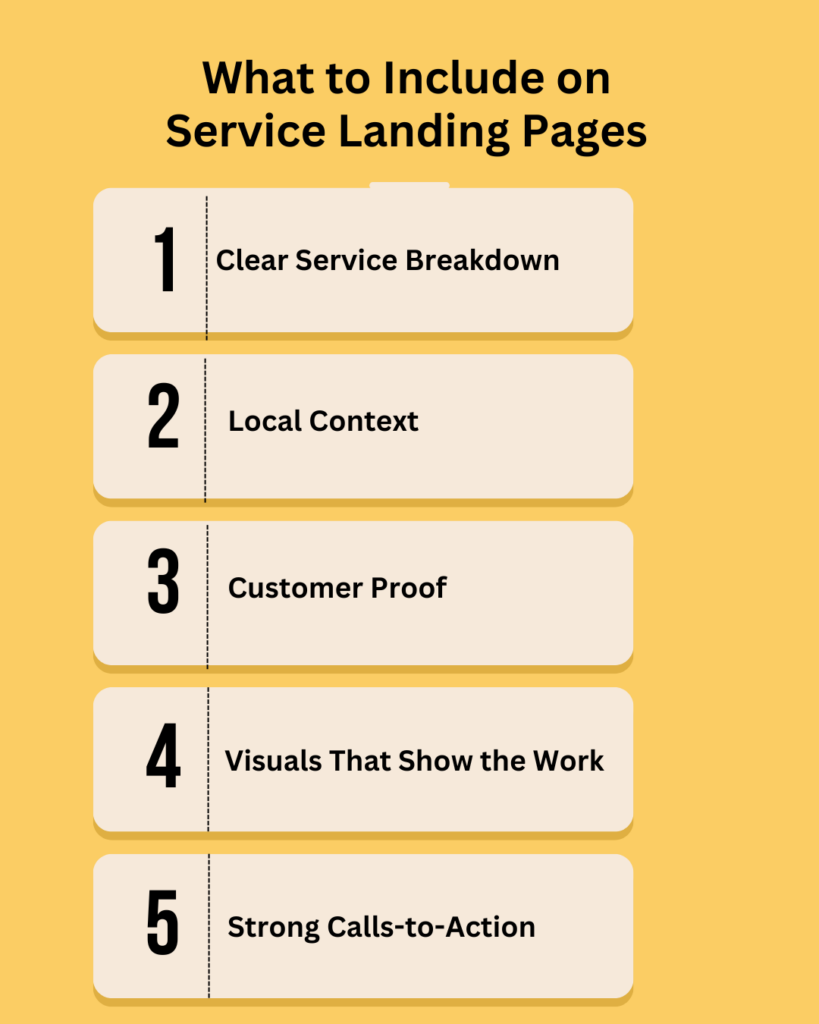
- Clear Service Breakdown
Don’t just say “Plumbing Services.” List out drain cleaning, water heater installation, leak detection, etc., so both users and search engines understand the full scope.
- Local Context
Add references to the city or neighborhood where you offer that service. Example: “AC repair in Downtown Austin apartments” vs. just “AC repair.”
- Customer Proof
Emphasize your local event contribution, sponsorships, or partnerships. If someone in a target area praises your work, highlight it here.
- Visuals That Show the Work
Images of your crew on the site, before and after photos, or brief explanation videos can be utilized to augment the page.
- Strong Calls-to-Action
Place CTAs mid-page like “Book Your Water Heater Repair Today” or “Schedule a Free Roofing Estimate in Denver.” These should feel natural and local.
Real Example: Plumbing Contractor Covering 3 Cities
| Page | What Makes It Unique |
| Emergency Plumber in Dallas, TX | References Dallas’s aging pipe infrastructure; testimonial from Oak Cliff resident |
| Drain Cleaning in Fort Worth, TX | Local hard water challenges: case study from Near Southside neighborhood |
| Water Heater Repair in Plano, TX | High-demand season content; quote from Plano homeowner; Plano-specific CTA |
Each page tells Google, ‘I’m not just floating around with no base. I’m the expert in this specific place. ‘That combination of geographic specificity, unique content, and local proof is what drives home service marketing results at scale.
On-Page SEO Checklist for Each Landing Page
• Page title: [Service] in [City, State]: 50-60 characters
• Meta description: Include primary keyword, city, and a clear benefit: 145-155 characters
• H1: City + Service combination: appears once
• H2s: Break content into scannable sections; include city name naturally in 2-3 H2s
• Internal links: Link to your main service page and GBP from each location page
• Image alt text: Include city and service description in all image alt tags
• URL structure: /dallas-plumber/ or /plumbing-dallas-tx/, clean and readable
6. Schema Markup for Service Area Businesses
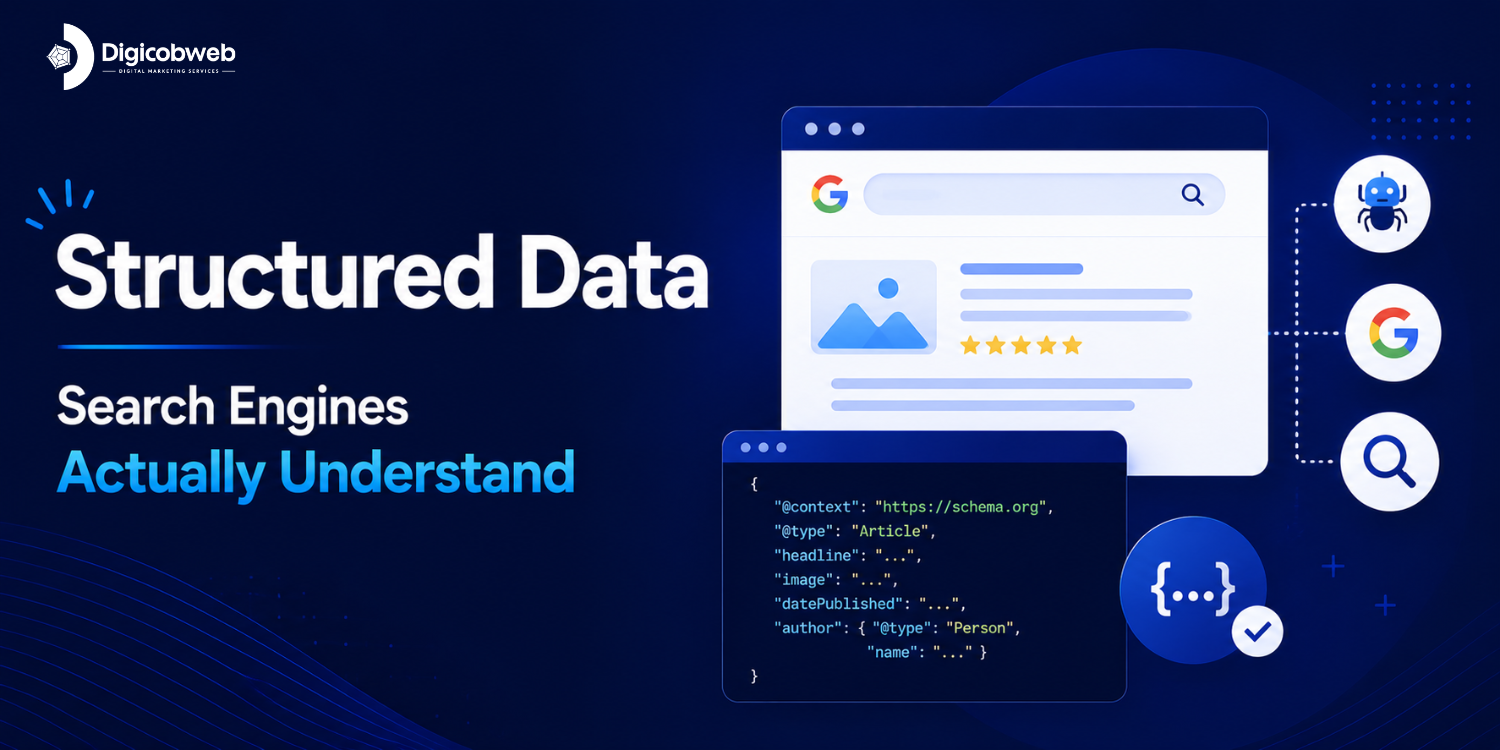
Schema markup is structured data code added to your website that tells search engines exactly what your business is, where it operates, what services it offers, and how customers can reach you. For service area businesses, it is the technical layer that transforms your service area pages from readable content into verified, machine-readable entities.
Why Schema Is Now Non-Negotiable: A 2025 Search Engine Land controlled experiment compared three identical pages; only the one with properly implemented JSON-LD schema appeared in a Google AI Overview. Pages without schema failed to rank for AI-generated answers entirely. In 2026, schema is the entry ticket to AI overview citations.
Types of Local Content That Work
| Schema Type | What It Does | Where to Add It |
| LocalBusiness | Defines your business name, phone, service area, hours | Homepage + Contact page |
| Service | Specifies each individual service you offer | Each service landing page |
| FAQ Page | Marks up Q&A content for AI Overview extraction | FAQ sections on landing pages |
| Review | Highlights customer reviews and star ratings | Pages with testimonials |
| GeoCoordinates | Provides precise lat/long of your service base | LocalBusiness schema block |
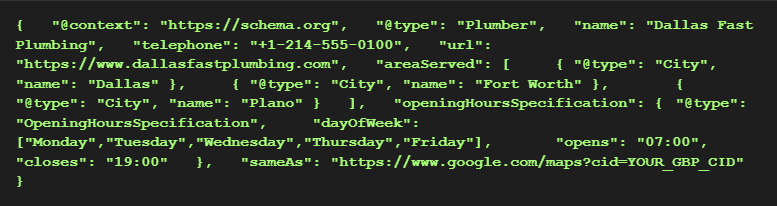
Sample JSON-LD for a Service Area Business
Add this to your homepage <head> or service area pages. Replace the placeholder values with your actual business data:
Schema Best Practices for SABs
• Use the most specific subtype available: plumber, HVAC business, electrician, or landscaping, not the generic local business if a more specific type exists.
• NAP in your schema must exactly match your GBP, not be similar; it must be exactly identical. Even ‘Street’ vs. ‘St.’ creates a discrepancy Google may penalize.
• Add a unique LocalBusiness schema block to each service area landing page with that city’s specific data.
• Validate using Google’s Rich Results Test (search.google.com/test/rich-results) after implementation.
Update your schema within 48 hours of any change to your hours, phone number, or services.
7. Local Content Strategy for Service Areas
Location-specific landing pages target direct service keywords like ‘plumber in Phoenix.’ But local content blog posts, guides, and case studies tied to your service areas build the broader topical authority that helps all your pages rank stronger over time.
Types of Local Content That Work for Service Businesses
Area Guides and Seasonal Tips
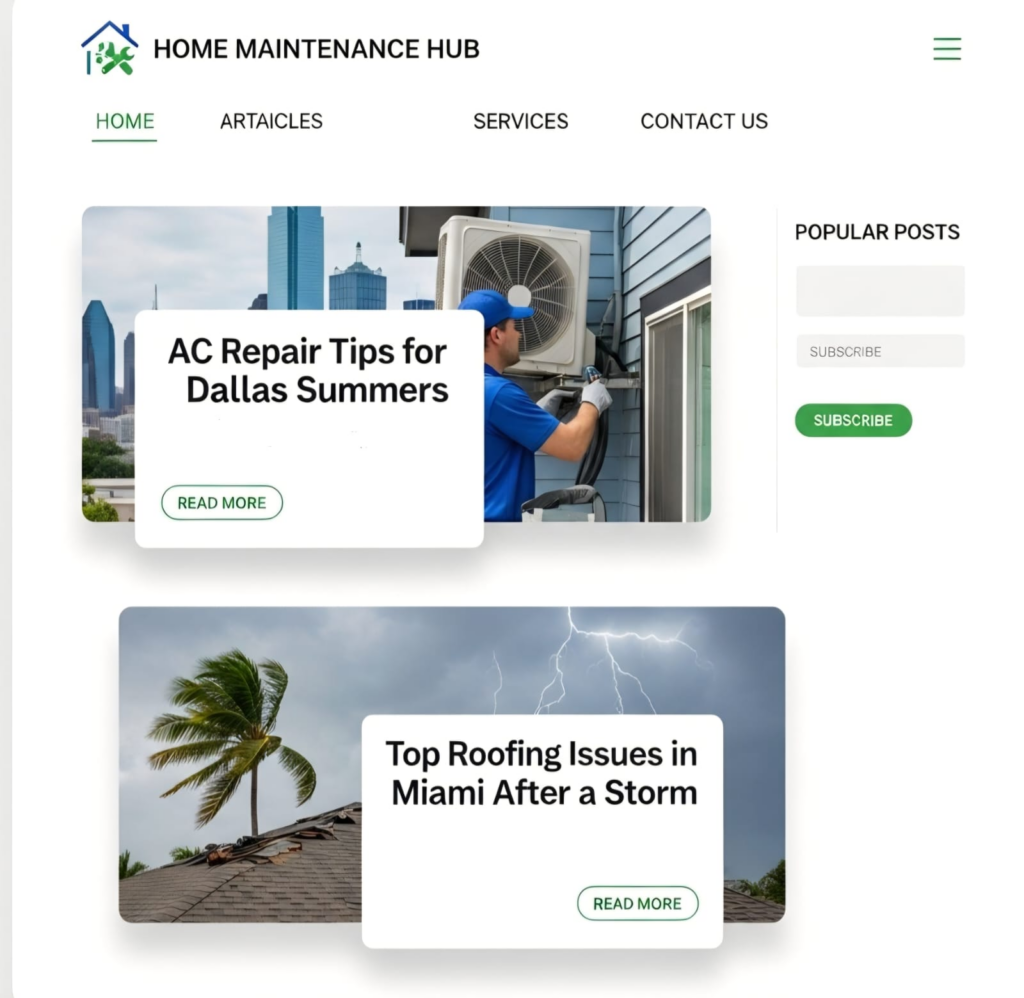
Write content that connects your service to local conditions. An HVAC company can publish ‘How to Prepare Your Phoenix Home for 110-Degree Summer Heat.’ A plumber can write ‘Why Chicago Homes Experience Frozen Pipes Every Winter.’ This type of content ranks for longtail local keywords and demonstrates genuine geographic expertise.
Localized Service Tips
Share advice tied to local conditions that only someone operating in that area would know. A pest control contractor covering Florida’s Gulf Coast can publish ‘Managing Termites in Florida’s Year-Round Humid Climate’ content that resonates with local searchers and signals real local presence to Google.
Case Studies by Service Area
Document real jobs done in specific cities with the homeowner’s permission. A before-and-after story from a specific Dallas neighborhood or a roofing repair in a named Chicago suburb creates natural geographic keyword opportunities and proves you actually work in those locations.
Community Involvement
Any involvement with local organizations, sponsorships, charity builds, or community events is worth documenting in a blog post. Beyond the credibility signal, these posts often earn natural backlinks from the organizations you work with.
Content Frequency: For contractor local SEO, aim for 2-4 service-area-focused blog posts per month. Consistency signals to Google that your site is actively covering your service zones, not just holding static landing pages.
Local Content Examples by Service Type
| Service Type | Example Local Content Topic |
| Plumbing | ‘How Phoenix’s Hard Water Damages Your Pipes And How to Fix It’ |
| HVAC | ‘Preparing Your Dallas Home’s AC Before Texas Summer Begins’ |
| Roofing | ‘How to Assess Storm Damage on Chicago Roofs After a Hail Event’ |
| Pest Control | ‘Termite Season in Houston: When to Call and What to Expect’ |
| Landscaping | ‘Spring Lawn Prep Guide for Denver’s Short Growing Season’ |
| Electrical | ‘Understanding Older Wiring in Fort Worth’s Historic Neighborhoods’ |
8. Building Authority in Your Service Locations
For home service marketing to succeed at scale, your business needs more than optimized pages; it needs a network of trust signals that connect your brand to each area you serve. Authority comes from reviews, partnerships, local media, and the consistency of your presence across platforms.
Key Authority-Building Tactics for Service Area Businesses
Geo-Specific Reviews
Reviews are now a primary local ranking signal, not a tiebreaker. When customers leave reviews mentioning their city or neighborhood, it creates a direct geographic relevance signal for that location. Make review requests a systematic part of your post-job process. Use a short email or SMS sent 3–5 days after service completion with a direct link to your Google review form.
Local Partnerships and Sponsorships
Partnering with local organizations, sponsoring a youth sports team, collaborating with neighborhood associations, or working with regional suppliers creates natural trust signals and, in many cases, links opportunities back to your service area pages.
Local Media and Podcast Mentions
A contractor mentioned in a regional newspaper, local news site, or industry podcast immediately gains credibility signals that competitors without that coverage lack. If you get featured, post it on your site and link to it from your relevant service area pages.
Backlinks from Local Sources
Earn inbound links specifically to your city-level pages. Partners, suppliers, local business associations, and community organizations are the right targets. A single link from a local chamber of commerce site or a regional contractor association carries strong location relevance for map rankings.
Authority Compound Effect: When reviews, citations, local links, and media mentions all point to the same business name, phone, and service areas consistently, Google builds stronger confidence in your local entity. This confidence directly improves how often you appear in the Local Pack across your service zones.
9. Mobile Optimization for Local Service Search
Local searches are 90% mobile. When someone’s pipe is leaking or their AC stops working, they search on their phone. If your service area pages load slowly or are difficult to navigate on mobile, you lose those leads before they ever contact you and poor mobile performance is now a direct ranking signal.
Mobile Essentials for Service Area Businesses
• Page speed: Aim for under a 3-second load time on mobile. Use Google PageSpeed Insights to audit your landing pages.
• Click-to-call: Your phone number should be a tappable link on every page, especially service area landing pages. Place it above the fold.
• Simple navigation: Avoid heavy menus or popups on mobile. Users searching for emergency services need to find your contact in seconds.
• Core Web Vitals: Google’s LCP (Largest Contentful Paint), CLS (Cumulative Layout Shift), and INP (Interaction to Next Paint) scores directly affect local rankings. Monitor these in Google Search Console.
• Mobile-optimized forms: If you use a contact or quote form, test it on multiple devices. A broken form on mobile is a lost booking.
Quick Win: Add a sticky click-to-call button at the bottom of every service area landing page. For home service marketing, phone calls are the primary conversion action making it effortless to call from mobile directly increases bookings.
10. Tracking Performance Across Service Areas
Serving multiple locations means you can’t just look at traffic or leads as one big number. You have to know what is succeeding in each town, city, or neighborhood you are covering. Otherwise, you could be throwing money, doubling up in one place, and missing out somewhere else.
Metrics to Monitor
| Metric | What It Tells You | Tool |
| Local keyword rankings | Where you rank for ‘[service] in [city]’ queries | Ahrefs / Semrush / Local Falcon |
| GBP Insights (calls, clicks) | Which service areas drive the most customer contact | Google Business Profile |
| Landing page traffic + conversions | Which location pages generate leads | Google Analytics 4 |
| Call tracking by area | Which city pages drive the most phone bookings | CallRail / WhatConverts |
| Review distribution | Which areas have review gaps | Google / Semrush |
| Citation consistency score | NAP accuracy across all directories | BrightLocal / Moz Local |
| Core Web Vitals by page | Mobile performance of each landing page | Google Search Console |
Review Distribution Check
If the vast majority of your reviews reference one city, and your GBP covers five service areas, the other four locations have weak geographic relevance. Actively solicit reviews from customers in underrepresented areas by routing them to the correct city-specific review link or a platform that captures location context.
Conclusion
For service area businesses, not having a storefront doesn’t mean you can’t play in local search. It simply requires a different approach to service area business SEO. With the optimization of your Google Business Profile, strategically defining service area locations, constructing service-specific landing pages, and developing local content that indicates relevance, you can build solid visibility even in the absence of a physical office.
Consistency is the secret. Whether your business is in plumbing, HVAC, landscaping, or some other type of home service, you will succeed based on how well you map digital signals to actual service areas. Good reviews, location-based content, and authority within your service areas keep you ranking where it matters most: where your customers are.
If you want to move your career to the next level of home service marketing, begin with the essentials presented here and then adjust according to performance reports from each service location. With time, these tactics make your contractor’s local SEO more predictable and profitable, as it ensures that you don’t only appear in search but, indeed, gain customers in every area you’re operating in.