Introduction
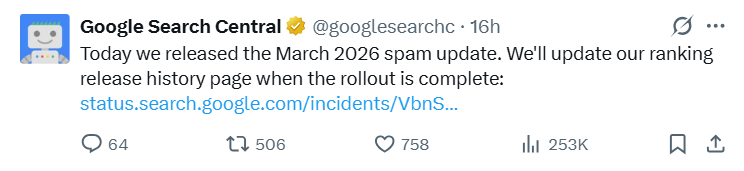
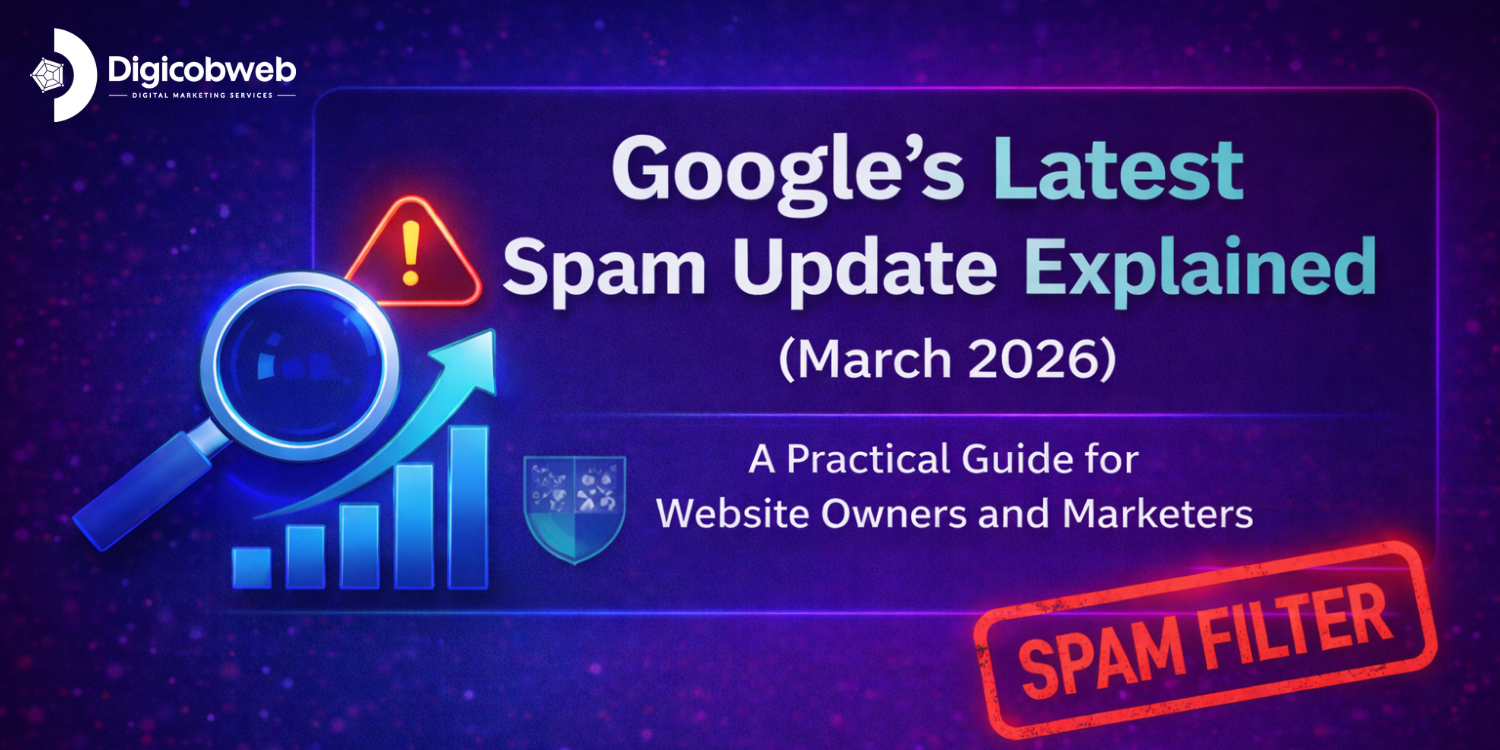
The Google March 2026 spam update began rolling out on March 24, 2026. It caught plenty of site owners off guard. Google confirmed the rollout on its Search Status Dashboard and said it would take about one to two weeks to finish. If your traffic fell hard in mid-March, this update is a strong suspect.
In summary: this wasn’t a small adjustment. It aimed at a broader set of manipulative tactics than earlier spam updates. Sites built on scaled content abuse, link schemes, and cloaking saw rankings drop fast.
In this guide, you’ll see what changed, who got hit, how to tell whether your site was affected, and what to do next. You’ll also see how this update fits alongside earlier spam and core updates. Affiliate site? e-commerce store? Local business? The playbook still matters to you.
Let’s get into it.
What Happened With Google in March 2026 Spam Update
Google announced the March 2026 spam update on its official Google Search Central blog on March 24, 2026. The company said the update targeted “spammy practices that degrade the quality of search results for users.” Google completed the rollout on March 24, 2026. That gave it ~19.5 hours.
During that window, rankings got shaky across almost every vertical. Semrush Sensor and Moz both showed turbulence well above normal.
Google also linked the rollout to SpamBrain, its AI-driven spam detection system. That system looks for spammy content and spammy links at scale. In March 2026, Google widened what SpamBrain could spot, especially AI-generated spam and manipulative link networks.
What Is a Google Spam Update, Exactly?
A Google spam update is an algorithm change built to catch sites that break Google’s spam policies. Those policies cover keyword stuffing, hidden text, link manipulation, cloaking, scraped content, and more.
Think about it this way. Core updates reassess quality. Spam updates punish rule-breaking. Both can move rankings, but they do it for different reasons.
Here’s why this matters: if a core update hit your site, content quality is usually the issue. If a spam update hit your site, policy violations are the likely problem. The recovery path changes completely.
Google usually releases one to three spam updates each year. In 2025, Google shipped one major spam update in August. Then came this March 2026 update less than seven months later. That pace tells you something. Google cares more about spam, especially AI spam, than ever.
How the Google March 2026 Spam Update Differs From Core Updates
A lot of site owners mix up spam updates and core updates. That mistake leads to bad fixes and wasted time. The table below clears that up.
| Feature | Spam Update | Core Update |
| Purpose | Catch policy violations | Re-evaluate content quality |
| System | SpamBrain (AI-based) | Broad ranking systems |
| Impact | Penalty or deindexing | Ranking shifts (up or down) |
| Recovery | Fix violations, then wait | Improve content quality, then wait |
| Manual actions | Sometimes issued | Rarely issued |
| Rollout time | 1-2 weeks | 2-4 weeks |
So your first job after a ranking drop is simple. Figure out which update caused it. Check the Google Search Status Dashboard first. Then compare your traffic pattern with community trackers like the Search Engine Journal Google algorithm update tracker. That tells you whether you’re dealing with spam, quality, or both.
And yes, sometimes both hit at once. Google has rolled out core and spam updates within weeks of each other before. It happened in late 2023. It happened again in early 2025. Dates matter.
What Google Specifically Targeted This Time
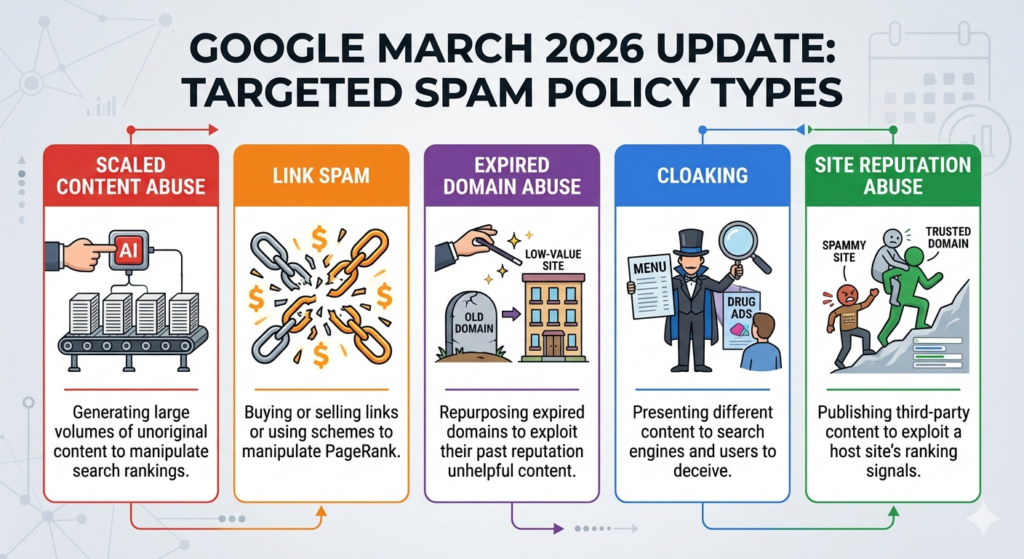
The March 2026 spam update widened enforcement across several policy areas. Search Engine Journal, Amsive, and independent SEO analysts pointed to the same core targets.
1. Scaled Content Abuse
Google went after sites pushing out hundreds or thousands of AI-written pages with little or no editorial review. That includes programmatic SEO pages, auto-built location pages, product roundups, and how-to articles published without human oversight.
For example, several coupon aggregator sites lost more than 80% of indexed pages during the first week. Most of those pages were near duplicates. Only the city name changed.
2. Link Spam and Manipulative Link Networks
SpamBrain’s link graph analysis got a major boost. Private blog networks that survived earlier updates got hit much harder this time. Google also zeroed in on “link insertion” deals, where site owners sell contextual links inside existing pages.
3. Expired Domain Abuse
Sites built on expired domains only to inherit backlinks got flagged more often. Google now seems better at tracking domain history changes. If you bought a former cooking blog and turned it into a casino affiliate site, expect trouble.
4. Cloaking and Sneaky Redirects
Sites showing Googlebot one version and users another version took immediate hits. That includes JavaScript redirects that send mobile visitors to affiliate offers while search crawlers see informational copy.
5. Site Reputation Abuse (Parasite SEO)
Google addressed this in November 2024 with a policy update. Enforcement still got tougher in March 2026. Big publishers hosting third-party content sections, like coupon hubs or outsourced review areas, saw those sections lose visibility.
Who will get affected the most? Impact by Site Type
Not every site felt the impact the same way. The Google March 2026 spam update hit some business models harder than others. Here’s the early pattern from SEO tool data and community reports.
1. Affiliate Sites
Thin affiliate sites took the biggest hit, especially in finance, health supplements, and VPN. Sites with auto-generated comparisons and no original testing lost the most ground. Meanwhile, affiliate sites with real hands-on reviews and clear methodology often held up better.
2. Local SEO Sites
Businesses using doorway pages saw major drops. That includes dozens of city pages with nearly identical copy. Legitimate local businesses with unique, location-specific content were mostly fine.
3. eCommerce Sites
Large stores with product descriptions copied from manufacturers lost visibility on category and product pages. Stores with original descriptions and authentic customer reviews kept their positions much better.
4. Publishers and Media Sites
Major publishers that ran third-party “parasite” sections took hits on those areas. Their core editorial sections usually stayed intact. Forbes Advisor and other large publishers that cleaned up third-party content in 2025 avoided the worst outcomes.
5. SaaS and Tech Sites
SaaS companies that relied on aggressive guest posting and PBN-based link building saw drops on money pages. Content-led SaaS blogs with natural backlink profiles mostly stayed stable.
How to Check if the March 2026 Spam Update Hit Your Site
Before you panic, get the data. Follow these steps to confirm whether your site got hit.
Step 1: Check Google Search Console
Log into Google Search Console. Open the performance report. Set the date range from last 28 days. Look for a step drop in clicks and impressions starting around March 24 to March 30.
Also check the Manual Actions report under Security & Manual Actions. If Google found a specific violation, you’ll see it there. Not every spam hit triggers a manual action. Many happen automatically, with no warning at all.
Step 2: Compare Against the Update Timeline
Map your traffic data against the confirmed March 6-19 rollout. If your drop started before March 6, another update or technical issue may be behind it. If the slide started around March 8-12 and kept going through mid-March, the spam update is the leading suspect.
Step 3: Analyze Which Pages Lost Rankings
In GSC, open the Pages tab and sort by change in clicks. Look at the URLs that lost the most traffic. Then inspect those pages closely. Are they thin? Stuffed with keywords? Hiding links? Scraping text from elsewhere?
Step 4: Check Your Backlink Profile
Use Ahrefs, Semrush, or Moz to audit your links. Look for weird spikes in referring domains from PBNs, link farms, or unrelated foreign-language sites. SpamBrain’s upgraded link analysis means old schemes may now trigger penalties.
Step 5: Review Server Logs
Check your logs for changes in Googlebot crawl behavior. If crawl frequency dropped sharply after March 6, Google may have deprioritized or started deindexing parts of your site. Screaming Frog Log Analyzer and Oncrawl both make this easier.
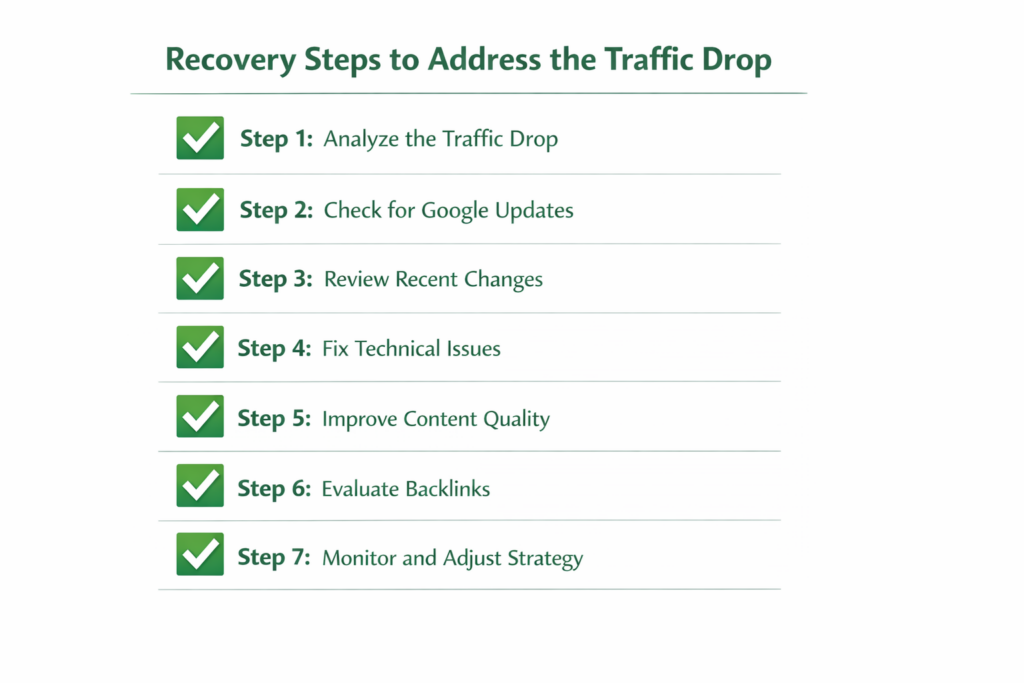
Recovery Checklist: What to Do Right Now
If the Google March 2026 spam update hit your site, move quickly. Recovery is possible. But it starts with an honest audit and real fixes.
1. Audit Your Content for Spam Policy Violations
Review every page that lost rankings. Look for:
- Keyword stuffing
- Hidden text or links
- Auto-generated content with no real value
- Scraped or copied content
- Doorway pages aimed at city or state variations
Remove those pages or rewrite them heavily if they violate policy.
2. Clean Up Your Link Profile
Find toxic backlinks and disavow them. Google says the disavow tool matters less than it used to, but large-scale link spam is still a strong use case. Build a disavow file and submit it to GSC.
Also, stop any live link-building that relies on paid placements, PBNs, or exchanges. Those tactics carry far more risk now than they did five years ago.
3. Consolidate Thin and Duplicate Content
If you have 50 pages covering slight variations of the same idea, merge them into one strong page. Then use 301 redirects to send the old URLs to the new one. That cuts down thin content and concentrates authority.
4. Add E-E-A-T Signals
Strengthen your experience, expertise, authoritativeness, and trustworthiness signals. Add author bios with real credentials. Include original research, case studies, or first-hand testing. Link to trusted sources. Show contact details and business information clearly.
5. Fix Technical Issues
Check for cloaking, sneaky redirects, or rendering problems that show Google one version and users another. Run the page through Google’s URL Inspection tool and compare the rendered HTML with what a visitor sees in a browser.
6. Submit a Reconsideration Request (If Manual Action Exists)
If GSC shows a manual action, fix every issue Google listed. Document the changes. Then submit a reconsideration request. Google usually reviews these within two to four weeks.
7. Wait Patiently
Algorithmic spam penalties often don’t lift until Google rolls out another spam update. For the March 2026 update, that may mean waiting until mid-2026 or later. In the meantime, keep improving the site. There’s no shortcut here.
Recovery Timeline: What to Expect
One of the hardest parts of a spam update recovery is the timeline. Let me be clear about expectations.
- Short-term (1-4 weeks): After you fix violations, you may see small gains as Google recrawls updated pages. Don’t expect full recovery yet.
- Medium-term (1-3 months): If your changes are broad and Google accepts them, rankings may improve gradually. The result depends on how deep the penalty ran and how many pages got hit.
- Long-term (3-6+ months): Full recovery from an algorithmic spam penalty often waits for the next spam update cycle. Google needs a fresh pass to reassess your site against newer spam models. Until then, partial recovery is usually the best-case scenario.
For comparison, many sites hit by the October 2023 spam update didn’t recover fully until the June 2024 spam update. That was about eight months later. So set expectations realistically and keep building value during the wait.
How This Compares to Previous Google Spam Updates
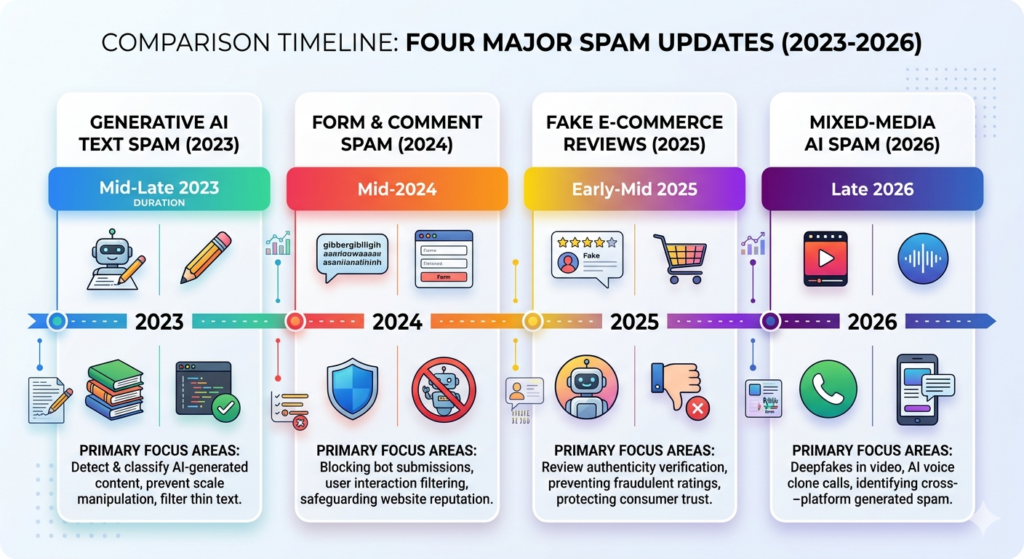
The latest Google algorithm update history shows a clear trend: spam enforcement keeps getting stricter. Here’s how the March 2026 spam update stacks up against recent updates.
| Update | Date | Duration | Primary Focus |
| October 2023 Spam Update | Oct 4-20, 2023 | 16 days | Cloaking, hacked content, auto-generated spam |
| March 2024 Core + Spam | Mar 5 – Apr 20, 2024 | 47 days | Scaled abuse, expired domains, site reputation |
| August 2025 Spam Update | Aug 26 – Sept 21, 2025 | 26 days | Link spam, AI content farms |
| March 2026 Spam + Update | Mar 24 – 25, 2026 | 19.5 hours | All categories, expanded SpamBrain |
The pattern is obvious. Every update covers more ground than the last. Google keeps feeding more data into SpamBrain and its machine learning systems, so old tactics age badly. What worked six months ago may already be dead.
What Is SpamBrain and Why Does It Matter?
SpamBrain is Google’s AI-based spam detection system. Google first announced it in 2018. It looks for spammy content and spammy links by studying patterns across billions of web pages.
Think of SpamBrain as a filter that keeps learning. It scans content patterns, link graph anomalies, and behavior signals to spot manipulation. Each spam update gives Google fresh data and better models. That widens what SpamBrain can catch.
For March 2026, Google gave SpamBrain its biggest upgrade yet. Specifically, it got better at spotting AI content farms, advanced cloaking, and layered link schemes that had slipped through before.
The takeaway is simple. If your SEO depends on manipulation, SpamBrain will catch up. The gap between “this works” and “this got penalized” keeps shrinking.
Practical Audit Framework for Your Site
Want to get ahead of the next update? Start auditing now. Here’s a framework you can use to spot spam risks before they turn into a traffic problem.
1. Content Audit:
- Flag any page under 300 words with no unique value
- Find pages generated at scale without human editing
- Check target terms with a density above 2.5%
- Review all auto-generated meta descriptions and title tags
2. Link Audit:
- Export your full backlink profile from Ahrefs or Semrush
- Flag domains with spam scores above 30%
- Identify links you bought, traded for, or placed through PBNs
- Review anchor text for over-optimization
3. Technical Audit:
- Test cloaking by comparing Googlebot-rendered pages with user-visible pages
- Confirm that redirects stay transparent, with no sneaky conditional jumps
- Check for hacked content using Google Search Console, server logs, and a crawl tool like Screaming Frog
- Verify that canonical tags point to the right URL
4. Brand Trust Audit:
- Make sure author bios are real and current
- Add contact details, address info, and support links
- Show original images, testing, or product proof where possible
- Remove anything that looks mass-produced or deceptive
5. Content Refresh Audit:
- Update pages that haven’t changed in 12 months
- Merge overlapping posts that compete with each other
- Add fresh examples, screenshots, or data points
- Replace generic filler with actual experience
What does this tell us? You don’t need a giant site overhaul to get safer. You need cleaner pages, cleaner links, and a clearer trust signal.
Final Thoughts
The March 2026 spam update made one thing clear. Google is still tightening the screws on manipulation, and it’s doing it faster than before.
If your site lost traffic, don’t guess. Check the dates. Review each affected page carefully. Inspect all your links. Then fix the real problem. You can recover, but only if you stop repeating the same patterns that caused the drop.
Focus on content people actually want. Clean up risky links. Remove thin pages. Show real expertise. If you do that, you’ll put your site in a much better position for the next rollout.
And yes, the next rollout will come.
Ready to audit your site? Start with Search Console, then move through the recovery checklist above. Your rankings won’t fix themselves.