

⚡ Quick Answer
Keyword research is the process of finding and analyzing the search terms your target audience types into Google. Done right, it tells you which topics to create content for, how competitive each term is, and whether you can realistically rank for it. The 7-step process: find keyword ideas → evaluate metrics → identify search intent → analyze SERP → select primary keyword → find secondary keywords → target long-tail variations.
Introduction
📊 96.55% of Content Gets No Traffic From Google
Ahrefs Keyword Research Study
That one number should change how you think about content. Most keywords are a dead end before you even start writing. The difference between content that ranks and content that disappears is not writing quality or publishing frequency. It comes down to keyword research done properly.
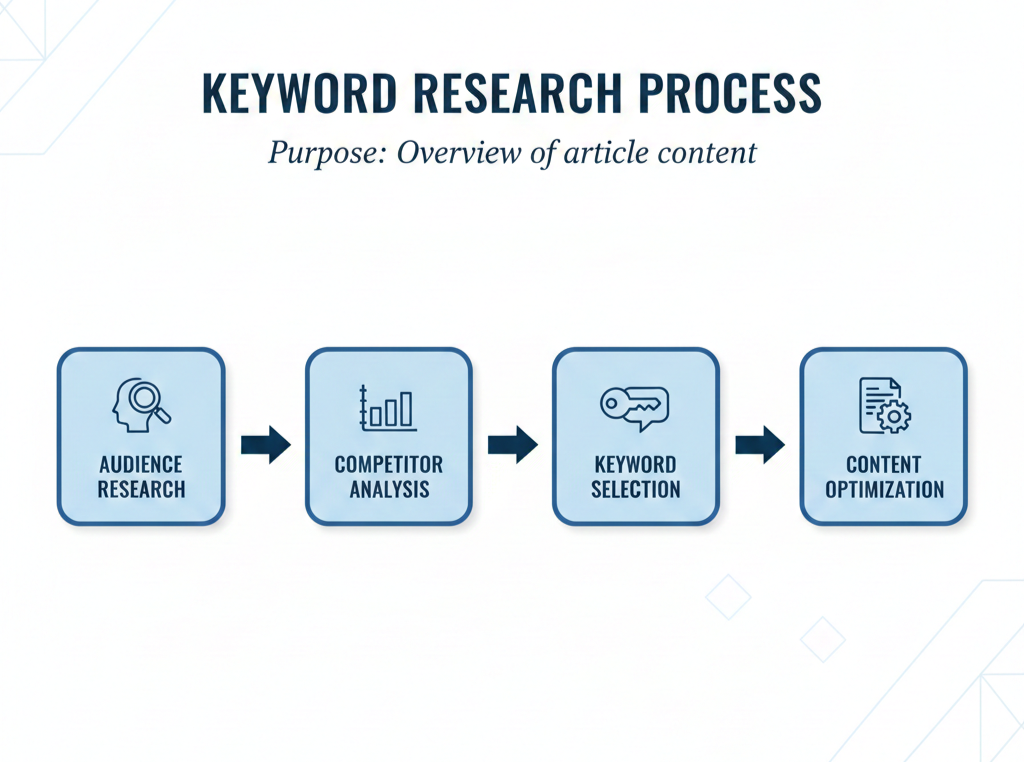
Finding the right keywords shapes everything you do in SEO. Good choices bring the right visitors. Poor choices leave your content buried. Simple as that.
Once you understand SEO keyword research step by step, you gain control. If you’re completely new to search, our SEO guide for beginners is a good place to start. You know which ones you can realistically compete for. And you stop writing content that doesn’t stand a chance.
📋 Key Takeaways
• Keyword research is a 7-step structured process, not guesswork
• Search volume alone means nothing without evaluating difficulty and intent
• Long-tail keywords often convert better than high-volume head terms
• In 2026, Google’s AI Overviews and zero-click searches change how you measure keyword value
• The right tools, used together, reveal opportunities your competitors are missing
How to Do SEO Keyword Research?
Choosing the right keywords comes down to understanding what your audience wants, what you can realistically rank for, and how each keyword supports your content goals. When you approach it with structure, the process becomes a lot easier to manage. You look at intent, competition, search patterns, and the language people actually use. That’s how you avoid bad choices and stay focused on terms that deliver results.
Here’s the step-by-step process that keeps everything clear and measurable.
Step 1: Find Relevant Keyword Ideas
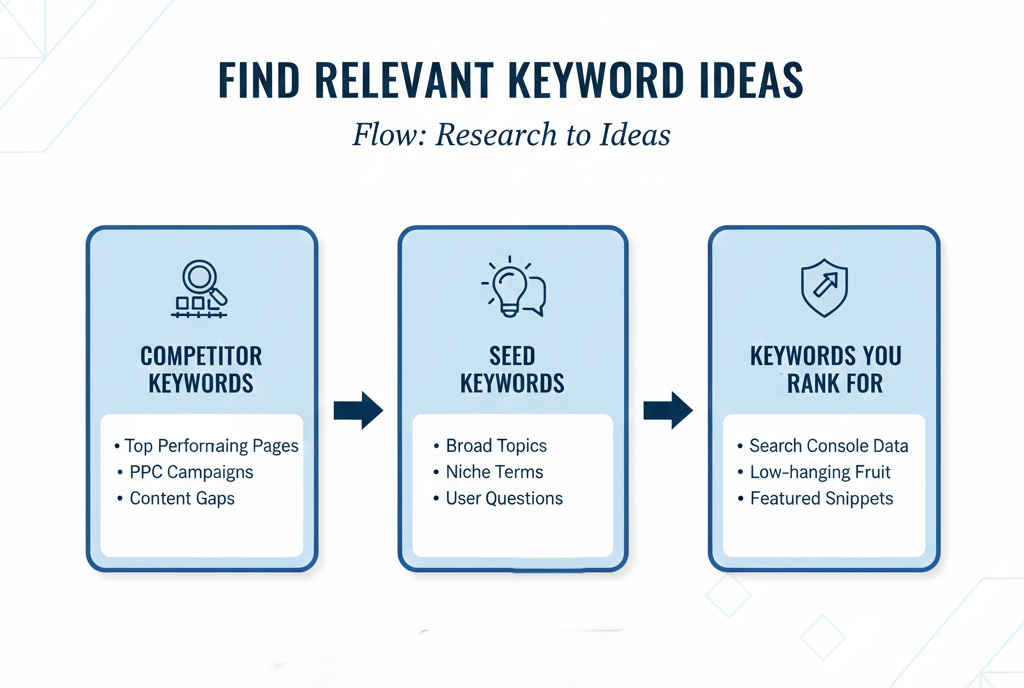
1. Finding Your Competitor’s Keywords
Competitors already did a lot of the research for you. They’ve ranked for keywords, tested topics, and shown you which queries attract traffic. Your job is to study that landscape and spot openings.
- Start with competitors who consistently appear in your search results.
- Enter their domains into keyword tools to see which keywords drive their traffic.
- Look at the keywords where they rank in positions 5–15; those are easier to challenge than the top 3
- Pay attention to the topics they cover repeatedly, because that signals high demand.
- Check the gaps too. Missing topics show you where you can step in and create stronger content.
Competitor keyword analysis saves time and helps you avoid blind spots.
2. Finding Keywords Using a Seed Keyword
A seed keyword is your starting point. It’s a basic phrase tied to your niche. From that one phrase, you can branch out into hundreds of search variations.
- Pick simple seed terms like “skin care routine,” “digital marketing,” or “home workout.”
- Enter them into a keyword tool and study the related searches.
- Look at questions, comparisons, and long-tail variations that appear repeatedly.
- Notice how people phrase their searches. Those patterns tell you what users actually want.
- Group the results by topic so you can build content clusters later.
This step expands your keyword pool fast and gives you a clear direction.
3. Find Keywords You Already Rank For
You’re probably ranking for dozens of keywords without realizing it. That’s a huge advantage Google already sees your site as relevant for those topics.
- Check Google Search Console for queries where you appear on pages 2–4.
- Look for keywords with decent impressions but weak clicks.
- Identify pages that almost rank well but need stronger optimization.
- Strengthen those pages first with better content, internal links, and clearer intent alignment.
- Expand those topics with related secondary keywords or follow-up content.
Step 2: Evaluate Keyword Metrics
1. Search Volume
Search volume shows how many people search for a keyword each month. But the number alone tells you very little. A keyword pulling 10,000 searches means nothing if 80% of those clicks go to one dominant brand.
- A steady search pattern, not random spikes.
- A volume that matches your site’s current strength.
- A keyword that fits your content goal, not just your curiosity.
- Topics that consistently attract the type of visitor you want.
💡 Insight:
Keywords with 100–1,000 monthly searches often deliver better conversion rates than high-volume terms. Focused intent beats broad reach every time.
Keywords with a level of volume frequently yield better real conversion rates than very high-volume ones since they draw individuals who have a clear purpose.
2. Keyword Difficulty
When checking difficulty, pay attention to:
- The authority of the sites already ranking a page 1 full of DA 70+ sites is a warning sign
- The depth of content in the top results: are you looking at 500-word posts or 5,000-word guides?
- The backlink strength of those pages
- Whether Google favors big brands or niche-specific sites for this query.
If the top results look unbeatable, shift to a longer or more specific variation. Those variations often rank faster and bring more qualified traffic.
Step 3: Identify Search Intent
Matching keyword intent to content format increases your chances of ranking.
Below are the four core intent types you must look for when choosing keywords.
1. Navigational Intent
Individuals with purpose are already aware of their intended destination. Users enter brand names, tool names, or website names in an attempt to navigate to a page.
Examples:
- “Canva login.”
- “Gmail sign-in”
| Note: Navigational keywords are generally not worth targeting in content marketing unless the brand being searched is yours. Focus your efforts on the other three intent types. |
2. Informational Intent
Users want answers; they’re trying to learn something, understand a topic, or solve a problem. This is the primary intent type for blog content.
Examples:
- “How to do keyword research?”
- “What is keyword research?”
- “Why is SEO important?”
3. Commercial Intent
People here are comparing options before making a decision. They’re close to buying, but still evaluating choices. This is one of the strongest types of intent for business-driven content.
Examples:
- “best free keyword research tools”
- “seo tools comparison”
- “top email marketing software”
These keywords fit list posts, comparisons, and reviews.
4. Transactional Intent
This intent means the user is ready to take action. They want to buy, subscribe, download, book, or sign up.
Examples:
- “buy hosting plan”
- “purchase marketing software”
These keywords belong on product pages, sales pages, or service pages.
Step 4: Analyse SERP
1. Review the Page Types That Rank
Open the keyword in an incognito window and study what Google is showing.
Ask yourself:
- Are they long guides or short answers?
- Is the search dominated by blogs or big brand domains?
- Are there product pages, YouTube videos, or local results taking up space?
This helps you understand how your page should be structured.
2. Check the Content Angle
Every ranking page follows a specific angle:
- Some focus on strategies.
- Some focus on tools.
- Some focus on beginner explanations.
Your job is to identify the angle users respond to and find a way to offer something stronger or clearer.
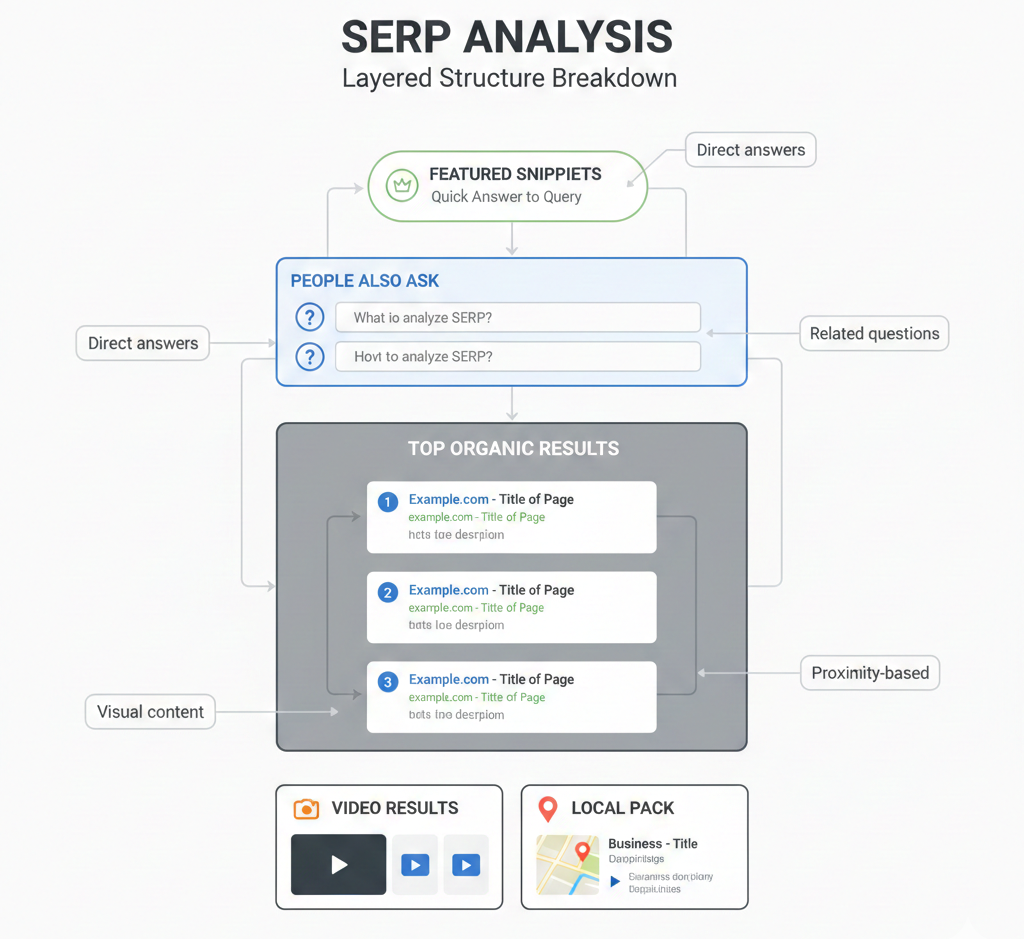
3. Study the SERP Features
In 2026, Google’s SERP is more layered than ever. According to Ahrefs’ study of 55.8 million AI Overviews, 97.7% of them appear for informational search queries Ahrefs exactly the intent type this blog targets. Understanding how AI Overviews work is now a non-negotiable part of keyword evaluation in 2026.
Look for:
- AI Overviews: Google’s generative summaries now appear for many informational keywords. If your keyword triggers an AI Overview, you need to structure your content to be cited within it
- Featured snippets: a well-structured answer in your content can earn the position zero spot
- People Also Ask: each question is a secondary keyword opportunity
- Video results: if YouTube videos rank, consider whether a supporting video would strengthen your content
- Local pack: relevant for service-area businesses
These features tell you what Google considers the most useful format for that specific query.
4. Check the Strength of the Competition
High-authority sites will require more effort to outrank. Niche-specific sites may give you more room to compete.
Check for:
- Domain authority and domain age
- Backlink count and quality of linking domains
- Topical relevance: Is this a site that covers your niche deeply?
- Content quality: depth, structure, recency, examples
This tells you if the keyword is worth targeting right now or if you should come back to it after building more authority.
5. Evaluate Content Depth
Scan the top results and look at how deeply they cover the topic. Short, weak pages mean you can outrank them with a thorough guide. Highly detailed articles mean you’ll need strong expertise to compete.
6. Spot Missing Elements
Every SERP has gaps. Understanding what’s missing starts with knowing what most sites get wrong. Our breakdown of 10 SEO mistakes that lower your rankings covers the most common SERP-level errors.
- Maybe no one explains the process clearly.
- Maybe no one provides examples.
- Maybe the content lacks visuals or updated data.
These gaps become your advantage.
Step 5: Select Primary Keywords
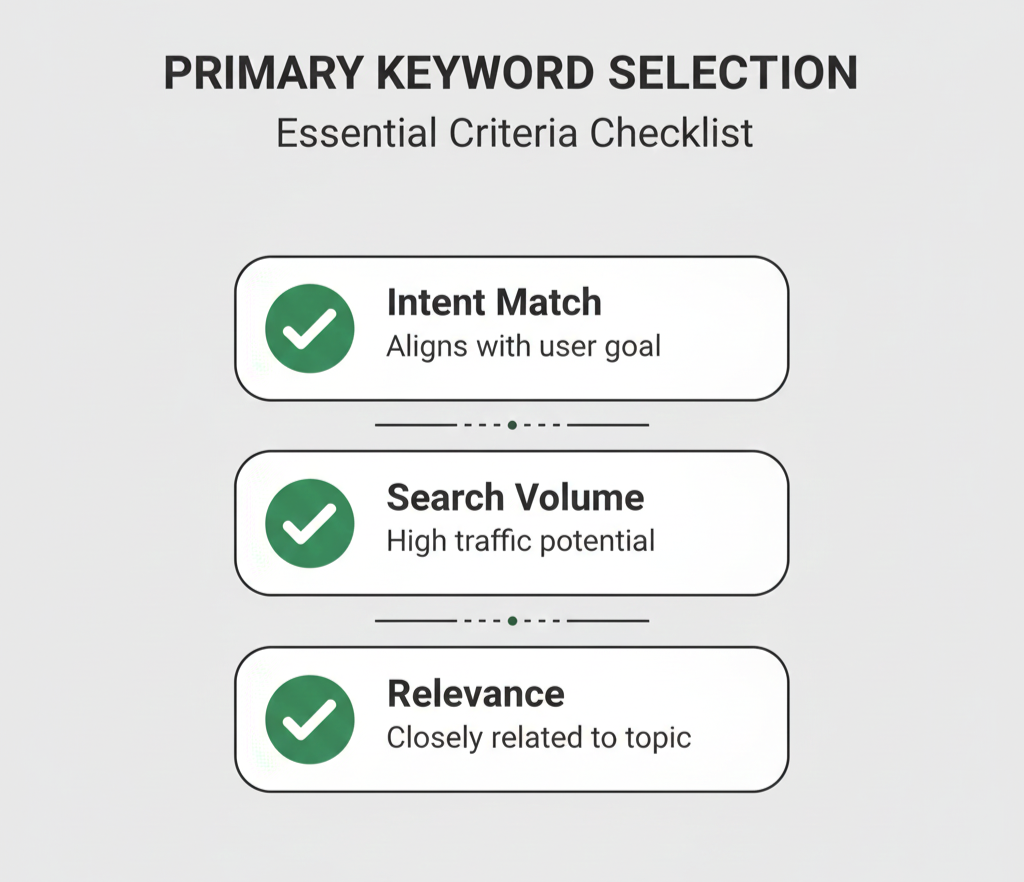
1. Match the Keyword to Your Page Goal
Ask yourself what the page is meant to do. Teach something? Compare options? Answer a question? Sell a solution? Choose a keyword that supports that purpose from the start.
2. Confirm the Search Intent
Check whether the keyword has clear informational, commercial, or transactional intent. Your content must reflect that intent exactly. If the keyword’s intent doesn’t match your content type, pick another one.
3. Check the Difficulty Level
If high-authority websites dominate the positions, switch to a narrower variant. Aim for a keyword you have a realistic chance of ranking for, rather than one that locks you into intense competition you can’t win yet.
4. Consistent Search Demand
A keyword with steady monthly volume gives you ongoing traffic potential. Skip terms that spike once and disappear. You want keywords that keep working month after month, year after year.
5. Make Sure the Keyword Fits Naturally
A strong primary keyword should blend into your content without forcing it. If it feels awkward in your sentences, or you can’t use it naturally in your headings, it’s the wrong choice.
6. Choose One Primary Keyword Per Page
Each page needs a single focus. Adding multiple main keywords confuses Google and weakens your content’s topical direction. One page, one primary keyword, supported by secondary and long-tail variations.
Step 6: Identify the Secondary Keywords
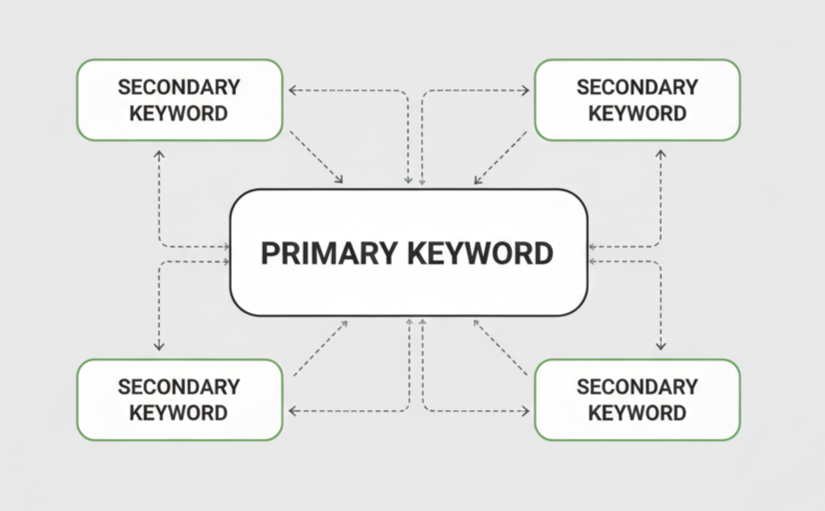
Secondary keywords support your primary keyword and help your page cover the topic more thoroughly. They’re not fillers; they’re the phrases that tell Google your content addresses the full scope of what users want.
1. Look for Related Phrases With Similar Intent
Search tools show variations of your main keyword that share the same intent.
For this topic, examples include:
- how to do seo keyword research
- seo keyword research step by step
- what is keyword research
They support your primary keyword and match the same informational intent.
2. Use Google’s Built-In Clues
Google surfaces secondary keyword ideas directly in three places:
- People Also Ask
- Related Searches
- Autocomplete suggestions
These are based on real search patterns, which makes them more reliable than tool-generated suggestions alone.
3. Check Competitor Subheadings
Competitor pages often reveal strong secondary keywords inside their H2 and H3 tags. Scan their content for repeated themes or phrases. If multiple competitors mention the same secondary keyword, it’s usually worth including.
4. Choose Keywords You Can Use Naturally
If an expression seems unnatural or out of place in your content, omit it. Secondary keywords should be integrated smoothly into your text without affecting the style or readability.
5. Use Secondary Keywords to Build Topic Depth
Place these keywords in the following:
- Subheadings
- Short explanations
- Examples
- FAQ sections
This shows Google that your content covers the topic fully rather than superficially.
6. Don’t Overload the Page
Secondary keywords ought to improve your content without overpowering it. A few chosen terms are preferable to cramming many into each part. Excellence surpasses volume invariably.
Step 7: Search for Long-Tail Keywords
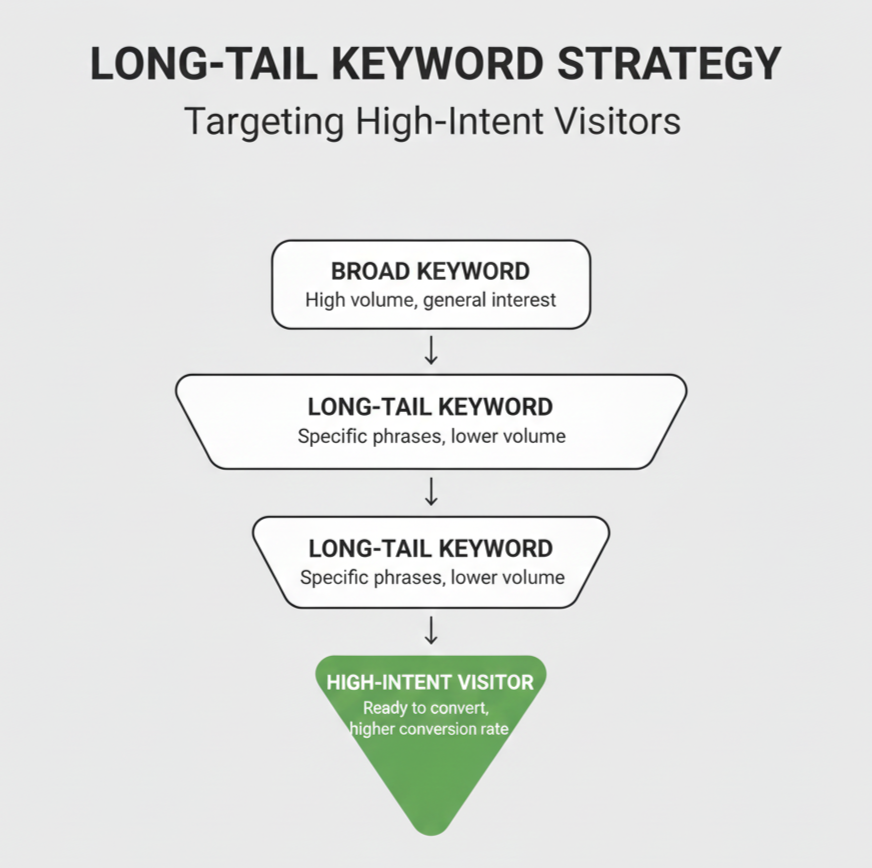
1. Look for Longer, More Specific Variations
Long-tail keywords include extra context. They might describe a problem, a goal, or a specific user situation.
Examples for this topic include:
- how to do keyword research for beginners
- free tools to find seo keywords
- how to find low-competition keywords
Each variation targets a clear and focused intent.
2. Use Question-Based Searches
People often type their questions directly into Google. These questions reveal pain points and help you write content that answers them immediately.
Check:
- People Also Search For
- Forums like Reddit and Quora
- Social communities and FaceBook Groups
- Long-question queries in keyword tools like AnswerThePublic
Questions often turn into high-converting long-tail keywords.
3. Study Autocomplete Suggestions
Start typing your primary keyword into Google and watch what appears. Autocomplete suggestions expose real user language and long-tail variations that may not show up in tools.
These suggestions often highlight search trends or rising topics in your niche.
4. Use Long-Tail Keywords for Targeted Sections
These keywords work well inside:
- Subtopics and supportive sections
- Specific worked examples
- Step-by-step explanations
- FAQ sections
They make your content feel more complete, practical, and genuinely useful.
5. Prioritize Intent Over Volume
A focused long-tail keyword with 200 monthly searches can drive better business results than a head keyword with 20,000. These visitors know what they want. They’re more committed, more engaged, and more likely to convert.
6. Build Clusters Around Long-Tail Themes
When multiple long-tail keywords focus on the same concept, create a content cluster. One pillar page supported by several focused supporting posts builds topical authority; this is the foundation of a strong content marketing strategy.
Does Google Understand Your Keyword Well?
Writing content for a misunderstood keyword wastes effort and kills ranking potential. Before you invest time in a page, confirm that Google interprets the keyword the same way you do.
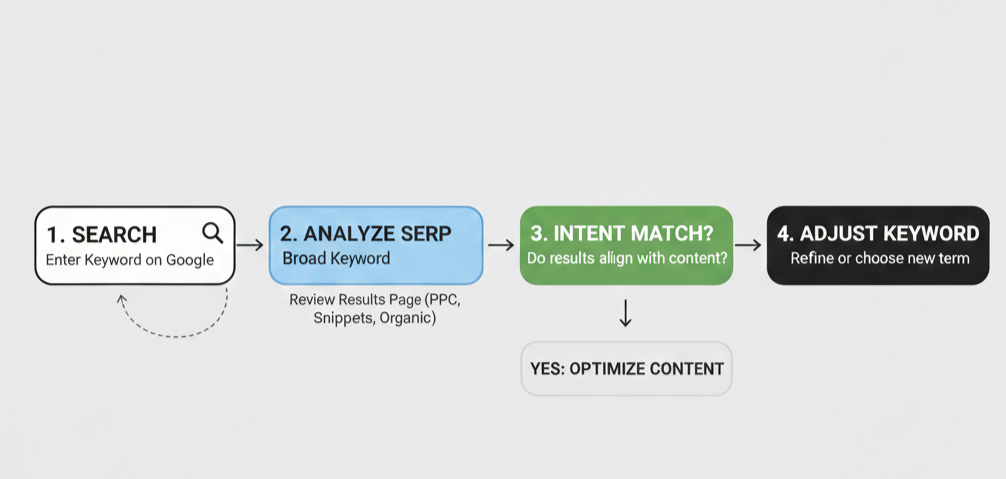
1. Search the Keyword
Type it into Google and look closely at the first page. Check what content types appear. Are they guides, lists, or product pages?
If the results align with your content plan, your keyword is clear. If not, consider refining the phrasing.
2. Examine the Top Pages
Top-ranking pages show you how Google interprets the keyword. Check headings, structure, and the specific angle each page takes. This is your competitive blueprint.
3. Check SERP Features
Featured snippets, “People Also Ask,” AI Overviews, and video results all indicate what Google thinks users want. Multiple results with similar angles confirm Google’s interpretation is consistent and that you need to match it.
4. Adjust Keyword if Needed
Don’t force your page to fit a keyword Google misunderstands. Refine the wording, add context, or target a long-tail variation. Your content should clearly and directly answer the exact query users intend.
Am I Capable of Facing Competitors on These Keywords?
Picking a keyword is one thing. Competing for it is another. Some keywords are crowded with authority sites that dominate the top results. Before committing to a keyword, honestly evaluate whether you can compete.
1. Analyze Top Ranking Pages
Check who currently holds the first page. Are they major brands or niche-specific sites? Look at content quality, length, structure, and the number of backlinks. If they’re detailed, authoritative, and heavily linked, breaking in requires a stronger strategy, not just a longer post.
2. Evaluate Domain Authority
Tools like Ahrefs, Semrush, or Moz show the domain strength of top-ranking sites. A newer site with lower authority generally struggles against well-established domains. If your site is newer, focus on lower-competition or long-tail keywords first. Build authority progressively, then move up the difficulty ladder.
3. Examine Content Depth
Scan the top results for coverage. Are they thorough guides or shallow posts? Weak or incomplete content is your opportunity; you can outrank them by delivering better, more updated, and better-structured content. But if the top pages are genuinely excellent, you’ll need original data, unique insights, or a better UX to compete.
4. Look for Niche Gaps
Sometimes top-ranking pages miss critical details or examples. Maybe they ignore common questions or provide outdated info. These gaps are openings you can exploit with focused content.
Top Tools for Analyzing Keyword Competition
No single tool gives you the complete picture. The best keyword researchers combine free and paid options depending on what they need at each stage of the process. Here’s a quick reference:
| Tool | Free/Paid | Best For |
| Google Search Console | Free | Keywords you already rank for, impressions, CTR |
| Google Keyword Planner | Free (Ads account) | Volume estimates, PPC validation, seed expansion |
| Ubersuggest | Free + Paid | Beginners, quick long-tail lists, budget option |
| AnswerThePublic | Free (limited) | Question-based searches, FAQ content ideas |
| Keywords Everywhere | Paid (affordable) | On-the-fly research while browsing Google/YouTube |
| Ahrefs Keywords Explorer | Paid | Deep KD analysis, click metrics, competitor gaps |
| Semrush Keyword Magic Tool | Paid | Intent categorization, content gap analysis, clusters |
| Moz Keyword Explorer | Paid | Priority score, SERP analysis, domain authority check |
How to Use These Tools Together
Start with Google Search Console to understand what you already rank for. Use Google Keyword Planner or Ubersuggest to build your initial keyword list. Then validate your top candidates in Ahrefs or Semrush, checking KD, search volume trends, and SERP composition before committing to any keyword.
AnswerThePublic and Keywords Everywhere are excellent supplements for finding question-based and long-tail keywords while you’re already browsing and researching.
Common Keyword Research Mistakes to Avoid
Most content that fails to rank doesn’t fail because of bad writing. It fails because of bad keyword decisions made before a single word was typed. Here are the mistakes that consistently hurt results.
1. Chasing Volume Without Checking Difficulty
A keyword with 50,000 monthly searches is useless if the first page is owned by Hubspot, Semrush, and Google itself. Always pair volume with a realistic difficulty assessment based on your current domain authority.
2. Ignoring Search Intent
Writing a sales page for an informational keyword, or a blog post for a transactional query, guarantees poor rankings. Google matches content format to search intent. If your format doesn’t match, you don’t rank regardless of how good the writing is.
3. Targeting Only High-Volume Head Terms
New and mid-sized websites consistently underperform when they go after head terms from day one. Long-tail keywords are faster to rank, easier to target, and often convert better. Build your authority with long-tail wins before targeting competitive head terms.
4. Not Considering 2026 SERP Realities
In 2026, Google’s AI Overviews appear for a significant portion of informational queries. Zero-click searches where users get their answer directly on the SERP without clicking now account for 58.5% of all US Google searches, according to SparkToro’s 2024 study. This means a keyword with 5,000 monthly searches may only generate 800-1,000 actual clicks to organic results.
What this means for you: When evaluating keyword value, look at estimated clicks (available in Ahrefs and Semrush), not just raw search volume. A keyword with lower volume but a high click-through rate is often more valuable than a high-volume term dominated by AI overviews and featured snippets.
5. Forgetting to Revisit Keyword Research
Search for behavior changes. New competitors enter. Google updates its algorithms. A keyword strategy built 18 months ago may be working against you today. Running a technical SEO audit alongside your keyword review will surface crawl and indexing issues that compound ranking problems.
6. Using One Tool for All Research
Every keyword tool has its own data set, crawl limitations, and methodology. Relying on a single tool means relying on one imperfect snapshot. Cross-reference at least two tools before making final keyword decisions on competitive terms. For a deeper look at modern options, see our guide to the best AI SEO tools for real-world optimization.
Conclusion
Keyword research isn’t guesswork. It’s a structured process that separates successful content from wasted effort. Knowing how to do keyword research means understanding your audience, analyzing competitors, evaluating metrics, and matching search intent.
Picking the right primary keyword anchors your page. Supporting it with secondary and long-tail keywords strengthens relevance and helps you cover the topic thoroughly. Evaluating SERP, checking competition, and using the right tools ensures you invest time in terms you can realistically rank for.
Follow this for SEO keyword research step by step, and your content will consistently attract the right visitors, build topical authority, and improve rankings. If you need help producing that content at scale, our content writing services are built exactly for this