Introduction
To run a business and not track your local search performance is driving blind. You think your Google Business Profile, citations, and reviews are working for you but until you audit them, you really don’t know for sure.
A local SEO audit is how you discover the unseen issues that keep your business from appearing in maps, local packs, and organic listings. Whether it’s duplicate citations, weak NAP consistency, or overlooked review signals, audits reveal to you the gaps between you and better visibility.
This guide gives you a step-by-step local SEO audit checklist. You’ll discover what to look for, what tools to use, and how to turn audit results into a concrete local SEO roadmap.
What is a Local SEO audit checklist?
Schema: Implement Article schema here. Mark this section as the article description for Article schema.
Quick DefinitionA local SEO audit checklist is a structured process used to evaluate how well your business is optimized for local search. It examines every factor that influences local visibility, from your Google Business Profile and citation consistency to review signals and on-page content, helping you identify gaps and prioritize fixes that drive real ranking improvements.
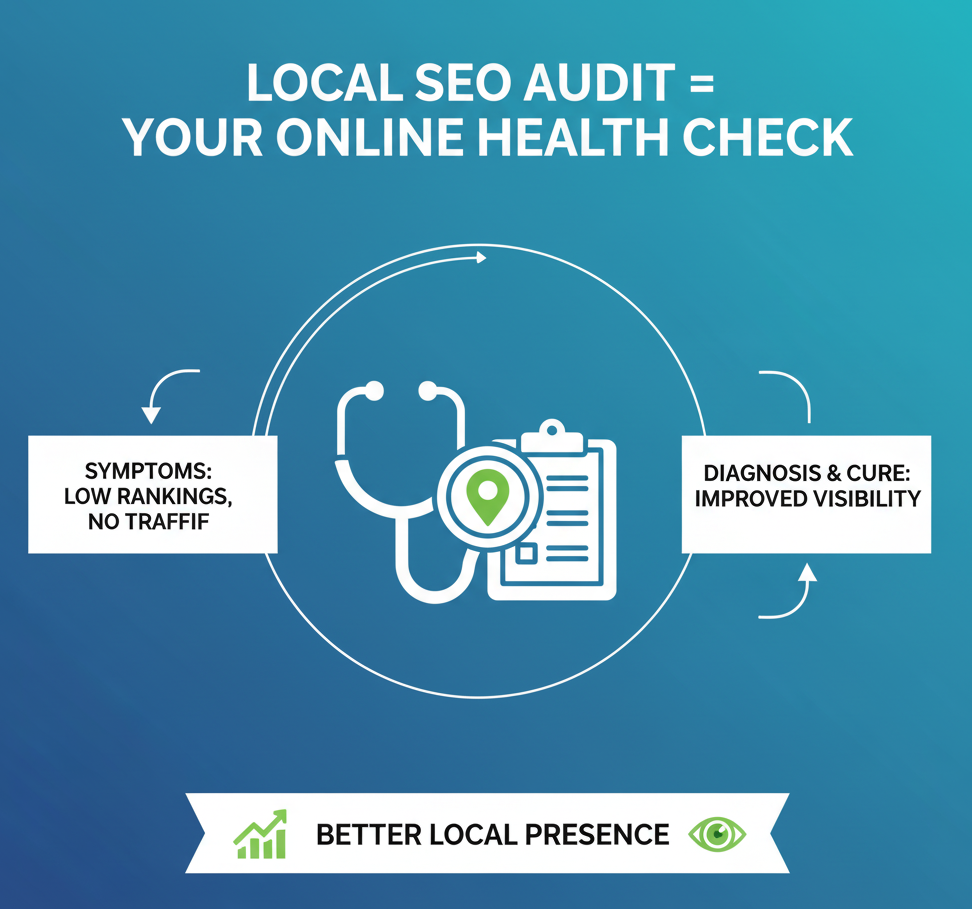
Think of it as a health check for your local visibility. As a regular checkup in a medical clinic can detect issues before they turn serious, a local SEO checkup detects technical weaknesses, content weaknesses, and missed opportunities, which your competitors are already utilizing.
A solid checklist should have:
- Google Business Profile check: Is your profile accurate, current, and optimized?
- Local relevance test: Is your website content consistent with location-based intent?
- Citation audit: Are your company’s listings consistent in directories?
- Review analysis: Are reviews showing trust signals, and are you responding to them?
- Competitor benchmarks: How does your business compare with businesses beating you?
The outcome isn’t just a list of problems. A local SEO audit gives you the foundation for a local SEO roadmap, a prioritized action plan that tells you exactly where to focus to move the needle in local search.
What is Included in a Local SEO Audit?
A local SEO audit isn’t a quick glance at your Google Business Profile or your keyword rank report. It’s a process that digs deep into each of the elements that decide how your business appears in local search engine results.
A full audit needs to cover the following big areas:
1. Google Business Profile Audit
Your Google Business Profile (GBP) is the basis of local presence. An audit confirms whether your profile is fully optimized with the proper categories, fresh contact information, business hours, services, and photos. It also confirms duplicate or suspended listings that will hurt rankings.
2. Website Local Relevance
Search engines should see that your site is confirming your local presence. This includes verifying local landing pages, schema markup, internal linking, and content that directly relates your business to the district that you’re located in.
3. Citation and NAP Consistency Audit
Citations (business listings in search results within directories) and NAP details (Name, Address, Phone) need to be 100% similar. Minor variations could confuse businesses and search engines, reducing trust metrics. A review of an audit reveals missing or inaccurate listings.
4. Review Profile Assessment
Reviews influence both local rankings and consumer confidence. Not only does an audit take into account your rating and volume of reviews, but also frequency, sentiment, and response approach. It will also measure your review profile against local competitors.
5. Local Ranking Assessment
Simply put: How well are you currently ranking for target keywords and locations?
A local ranking audit tests your visibility to the limit within the local pack, Google Maps, and organic listings. It reveals strengths and areas where competition is beating you.
6. Content Gap Analysis
Strong local content connects what is being searched for and what your site has. An audit examines gaps in topics (e.g., FAQs, local service pages, guides) and verifies whether your content satisfies search intent.
7. Competitor Benchmarking
A quality audit doesn’t exist in isolation. Comparing your profile to competitor profiles from backlinks to reviews to GBP optimization reveals what it will take to achieve a competitive advantage.
All these combined give a good impression about where you are and where you should go. The intent is not just to identify issues; it’s establishing a local SEO roadmap that supports your company’s visibility and competitiveness in local search.
How to Perform a Local SEO Audit (Local SEO Audit Checklist)
Schema: Implement HowTo schema here. Wrap all numbered steps below in HowTo schema to trigger rich results.
A local SEO audit is not a surface-level review. It’s a thorough analysis of every element that determines how your business appears in local search results.
Follow each step below to uncover the gaps and build a concrete action plan.
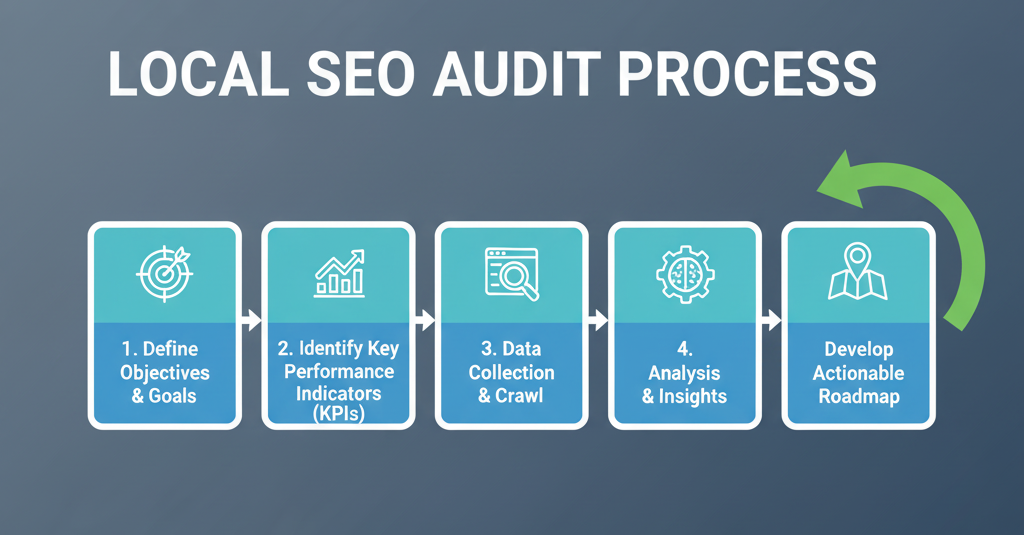
A local SEO audit is not a surface-level review. It’s a thorough analysis of every element that determines how your business appears in local search results. Follow each step below to uncover the gaps and build a concrete action plan.
Step 1: Define Your Audit Objectives and KPIs
Before you open a single tool, be clear on what you’re auditing and why. Without defined objectives, an audit becomes a data collection exercise with no clear outcome.
Set Your Objectives
• Determine your primary goal: improve local pack visibility, increase website traffic from local searches, or drive more calls and direction requests.
• Confirm whether you’re auditing a single location or a multi-location business; the scope and complexity differ significantly.
Map Your KPIs
• Track keyword ranking positions for your priority terms, both geo-modified searches (e.g., ‘plumber in Delhi’) and near-me searches.
• Monitor Google Business Profile (GBP) performance metrics: impressions, clicks, calls, and direction requests.
• Record your current review count, average star rating, and response rate as baseline figures.
Collect Baseline Data
• Export data from Google Search Console, Google Analytics 4, and Google Business Profile Manager before making any changes.
• Capture competitor snapshots of their GBP completeness, review counts, and visible ranking positions to use as benchmarks throughout the audit.
Why this matters: Skipping this step means you’ll have no way to measure whether your fixes are working. Baseline data is what turns an audit into a measurable growth strategy.
Step 2: Google Business Profile Audit
Your Google Business Profile is the single most influential factor in local pack rankings. An incomplete or inaccurate profile is the first thing that holds businesses back and the quickest win when fixed.
Business Information Accuracy
• Verify that your NAP (Name, Address, Phone) exactly matches what appears on your website and across all citations.
• Confirm business hours are correct, including holiday hours and any special seasonal changes.
• Check that your website URL, appointment links, and messaging are active.
Category and Services Optimisation
• Ensure your primary category is the most specific, top-level service relevant to your business (e.g., use ‘Plumber,’ not ‘Home Services’).
• Add all applicable secondary categories to capture additional search intent.
• List every service and product with clear descriptions and pricing where applicable; this directly influences what searches your profile appears for.
Visual and Engagement Optimisation
• Add storefront photos, staff photos, product images, and interior shots. Profiles with photos receive significantly more clicks and direction requests than those without, according to Google’s own data.
• Add video content or a virtual tour where applicable.
• Publish GBP posts regularly at least once a week to signal activity to Google and engage potential customers.
Profile Hygiene
• Search Google Maps for your business name and address to identify any duplicate or suspended listings; these split your ranking authority.
• Review and respond to all open Q&A entries. Unanswered questions create uncertainty and reduce conversion rates.
Step 3: Website Local Relevance Assessment
Your website must confirm and reinforce your local presence. Search engines cross-reference what your GBP says with what your website says — inconsistencies hurt both trust and rankings.
Review Local Landing Pages
• Every location you serve should have a dedicated page with a unique address, phone number, embedded map, and original location-specific content.
• Do not use copy-paste ‘template’ location pages with only the city name swapped. Google identifies and discounts these as thin content.
On-Page Optimisation
• Include geo-modified keywords naturally in title tags, H1 headings, and meta descriptions (e.g., ‘SEO Services in Ahmedabad,’ not just ‘SEO Services’).
• Ensure internal links connect service pages, location pages, and relevant blog content using descriptive anchor text.
• Add LocalBusiness schema markup with your NAP data, operating hours, and service area to every key page.
Mobile and Technical Checks
• Test your site with Google PageSpeed Insights. The majority of local searches happen on mobile, so a slow site directly loses customers.
• Confirm click-to-call buttons work on all mobile devices.
• Verify the site is HTTPS secure; an insecure site reduces user trust and is a ranking signal.
Step 4: Local Content Gap Analysis
Strong local content is what connects the searches your customers are making to the answers your website provides. If your competitors are publishing content that answers local questions and you aren’t, they’ll keep outranking you.
Identify Your Competitors
• Search your primary keywords in Google and note which businesses appear in both the local pack and organic results; these are your actual local competitors, not just businesses you know.
• Examine their service pages, blog posts, FAQ sections, and neighborhood guides.
Find the Gaps
• Are competitors publishing neighborhood guides or area-specific service pages that you don’t have?
• Do they have comprehensive FAQ pages that address the exact questions your customers are searching for?
• Are they using visual content videos, infographics, or before/after images that you aren’t?
Build a Local Content Roadmap
• Add missing FAQ sections to your service and location pages, written to match exact search queries from Google’s People Also Ask results.
• Plan blog posts targeting long-tail local keywords (e.g., ‘how much does roof repair cost in Mumbai’) to capture high-intent traffic.
• Consider community-focused content: local event coverage, customer case studies, or guides to your service area. These build both relevance and backlinks.
The payoff: A single well-optimized local FAQ page can capture multiple featured snippets and AI overview placements, multiplying your visibility without increasing your ad spend.
Step 5: Citation and NAP Consistency Audit
Citations of your business listings across directories are a foundational local ranking signal. But only when they’re consistent. Even small discrepancies in how your name, address, or phone number appears can erode trust signals and suppress your rankings.
Audit Your Citation Sources
• Check the major general directories: Google Business Profile, Apple Maps, Bing Places, Yelp, Facebook, Justdial, Sulekha, and IndiaMART (for Indian businesses).
• Check niche and local directories relevant to your industry and city.
Correct Inconsistencies
• Standardize your NAP format across all listings; decide on one version and apply it everywhere (e.g., always ‘Street,’ never ‘St.’).
• Remove or merge duplicate listings. Duplicates are one of the most common causes of ranking suppression we find in audits.
• Update any listings with old phone numbers, outdated addresses, or previous business names.
Track Ongoing Accuracy
• Use a citation management tool such as BrightLocal or Moz Local to monitor listings automatically for new inconsistencies or unauthorized edits.
• Schedule a quarterly citation check as part of your ongoing local SEO maintenance.
Step 6: Review Profile Evaluation
Reviews influence both local rankings and customer decisions. Google uses review signals’ volume, recency, rating, and response rate as ranking factors in the local pack. And consumers trust them: BrightLocal found that 49% of consumers trust online reviews as much as personal recommendations.
Review Volume and Frequency
• Compare your review count to the top 3 local competitors for your primary keywords.
• Check whether your most recent reviews are recent: a business with 200 reviews but none in the past 6 months will rank below a competitor with 50 recent ones.
Quality and Sentiment Analysis
• Track your average star rating and identify recurring themes in negative reviews; these signal real service or communication gaps to fix.
• Use review analysis tools to monitor sentiment trends and spot patterns before they affect your rating significantly.
Response Management
• Respond to every review, positive and negative, within 48 hours.
• Write personalized responses: reference the reviewer’s specific comment, thank them genuinely, and for negative reviews, acknowledge the issue and offer a resolution path.
• Avoid copy-paste template responses Google can identify these, and they signal low engagement to both the algorithm and prospective customers.
Step 7: Local Ranking Assessment
You can’t fix what you can’t measure. A local ranking assessment tells you exactly where you stand for your priority keywords across different locations, devices, and search types.
Track Local Keyword Performance
• Use a local rank tracking tool (such as BrightLocal or Whitespark) to monitor your visibility across different postcodes or neighborhoods, not just your primary address.
• Track both desktop and mobile positions separately; they often differ significantly for local searches.
Benchmark Against Competitors
• Compare your ranking positions to 3–5 leading local competitors for each priority keyword.
• Note the gap between your local pack visibility and your organic rankings; the two require different optimization strategies.
Assess Engagement Signals
• In Google Search Console, monitor CTR and impressions for local-intent search queries. A high impression count with a low CTR indicates your title tag or meta description needs improvement.
• In GBP Insights, track calls, direction requests, and website clicks; these are the engagement signals that feed back into local pack rankings.
Step 8: Competitor Comparison Benchmarks
A local SEO audit conducted in isolation tells you where you are. Competitor benchmarking tells you what you need to do to get ahead. The two go together.
Google Business Profile Comparison
• Review the completeness of your top competitors’ GBP profiles: categories, services listed, photo counts, and post frequency.
• Note any features they’re using that you aren’t, such as product listings, service menus, or Q&A activity.
Backlink and Citation Audit
• Use a backlink analysis tool (such as Ahrefs or SEMrush) to identify where competitors are earning local citations and backlinks from local business associations, sponsorships, chamber of commerce listings, and niche directories.
• Each gap you find is a link-building opportunity for your own strategy.
Review and Reputation Comparison
• Compare average star ratings, total review volumes, and response rates with your top competitors.
• Study how competitors handle negative feedback. The tone, speed, and quality of their responses often set the standard customers expect in your market.
On-Page SEO Review
• Examine how competitors use keywords in their title tags, H1 headings, and meta descriptions.
• Note their use of local modifiers (e.g., ‘best dentist in Surat’) and whether they’re targeting neighborhood-level specificity that you aren’t.
Step 9: Building Your Actionable Local SEO Roadmap
The audit only has value if it leads to action. This final step converts your findings into a prioritized, time-bound plan that your team can execute.
Prioritise by Impact
• High priority (fix immediately): Inconsistent citations, missing or incorrect GBP information, slow site speed, missing author bylines, broken links.
• Medium priority (fix within 30 days): Content gaps, missing location pages, review response backlog, schema markup implementation.
• Long-term (build over the next quarter): Review the acquisition program, local backlink outreach, and neighborhood content strategy.
Assign Ownership
• SEO team: Technical fixes, schema implementation, citation corrections.
• Content / marketing team: Blog posts, FAQ pages, review responses, GBP posts.
• Development team: Site speed improvements, mobile optimization, structured data.
Document and Track
• Create a shared spreadsheet with every task, the owner responsible, the deadline, and the KPI it impacts.
• Set a 30-day check-in to compare performance against your baseline data.
Repeat the full audit every 12 months, with lighter quarterly check-ins on rankings, citations, and review volume
|
Need an Expert to Handle Your Local SEO Audit? Our team specializes in Google Business Profile audits, citation management, and local ranking analysis. |
| Talk to Our Local SEO Specialists |
Common Local SEO Issues Found in Audits
In auditing local businesses across multiple industries and markets, the same critical issues appear repeatedly. Knowing what to look for helps you find them faster.
1. Inconsistent NAP Across Directories
The most frequent issue we encounter is NAP inconsistency. A business might be listed as ‘Road’ in one directory and ‘Rd.’ in another or show a phone number that was changed two years ago. These discrepancies confuse search engines and erode the trust signals that support local pack rankings.
2. Duplicate Google Business Profile Listings
Many businesses have two or more GBP listings without realizing it was created by former employees, previous agencies, or Google’s automated data pulls. Duplicate listings split ranking authority and can trigger profile suspensions.
3. Missing or Generic Location Pages
Businesses serving multiple cities often use copy-paste location pages with only the city name swapped out. Google identifies these as thin content, and they rarely rank. Each location needs genuinely unique, locally relevant content to perform.
4. Unanswered Reviews
Leaving reviews, especially negative ones, without a response is one of the most visible trust signals working against you. Google’s local ranking algorithm treats review engagement as a positive signal, and prospective customers read your responses as a direct indicator of how you treat people.
5. No Local Content Strategy
Many local businesses have no blog, no FAQ section, and no area-specific guides. They’re leaving significant long-tail traffic on the table, the kind of high-intent, location-specific searches that bring in ready-to-buy customers.
6. Slow Mobile Site Speed
Since the majority of local searches happen on mobile, a site that loads slowly on a smartphone will lose both visitors and rankings. A 1-second delay in page load time can reduce conversions by up to 7%, according to industry research. Site speed is not a nice-to-have; it’s a direct ranking and revenue factor.
Why Do a Local SEO Audit?
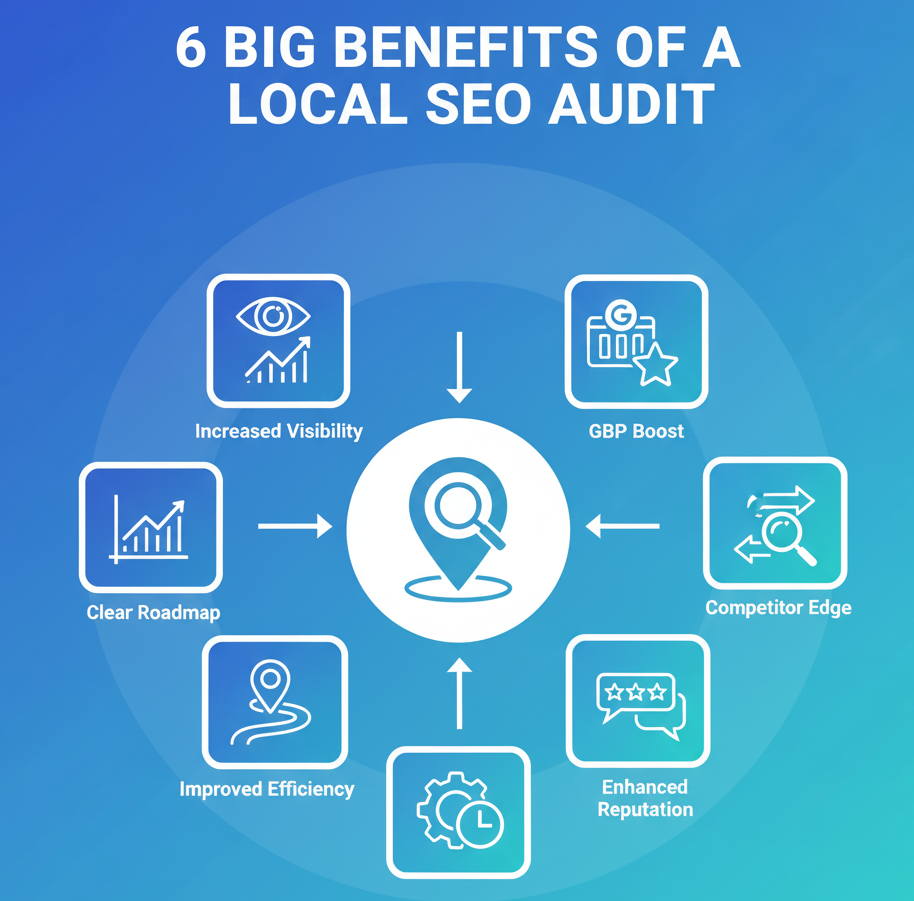
A local SEO audit isn’t a maintenance task; it’s a strategic growth lever. Here are the core business benefits.
1. Spot Critical Visibility Issues Early
- Incorrect citations, outdated business hours, or partial location information can get your business removed from local pack pages.
- An audit puts you in front of such issues before they damage search visibility or drive away customers.
2. Improve Google Business Profile Performance
- A systematic Google Business Profile audit optimizes categories, services, and reviews.
- Highly ranked, well-established companies with well-defined, optimized GBPs always dominate and get more clicks, calls, and direction requests.
3. Understand Competitor Positioning
- Competitor research locally illustrates audits of how others place for the local pack.
- You see their review sources, backlink strategies, and content themes, allowing you to make your own method better.
4. Build a Stronger Reputation
- Review analysis surfaces areas of customer satisfaction and response management gaps.
- With review audits, you can increase trust signals and attract more local customers.
5. Save Time and Resources
- Instead of a wild guess at what’s going wrong, a local ranking audit gives you clear, data-driven answers.
- You focus efforts on fixes most important to you, whether citations, on-page optimization, or content creation.
6. Create a Clear Local SEO Roadmap
- The audit directly informs your local SEO roadmap, providing an actionable plan for the next quarter or year.
- This roadmap supports business objectives, holds someone accountable, and prevents wasted investment in strategies that won’t drive the needle.
Conclusion
Local SEO audit is not just tick-boxing; it’s the way to maintain local visibility. Whether it’s revealing citation errors, sorting out Google Business Profile gaps or mapping content opportunities, an audit informs you where you are and what you need to do next.
That’s the reality: businesses that tackle audits as an isolated event lag behind those that leverage them as a strategic guide. By staying true to an ongoing local search checklist, you’re getting yourself ready for triumph with algorithmic updates, adapting to altering customer patterns, and maintaining trust signals constantly working its way through calls, clicks, and walk-ins.
The top local SEO tactics never seek rankings in a blind sprint. They establish a solid process through which visibility is measured as tangible revenue. And that process starts with a complete, reproducible audit.