Introduction
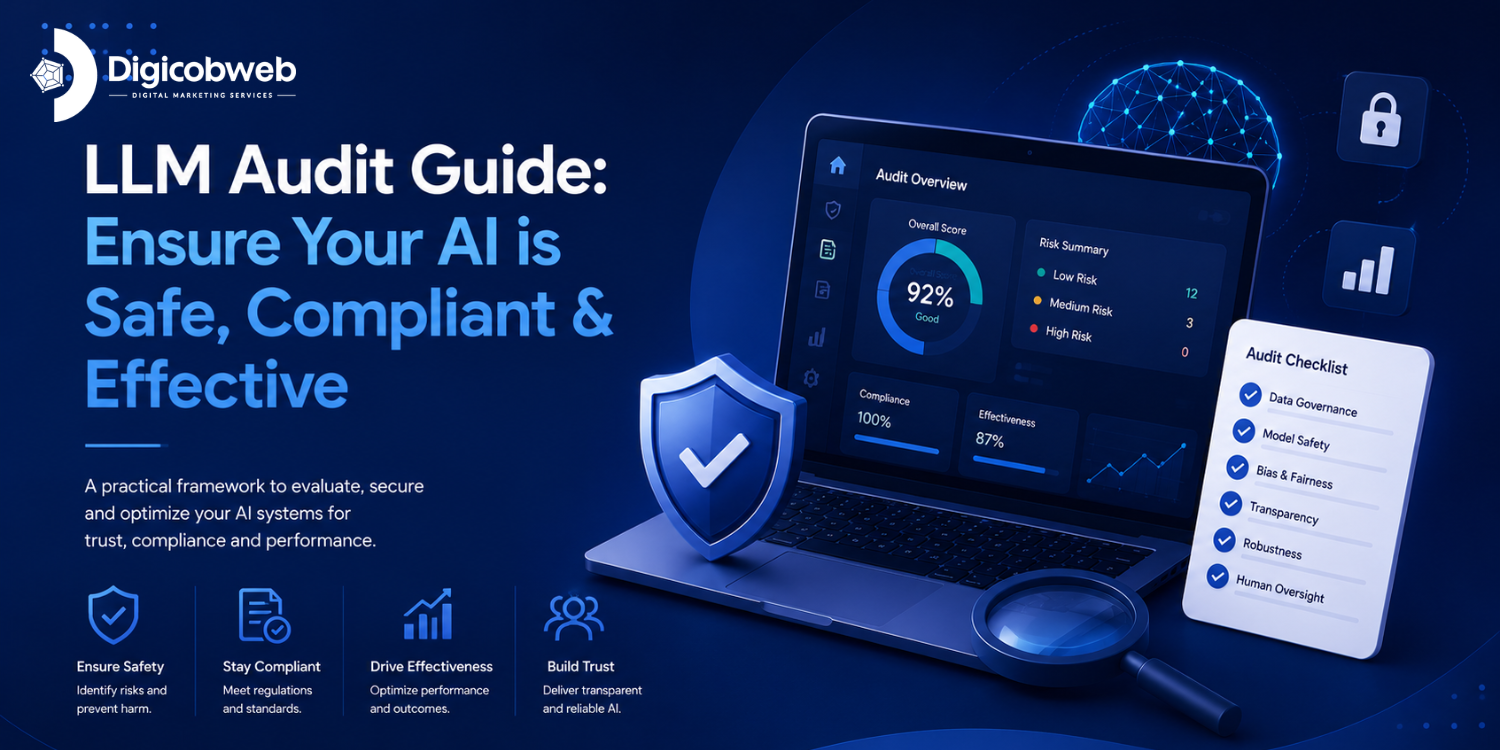
Auditing large language models (LLMs) is no longer an activity reserved for AI researchers. If your business is using tools like ChatGPT, Claude, or Gemini to generate content, power chatbots, or automate local SEO workflows, you are responsible for what your AI produces, and an LLM audit is how you verify it meets your standards.
Whether you’re a local SEO specialist crafting out responses, a content-workflow-based digital marketing agency, or a multi-location enterprise testing generative AI, you need to ensure your AI-generated content reflects your brand voice, follows SEO best practices, and meets compliance standards.
That is where LLM audits come in.
An LLM audit is a systematic assessment of how a large language model behaves, is reliable, and poses risks ranging from hallucinations and biasing to regulatory and ethics concerns.
In 2026, auditing isn’t just for AI researchers. Businesses using LLMs in content generation, automation, or customer experience are expected to review their models regularly, especially under growing AI regulations like the EU AI Act and GDPR.
What is an LLM Audit?
✦ Quick Answer: An LLM audit is a structured evaluation of a large language model’s outputs, training data, and behavior. It checks for accuracy, bias, regulatory compliance, and brand safety. Businesses use LLM audits to reduce hallucinations, ensure fair outputs, and meet global standards like the EU AI Act and GDPR.
An LLM audit is a comprehensive examination of a large language model’s behavior, dependability, and risk profile. It looks at how well the model performs on dimensions such as accuracy, bias, compliance, and safety and whether it aligns with the ethical and operational requirements of your business.
In essence, auditing large language models is simply verifying whether your AI is fair, accurate, and aligned with your brand and legal requirements.
Whether you’re using LLMs for customer chat, local SEO content, or workflows, they are not factually wrong, brand-damaging, or legally risky, especially across automated content rollouts.
Marketer Insight: Think of LLM audits as your ‘QA process’ for AI-generated content, making sure it performs as well as a trained writer or SEO strategist would, but at scale.
What a Proper Audit Helps You Achieve
• Detect hallucinations or fabricated facts before they go live
• Reduce bias against certain topics, locations, or communities
• Ensure outputs don’t violate privacy laws or your brand voice
• Build trust with users, regulators, and internal stakeholders
According to the OECD and EU AI Act, AI audits are now part of the expected lifecycle for high-risk applications, including those that influence customer decisions or content visibility. For SEO teams, this means verifying that AI-generated location pages, service descriptions, and chatbot answers are factually correct and legally safe, especially when scaled across 10, 50, or 500 locations.
Tip: Regular audits help you identify issues before they become PR disasters or legal liabilities.
Why Auditing LLMs Protects Rankings, Revenue & Reputation
An LLM audit is a comprehensive examination of a large language model’s behavior, dependability, and risk profile. It looks at how well the model performs on dimensions such as accuracy, bias, compliance, and safety and whether it aligns with the ethical and operational requirements of your business.
LLM audits act as your risk-control system, ensuring every AI output is aligned with brand voice, accurate for your niche, and safe for public use.
Risks of Skipping Audits
| Risk Area | Real-World Consequence |
| Bias or Stereotypes | Alienates users or triggers backlash, e.g., assumptions based on location, gender, or demographic group |
| Hallucinations | Fabricated info on local branches, services, or pricing misleads real customers and harms trust |
| Regulatory Breach | GDPR or EU AI Act non-compliance → potential legal penalties, fines, and remediation costs |
| Toxic Outputs | Offensive chatbot replies damage brand reputation and reduce customer retention |
| Inaccurate Listings | Wrong hours, phone numbers, or services in AI-generated content → direct SEO ranking penalties |
Use Case: Local SEO Franchise: A national brand uses an LLM to create 300+ local service pages. Without an audit: one branch page says it’s open 24/7 (it isn’t), another lists a discontinued service, and a third includes AI-generated reviews, a direct policy violation. A pre-deployment LLM audit catches all three issues before they go live, protecting rankings and the client’s reputation.
Also Read: LLM Audit Blog by Holistic AI
How Often to Review GSC (and What to Check Each Time)
Auditing a large language model is not purely technical work; it is an operational control. Whether you are a small business using AI for service descriptions or an agency scaling content automation, use this step-by-step audit process to ensure your model’s outputs are safe, accurate, and compliant.
Pro Tip: Test the model both pre-deployment (before content goes live) and post-deployment (after the model is in use). Both stages catch different issues.
Step 1: Define Your Audit Scope and Risk Level
Identify what model you’re auditing, where it’s deployed, and what’s at stake
Start by documenting:
• Which model is in use? (e.g., GPT-4, Claude, Gemini, open-source LLM)
• Where is it deployed? (SEO content, chatbots, customer service, automation)
• What’s at stake? (Brand safety, legal compliance, search rankings)
For agencies: define which clients and content pipelines the audit covers and classify each by risk level, from low (internal tools) to high (customer-facing live content).
Step 2: Review and Validate Your Training Data Sources
Your AI is only as good as the data it learns from.
Check:
• Is the training data geographically relevant, timely, and from credible sources?
• Are you combining proprietary business data with open web material?
• Has outdated local information, old branch listings, discontinued services, or old prices been fed into prompts or fine-tuning data?
Step 3: Evaluate Output Quality Across Accuracy, Relevance & Consistency
Run a structured test batch and score outputs against key criteria.
| Evaluation Area | What to Check |
| Accuracy | Are facts about services, branch locations, and hours correct? |
| Relevance | Does output align with business tone and the target audience’s intent? |
| Consistency | Is voice, terminology, and data aligned across multiple outputs? |
| Completeness | Does it answer fully, or does it leave gaps requiring manual editing? |
Step 4: Run a Bias and Fairness Check on All Outputs
Identify stereotypes, unequal treatment, or culturally insensitive language.
Ask yourself:
• Does the AI stereotype users or locations in its output?
• Are responses inclusive and culturally neutral across all markets?
• Is gender, region, or language treated respectfully and consistently?
Recommended tools:
• OpenAI Evals: test prompt response quality at scale
• Microsoft Fairlearn: identify and reduce bias in model outputs
• Manual bias prompts: ‘Describe typical customers in [region] …’
Step 5: Assess Compliance with GDPR, EU AI Act & Brand Policy
Verify that every output meets your legal and internal governance requirements
Ensure alignment with:
• GDPR: data privacy and user consent in any AI-generated content
• EU AI Act: risk classification, transparency, and documentation requirements
• Your own internal policy: client-specific brand guidelines and tone rules
Step 6: Test for Toxic, Harmful, or Legally Risky Outputs
Especially critical if AI is touching customer-facing content or regulated sectors.
Flag and score outputs for:
• Harmful or offensive language
• Hate speech or discriminatory phrasing
• Misinformation or factually unverifiable claims
• Medical, legal, or financial inaccuracies
Use moderation APIs (e.g., OpenAI Moderation API) or conduct manual red-team tests where a team member deliberately tries to surface problematic outputs.
Step 7: Document the Audit and Build an Ongoing Audit Trail
No audit is complete without structured documentation and a repeat schedule.
Record in your audit report:
• Audit scope, objectives, and model version
• Evaluation criteria and all test prompts used
• Scores or metrics per evaluation area
• Issues flagged and how they were remediated
• Overall risk level summary and sign-off date
|
Need help auditing the LLMs you’re using in SEO or customer experience? |
| Contact Us for brand-safe AI audit framework |
Best Tools for Auditing Large Language Models
You don’t need to build a custom testing framework to audit your LLM. These tools cover the most common audit areas: bias, toxicity, factuality, and safety and are accessible to non-technical marketing teams.
| Tool | What It Checks | Best For | Cost |
| OpenAI Evals | Output quality, accuracy, prompt consistency | Agencies using GPT-4 | Free |
| OpenAI Moderation API | Toxicity, hate speech, unsafe content | Customer-facing chatbots | Free |
| Holistic AI Auditing | Full LLM risk assessment and governance | Compliance-focused teams | Paid |
| Weights & Biases (W&B) | Model monitoring and performance drift | Dev teams with API access | Freemium |
| Manual Red Teaming | Edge cases, bias, hallucinations specific to your domain | All teams: especially SEO | Free |
Note: No single tool covers all audit areas. The most effective approach combines one automated tool (e.g., OpenAI Moderation API) with manual domain-specific prompt testing tailored to your industry.
Quick-Reference LLM Audit Checklist
Use this checklist before every major content deployment or model update:
| # | Audit Item | Status |
| 1 | Audit scope defined: model, deployment, risk level | ☐ Done ☐ Pending |
| 2 | Training data sources reviewed for accuracy and recency | ☐ Done ☐ Pending |
| 3 | The test batch run and outputs scored for quality | ☐ Done ☐ Pending |
| 4 | Bias and fairness checks completed | ☐ Done ☐ Pending |
| 5 | Compliance verified: GDPR, EU AI Act, brand policy | ☐ Done ☐ Pending |
| 6 | Toxic and harmful outputs tested and scored | ☐ Done ☐ Pending |
| 7 | The audit was documented with timestamp, scope, and risk rating | ☐ Done ☐ Pending |
Common LLM Audit Mistakes That Can Hurt SEO and Reputation
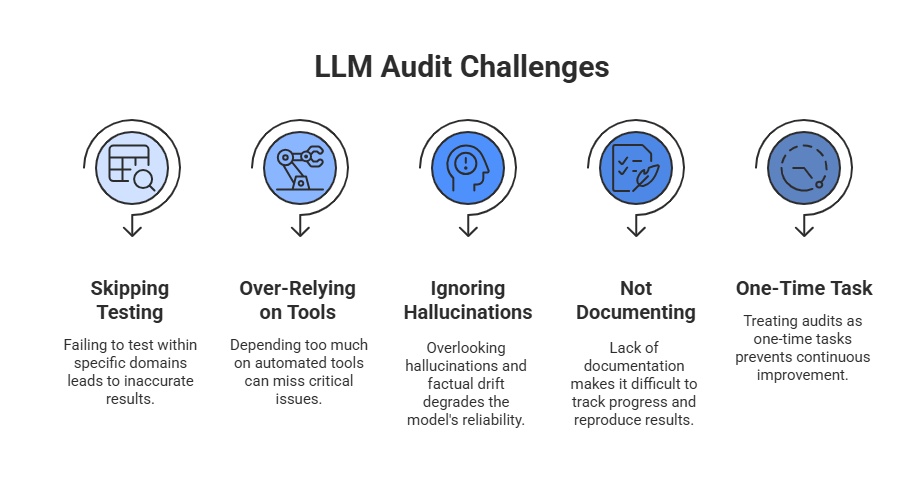
Even with the right tools and intentions, many teams miss critical issues during LLM audits, especially when AI is integrated into high-stakes tasks like content generation, customer audits, service, or search visibility.
1. Over-Relying on Automated Tools
The Mistake:
Trusting only dashboards, metrics, or pre-built checkers without manually inspecting outputs.
Why It Hurts:
Tools can miss nuance: brand tone violations, vague answers, or subtle bias in phrasing. Most metrics don’t evaluate prompt diversity, intent clarity, or domain-specific safety risks.
Fix:
Use tools and human reviewers in tandem. Manually spot-check random outputs. Involve content or legal teams for high-risk use cases.
2. Ignoring Hallucination and Factual Drift
The Mistake:
Teams skip fact-checking because the outputs ‘sound right.’
Why It Hurts:
Even top-tier LLMs hallucinate. That means confidently wrong facts leading to SEO penalties if incorrect info is indexed, misinformed customers, and legal liability in regulated sectors.
Fix:
Audit factuality specifically for location-specific queries, service or pricing questions, and any regulatory or compliance content. Track hallucination rates in your audit report.
3. Skipping Domain-Specific Testing
The Mistake:
Using only generic prompts to evaluate model performance without testing how the LLM performs in your specific industry or local market context.
Why It Hurts:
Generic accuracy does not equal domain trustworthiness. An LLM might handle broad FAQs well but hallucinate when asked about local regulations, niche service offerings, or SEO strategies for specific markets.
Fix:
Design evaluation scenarios based on your business type (healthcare, legal, marketing), local terminology, and compliance requirements specific to your region.
4. Not Documenting the Audit Process
The Mistake:
Teams audit well but fail to document what was tested, how it was evaluated, and what changed.
Why It Hurts:
No audit trail means no accountability. You cannot prove safety or improvements over time, which limits AI governance, team collaboration, and compliance reporting.
Fix:
Always record test prompts and evaluation notes, risk ratings per area, and the final report with a timestamp and model version number.
5. Treating the Audit as a One-Time Task
The Mistake:
Conducting a single post-deployment audit and never repeating it.
Why It Hurts:
LLMs are dynamic. Model updates, prompt changes, or data shifts can invalidate past audits. Risks also evolve as usage expands from internal support tools to auto-publishing live SEO content.
Fix:
Set a quarterly audit cycle, or trigger a new audit whenever the model version changes, the use case changes, or training data is updated.
Conclusion: LLM Auditing Isn’t Optional Anymore
Whether you’re leveraging large language models to create SEO content, help customers, or drive local discovery, you’re responsible for what your AI writes and does.
Large language model auditing is no longer the domain of AI researchers and developers. By 2026, local SEO teams, agencies, and even small businesses have to embrace simple audit workflows to be able to provide for the following:
- Fairness and transparency in outputs
- Accuracy in location-specific information
- Brand-safe, regulation-compliant responses
- Measurable ROI without reputational risk
Done right, LLM audits can help you stand out not just for using AI, but for using it responsibly.